
Yes, you can get a mortgage during or after a consumer proposal — but the path depends heavily on where you are in the process and how much you can put down. An active proposal limits you to alternative and private lenders, who typically require at least 20% down and charge higher rates. Once you have your certificate of full performance (Form 46), traditional lenders become accessible, though most want to see a period of clean credit history post-completion before approving an insured mortgage.
Three things to do right now:
- Stay current on all secured payments. Your mortgage is a secured debt and sits outside the proposal under the Bankruptcy and Insolvency Act. Missing payments on it is a separate and serious problem.
- Contact a specialised mortgage broker before applying anywhere. A broker who regularly places files for clients with consumer proposals can match you to the right lender without triggering multiple hard credit pulls.
- Start saving toward a 20% down payment if you need to move before the two-year post-completion window opens for insured options.
When you are ready to take the next step, Deneenoel works with over fifty Canadian lenders and has direct experience placing complex files for Albertans in exactly this situation.
Key takeaways
Getting a mortgage with a consumer proposal is achievable at every stage — the outcome depends on lender tier, down payment size, and how deliberately you rebuild credit after completion.
| Point | Details |
|---|---|
| Active proposal: alternative lenders only | Prime lenders will not approve during an active proposal; 20%+ down opens alternative and private options. |
| Two-year post-completion rule | Most prime lenders and CMHC insurers want a period of clean credit history after the proposal is complete. |
| R7 notation timeline | The R7 stays on your credit file for three years post-completion or six years from filing — manual underwriting can look past it sooner with clean trade lines. |
| 20% down payment changes everything | Reaching 20% removes the CMHC insurance requirement and opens alternative lenders even during an active proposal. |
| Deneenoel for complex file placement | Deneenoel works with 50+ Canadian lenders and places complex files for Albertans in or after a consumer proposal — a broker-first approach avoids unnecessary hard pulls. |
Table of Contents
- How does a consumer proposal affect your existing mortgage?
- Which lenders will consider your file during or after a proposal?
- How long after a consumer proposal before you can get a mortgage?
- Down payment rules and mortgage default insurance after a proposal
- How to rebuild your credit and mortgage eligibility after a proposal
- What documents do lenders need when your file includes a consumer proposal?
- Why working with a mortgage broker matters when you have a consumer proposal
- Common mistakes that will hurt your mortgage application
- Your step-by-step plan from today to mortgage approval
- A broker's perspective on consumer proposals and mortgages
- How Deneenoel can help you move forward
- Sources
How does a consumer proposal affect your existing mortgage?
A consumer proposal covers unsecured debts — credit cards, personal loans, lines of credit, and similar obligations. Your mortgage is a secured debt, meaning the lender holds your home as collateral. Under the Bankruptcy and Insolvency Act, secured creditors are not bound by a consumer proposal, so homeowners who keep making mortgage payments generally keep their homes.
What happens at renewal
Renewal timing matters more than most borrowers realise. If your mortgage renews with your current lender and you have been making payments consistently, many lenders will simply roll the mortgage over without requiring full requalification. That is the path of least resistance while a proposal is active. Switching lenders at renewal is a different story: a new lender will pull your credit, see the R7 notation, and underwrite you as a new applicant. For most people mid-proposal, staying with the existing lender at renewal is the practical choice, even if the offered rate is not the sharpest on the market. You can explore your mortgage renewal options in Alberta once the proposal is complete and your credit has begun to recover.
Refinancing during an active proposal
Refinancing while a proposal is active is possible but uncommon. Lenders who will consider it typically require meaningful equity in the property, at least twelve months of consistent proposal payments, and they often require that some or all of the refinance proceeds go toward paying out the proposal. This is an equity-dependent exit strategy, and the fees and interest rate will be higher than a standard refinance. If you have enough equity and a pressing reason to act, a broker can assess whether the numbers make sense. Otherwise, completing the proposal first and then refinancing is usually the cleaner path.
Scenario: A homeowner in year two of a five-year consumer proposal has a mortgage renewing in six months. Their current lender offers a renewal at a rate slightly above market. The practical options are: accept the renewal with the current lender (no requalification required), or work with a broker to assess whether an alternative lender will consider the file given the active proposal. In most cases, accepting the current lender's offer and revisiting the rate once the proposal is complete is the lower-risk move.
Which lenders will consider your file during or after a proposal?
Not all lenders treat a consumer proposal the same way. Understanding the three main categories helps you set realistic expectations and avoid wasting hard inquiries on lenders who will decline you outright.
| Lender category | When they may consider your file | Down payment typically required | Rate premium vs. prime | Underwriting flexibility |
|---|---|---|---|---|
| Prime (A-lenders) | Generally 2+ years post-completion, clean credit rebuilt | 5–20% (insured available if CMHC rules met) | Minimal to none | Automated; R7 often triggers decline |
| Alternative (B-lenders / credit unions) | Active proposal or shortly post-completion | 20% or more | Moderate (1–3% above prime) | Manual review; income and equity weighted heavily |
| Private lenders | Active proposal with sufficient equity | 20%+ | Significant (fees plus higher rate) | Highly flexible; equity-driven decisions |
Prime lenders, including the major banks, rely heavily on automated underwriting. An R7 notation stays on your credit report for three years after completion or six years from the filing date, which means automated systems at A-lenders will often flag your file even when everything else looks strong. Manual underwriting, which some A-lenders will do in exceptional cases, can look past the R7 sooner — but it requires a very clean post-completion credit history.
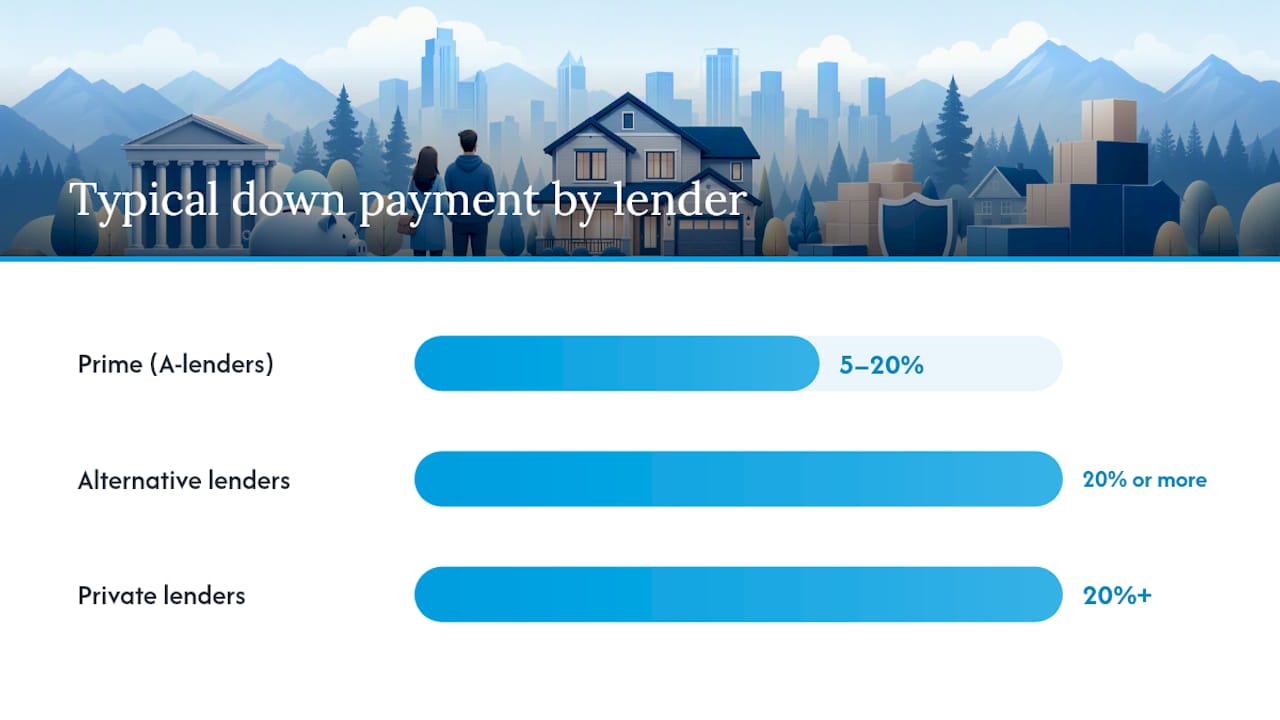
Alternative lenders and credit unions are the realistic middle ground. They assess files manually, weigh income stability and equity more heavily than credit score alone, and will often consider applications during an active proposal when the down payment is at least 20%. The rate premium is real but manageable, and many borrowers use an alternative lender as a bridge while they rebuild toward prime qualification.
Private lenders are equity lenders first. They care less about your credit history and more about the loan-to-value ratio. If you have significant equity and a genuine short-term need, a private mortgage can work — but the combination of higher rates and lender fees means it should be a deliberate, time-limited choice rather than a default.
Pro Tip: CMHC mortgage loan insurance uses GDS/TDS calculations alongside time-since-discharge rules. If your proposal was completed more than two years ago and your income ratios are clean, document quality and employment stability often carry more weight than the proposal itself in the insurer's assessment.
How long after a consumer proposal before you can get a mortgage?
The timeline is not fixed — it shifts based on lender type, down payment size, and how well you have rebuilt credit since completion.
Key timeframes at a glance:
- During an active proposal: Alternative and private lenders only; 20%+ down payment typically required; higher rates apply.
- 0–2 years post-completion: Alternative lenders remain the primary option; prime lenders are largely inaccessible; CMHC insured mortgages generally unavailable.
- 2+ years post-completion: Prime lenders become accessible if credit has been rebuilt; CMHC-insured mortgages may be available if GDS/TDS ratios are met and insurer-specific rules are satisfied.
- 3+ years post-completion (or 6 years from filing): R7 notation drops from the credit bureau; automated underwriting at A-lenders no longer flags the proposal.
| Milestone | Typical lender access | Notes |
|---|---|---|
| Active proposal | Alternative / private | 20%+ down; higher rates |
| Completion (Form 46 issued) | Alternative / private; some B-lenders | Begin rebuilding credit immediately |
| 2 years post-completion | Prime lenders possible; CMHC may apply | Requires rebuilt trade lines and stable income |
| 3 years post-completion | R7 removed; full prime access | Automated underwriting no longer flags proposal |
Two conditional factors can shorten the wait. A down payment of 20% or more removes the need for CMHC insurance entirely, which sidesteps the insurer's time-since-discharge rules and opens alternative lenders sooner. A strong co-borrower with clean credit can also shift a file from a decline to an approval at the alternative-lender tier, even relatively soon after completion.
Mortgage financing after a consumer proposal is achievable at every stage of this timeline — the question is which lender tier is realistic for your current position, and whether the cost of acting now outweighs the benefit of waiting.
Down payment rules and mortgage default insurance after a proposal
Down payment size is the single biggest lever you control. Here is why it matters so much in this context.
In Canada, any mortgage with less than 20% down requires mortgage default insurance, typically provided through CMHC. CMHC and other insurers apply time-since-discharge rules and GDS/TDS ratio tests when underwriting insured mortgages. For borrowers with a recent consumer proposal, most insurers prefer to see at least two years since the completion date before approving an insured application. That means if you want to buy with less than 20% down and your proposal was completed less than two years ago, you will likely face a decline from the insurer even if a lender is otherwise willing.
Putting 20% or more down eliminates the insurance requirement entirely. That single change opens the alternative-lender tier immediately, even during an active proposal. It also reduces the lender's risk exposure, which translates to more flexible underwriting and, in some cases, a lower rate premium than you would pay with a smaller down payment through a private lender.

Documenting the source of your down payment is non-negotiable. Lenders will ask for 90 days of bank statements showing the funds accumulating, or a gift letter if the money comes from a family member. Large, unexplained deposits are a red flag that can stall or kill an application regardless of credit history. Guidance on preparing bank statements for a mortgage application covers exactly what lenders look for and how to present the paper trail cleanly.
How to rebuild your credit and mortgage eligibility after a proposal
Completing the proposal is the starting line, not the finish line. What you do in the months immediately following completion shapes how quickly lenders will consider you.
- Obtain your Form 46 (certificate of full performance). Your Licensed Insolvency Trustee (LIT) issues this once all proposal payments are made. Keep multiple copies — every lender will want one.
- Check both credit bureau reports within 30 days of completion. Pull your Equifax and TransUnion reports and correct any errors through the FCAC guidance process. Errors on credit reports are more common than most people expect, and a preventable mistake on your file can delay a mortgage approval by months.
- Open two new trade lines within 60–90 days of completion. A secured credit card and a small instalment loan (or a credit-builder product) are the standard starting points. Use them regularly and pay the full balance each month.
- Keep credit utilisation below 30%. On a $1,000 secured card, that means carrying no more than $300 at any point in the billing cycle. Low utilisation signals control to lenders.
- Request modest limit increases after 6–12 months of clean history. A higher limit at the same spending level lowers your utilisation ratio further and demonstrates that issuers trust you.
- Save aggressively toward a 20% down payment. Every dollar above the minimum threshold improves your lender options and reduces the rate premium you will pay.
- Keep your GDS and TDS ratios in check. Pay down any remaining non-mortgage debt and avoid taking on new instalment loans before applying. Lenders calculate your gross debt service (GDS) and total debt service (TDS) ratios as part of every underwriting decision.
- Collect Notices of Assessment (NOAs) for the past two years. Lenders want to see consistent, verifiable income. NOAs from the Canada Revenue Agency are the gold standard for income documentation.
Most borrowers who follow this sequence consistently find themselves in a strong position for alternative-lender approval within twelve to eighteen months of completion, and prime-lender consideration within two to three years.
What documents do lenders need when your file includes a consumer proposal?
Lenders reviewing a consumer-proposal file want two things: standard income and asset documentation, and specific paperwork that confirms the proposal's status and your payment history within it.
Standard documents:
- Two most recent pay stubs (or T4s and NOAs for the past two years if salaried)
- Two years of NOAs for self-employed applicants
- 90 days of bank statements for all accounts
- Down payment source documentation (statements showing accumulation, or a signed gift letter)
Consumer-proposal-specific documents:
- Form 46 (certificate of full performance) if the proposal is complete — this is the single most important document and should be the first thing you hand to your broker
- Form 79 (consumer proposal) or Form 67 (amendment to consumer proposal) as applicable, showing the original terms
- Trustee letter from your LIT confirming the filing date, completion date, total amount paid, and a statement that all obligations under the proposal have been met
- Proof of consistent proposal payments (bank statements or payment records covering the full proposal period)
The Office of the Superintendent of Bankruptcy maintains official guidance on LIT roles and the forms they issue. When requesting a trustee letter, ask your LIT to include the filing date, the completion date, the total amount paid to creditors, and a clear statement that the proposal is fully performed. A well-drafted letter from a trusted LIT can answer most lender questions before they are even asked, which shortens the underwriting timeline considerably.
Why working with a mortgage broker matters when you have a consumer proposal
Applying directly to lenders on your own is one of the most common and costly mistakes borrowers with a consumer proposal make. Each application triggers a hard credit inquiry, and multiple hard pulls in a short window further lower your credit score at exactly the moment you need it to recover. A mortgage broker who regularly works with rebuilding profiles can assess your file once and match it to the right lender tier without unnecessary inquiries.
Here is what a specialist broker does that a direct application cannot:
- Lender matching: Identifies which lenders in the alternative and private tiers are currently accepting consumer-proposal files and what their specific requirements are — this changes regularly and is not publicly listed.
- File packaging: Assembles the proposal-specific documentation alongside standard income and asset documents so the lender receives a complete, professional package on the first submission.
- Rate and term negotiation: Negotiates on uninsured and private options where rate and fee structures have more flexibility than posted rates suggest.
- Soft-credit assessment where available: Some lenders allow brokers to assess eligibility with a soft pull before a formal application, preserving your credit score during the shopping phase.
- Advocacy: Explains the context of the consumer proposal to underwriters directly, which matters more than most borrowers realise when a file goes to manual review.
Consider a borrower who completed a consumer proposal fourteen months ago, has two clean trade lines, a stable salaried income, and has saved 22% for a down payment. Applied directly to a major bank, the file would likely be declined automatically. Submitted by a broker to a B-lender with manual underwriting and a track record of accepting post-proposal files, the same borrower has a realistic path to approval. The difference is not the borrower's profile — it is the placement strategy.
Deneenoel works with over fifty Canadian lenders and has direct experience placing files for Albertans navigating consumer proposals. A pre-approval review or file assessment is the right first call before you do anything else.
Common mistakes that will hurt your mortgage application
Knowing what not to do is as important as following the right steps. These are the errors that most reliably derail mortgage applications for borrowers with a consumer proposal.
Application mistakes:
- Applying to multiple lenders directly and triggering several hard inquiries within weeks of each other
- Submitting an application before the Form 46 is issued or before the credit bureau has been updated to reflect completion
- Not disclosing the consumer proposal upfront — lenders will find it, and a surprise on the file reads as concealment
Credit behaviour red flags:
- Taking on new unsecured debt (a car loan, a new credit card with a high limit) immediately before applying — it raises your TDS ratio and signals financial stress
- Missing any secured payment during or after the proposal period
- High credit utilisation on post-completion trade lines (above 50% is a significant negative signal)
- Unexplained large deposits in bank statements — lenders will ask, and an unclear answer stalls the file
Process errors:
- Not consulting your LIT before taking on any new lending during an active proposal — new credit during a proposal can complicate the proposal terms
- Skipping the credit-report check and missing errors that could be corrected before the application
- Applying for a prime mortgage too soon, before the two-year post-completion window, and burning a hard inquiry on a predictable decline
The R7 notation on your credit file is visible to every lender. Trying to work around it by applying broadly and quickly is counterproductive. Patience and a deliberate sequence produce better outcomes.
Your step-by-step plan from today to mortgage approval
The sequence below is designed to minimise hard credit pulls, protect your credit score, and move you toward the right lender tier at the right time.
Today (active proposal or just completed):
- Pull your Equifax and TransUnion credit reports and correct any errors through the FCAC process.
- Confirm your proposal status with your LIT and request Form 46 if the proposal is complete.
- Contact a specialised mortgage broker for a file assessment — not a bank, not a direct lender.
Short term (0–12 months post-completion):
- Open two post-completion trade lines and manage them with consistent, full payments.
- Save toward a 20% down payment; document every dollar in a dedicated account.
- Collect two years of NOAs, T4s, and recent pay stubs.
- If you have strong equity and a pressing need, ask your broker whether a private-lender refinance to pay out the proposal makes financial sense — this is an equity-dependent decision and the costs are higher, but it can accelerate your timeline.
Medium term (12–36 months post-completion):
- At the 12–18 month mark, have your broker reassess your file for alternative-lender options with improved terms.
- At the 24-month mark, request a full prime-lender assessment if your credit is clean and income is stable.
- If CMHC-insured options are relevant to your situation, confirm with your broker that the insurer's time-since-discharge rules are met before submitting.
Decision criteria: Private lending makes sense when the cost of waiting (continued renting, a missed purchase opportunity, or a proposal dragging on) outweighs the rate and fee premium. Waiting for prime access makes sense when the savings on rate and insurance over a five-year term are material and your timeline is flexible. A broker who knows both sides of that calculation is the right person to help you decide. Debt consolidation through a mortgage refinance is also worth exploring once you have sufficient equity and post-completion history.
A broker's perspective on consumer proposals and mortgages
The clients I work with who have been through a consumer proposal often arrive with two misconceptions: that homeownership is years away, or that they need to accept whatever rate a lender offers because they have no leverage. Neither is true.
What I see consistently is that the borrowers who move through this process most successfully are the ones who treat the proposal completion as a starting point rather than a setback. They open trade lines immediately, they document everything, and they come to the broker conversation with their Form 46 in hand and two years of NOAs ready. That preparation is what turns a complex file into a fundable one.
The two-year post-completion window for prime access is a guideline, not a wall. I have placed files for clients at the alternative-lender tier within months of completion when the down payment was strong and the income was stable. I have also seen clients wait the full two years and still struggle because they did not rebuild credit in the interim. The timeline matters less than what you do with it.
If you are in a consumer proposal right now, or you completed one recently, the single most useful thing you can do is have an honest conversation with a broker who knows this space. Not to apply — just to understand where your file stands and what the realistic path looks like from here.
How Deneenoel can help you move forward
Navigating a mortgage with a consumer proposal on your file is genuinely complex, and the cost of a misstep — a hard inquiry on the wrong lender, a missed documentation requirement, a premature application — can set your timeline back by months.
Deneenoel works with over fifty Canadian lenders, including alternative and private lenders who regularly accept post-proposal files, and provides free file assessments to Albertans at any stage of the process. Whether your proposal is active, recently completed, or a few years behind you, the first step is a straightforward conversation about where your file stands and which lender tier is realistic right now. There is no cost to the assessment, and no application is submitted until you are ready and the right lender has been identified.
If you are in Edmonton or the surrounding area, book a file review with Deneenoel and get a clear picture of your options before you take any other step. Calgary-area clients can connect through the Calgary mortgage broker page. Wherever you are in Alberta, the goal is the same: a mortgage that fits your situation, placed with the right lender, at the right time.
This article is general information, not a substitute for advice from a qualified financial advisor. Consult a qualified financial professional about your own circumstances before acting on anything here.
Sources
These official and authoritative sources cover the rules, forms, and guidance referenced throughout this article.
- CMHC — Mortgage loan insurance: calculating GDS/TDS
- Office of the Superintendent of Bankruptcy (Government of Canada)
- Laws-lois
- Can you get a mortgage after a consumer proposal? | Hoyes Michalos
- Buying a house while in an active consumer proposal in Canada | LawyerInfo
- Complete consumer proposal guide for Canadians (Litvack Group)
- Check for errors on your credit report | Financial Consumer Agency of Canada
- Mortgage financing after a consumer proposal in Canada | Nicole Crichton (Dominion Lending Centres)