
A mortgage broker is a licensed intermediary who finds, compares, and places mortgage financing on your behalf across a network of lenders — banks, credit unions, B-lenders, and private lenders — so you get the most suitable product for your situation without spending weeks shopping on your own.
At a glance:
- Brokers assess your finances, manage your pre-approval, submit your application, and coordinate closing
- Most residential brokers are paid by the lender, not by you, through a finder fee typically calculated as 0.50%–1.10% of the mortgage amount
- Provincial regulators such as FSRA license and oversee brokers, giving you formal consumer protections
- Deneenoel (Denée Noel Mortgages) offers these services across Alberta with access to more than fifty Canadian lenders
Table of Contents
- What does a mortgage broker do, step by step?
- How mortgage brokers are paid — and what it costs you
- When is a mortgage broker worth using?
- How are mortgage brokers regulated in Canada?
- What to expect: the broker process and timeline
- Questions to ask a broker — and red flags to watch for
- How Deneenoel serves Alberta homebuyers
- Key takeaways
- Why transparency matters more than rate shopping
- Useful sources and where to verify a broker's licence
- Deneenoel: personalized mortgage guidance across Alberta
What does a mortgage broker do, step by step?
A broker's core services run from your first conversation through to the day your mortgage funds. Here is what that looks like in practice:
- Financial assessment. Your broker reviews income, liabilities, assets, and credit to calculate how much you can realistically borrow and which lender categories you qualify for.
- Pre-approval management. They submit a written pre-approval request, lock in a rate hold (typically 90–120 days), and give you a clear purchase budget before you make an offer.
- Lender research and comparison. Brokers compare products across banks, credit unions, and B-lender options to find the rate and terms that fit your file — not just the lenders you could walk into yourself.
- Application preparation and submission. They compile your documents, complete the application, and submit it to the chosen lender, handling the back-and-forth so you don't have to.
- Condition management. This is where brokers earn their keep. They gather updated documents, respond to underwriter requests, and keep the file moving so an approval doesn't stall at the last moment.
- Closing coordination. Your broker liaises with your real estate lawyer, the appraiser, and the lender to confirm funding is in place on possession day.
How mortgage brokers are paid — and what it costs you
For most standard residential mortgages, using a broker costs you nothing directly. Lenders pay the broker a finder fee of 0.50%–1.10% of your mortgage amount once your mortgage funds, which means the service is free to you in the majority of cases.
| Fee type | Who pays | Typical range |
|---|---|---|
| Finder fee | Lender, at funding | 0.50%–1.10% of mortgage amount |
| Trailer fee | Lender, annually | 0.10%–0.15% annually (where applicable) |
| Borrower fee | You, disclosed upfront | Varies; applies mainly to private/alternative files |
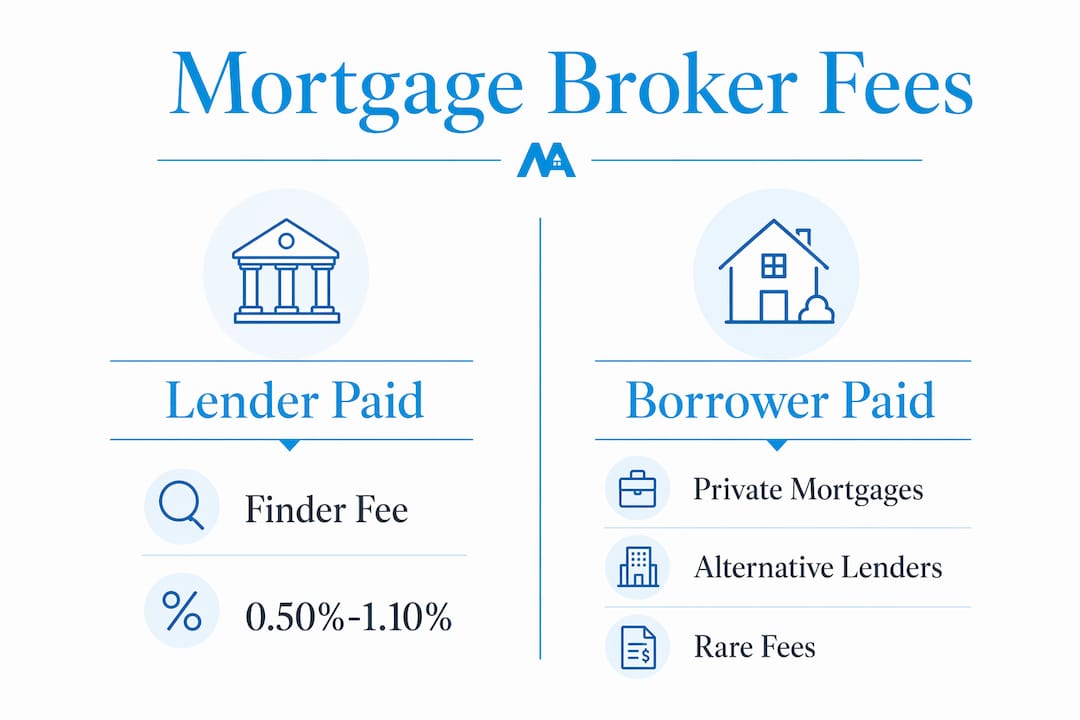
Borrower fees do come up — usually for private mortgages, alternative-lender placements, or files with very limited lender options. Any such fee must be disclosed to you in writing before you commit.
Pro Tip: Ask your broker directly: "Will I pay any fees, and if so, how much and when?" A reputable broker answers this without hesitation and puts it in writing.
One nuance worth knowing: brokers can sometimes buy down your rate by contributing part of their commission. Even a small reduction can save you hundreds of dollars over a five-year term, so it's worth asking if your mortgage amount is substantial.
When is a mortgage broker worth using?
A broker adds the most value when your situation has any complexity, or when you simply don't have time to shop multiple lenders yourself.
Situations where a broker is especially useful:
- First-time buyers who need guidance on the full process, from credit score requirements to closing costs
- Self-employed applicants whose income documentation doesn't fit a standard T4 model
- New-to-Canada borrowers navigating work permit mortgage rules and limited credit history
- Borrowers with bruised credit who need access to B-lenders or private lenders that banks won't consider
- Investment property buyers comparing rental-income qualification rules across lenders
- Renewal and refinancing clients who want to compare renewal options rather than accept their current lender's offer automatically
Brokers are particularly valuable for complex files because they understand the underwriting criteria of non-traditional lenders that a bank branch simply won't offer. That said, if you have a straightforward salaried income, strong credit, and an existing relationship with your bank, it still makes sense to get a broker quote alongside your bank's offer — you may be surprised by the difference.
How are mortgage brokers regulated in Canada?
Mortgage brokers are licensed professionals, not unregulated advisors. In Ontario, FSRA licenses and oversees all mortgage brokers and agents under the Mortgage Brokerages, Lenders and Administrators Act, 2006. Alberta has its own provincial regulator with equivalent licensing and conduct requirements.
Trust signals to look for when choosing a broker:
- A valid provincial licence number (verifiable on your regulator's public registry)
- Written disclosure of all fees and commissions before you sign anything
- Errors and omissions insurance coverage
- Clear explanation of which lenders they work with and why they're recommending a specific one
- No pressure to decide quickly or accept a single lender's product
Licensing means your broker has met mandatory education standards and is subject to conduct rules. If something goes wrong, you have a formal complaints process through the regulator — a protection you don't have with an unlicensed referral.
What to expect: the broker process and timeline
Most mortgage files move from first contact to funding in four to eight weeks, though timelines vary with property type and lender workload.
- Initial consult (Day 1–3). You share your financial picture; your broker pulls credit and calculates affordability. Documents needed: government ID, recent pay stubs or income proof, bank statements, and Notice of Assessment.
- Pre-approval (Week 1–2). Your broker submits to one or more lenders, secures a written pre-approval, and locks a rate hold so rising rates don't affect your budget during your property search.
- Offer accepted — application submitted (within 24–48 hours of accepted offer). Your broker sends the full application and property details to the chosen lender.
- Underwriting and conditions (Week 2–4). The lender reviews the file and issues conditions — additional documents, an appraisal, or confirmation of employment. Your broker manages all of this, gathering and submitting what's needed so the file doesn't stall.
- Final approval and closing (Week 4–8). Once conditions are cleared, your broker coordinates with your lawyer and the lender to confirm funding. You sign mortgage documents with your lawyer, and the funds flow on possession day.
Common delays: incomplete income documentation, appraisal values that come in below purchase price, or title issues. A good broker flags these risks early and has a plan B ready.
Questions to ask a broker — and red flags to watch for

Before you commit to working with any broker, a short interview tells you a lot.
Questions worth asking:
- Are you licensed, and what is your licence number?
- How many lenders do you have access to?
- How are you compensated, and will I pay any fees?
- Can you provide a written pre-approval with a rate hold?
- Have you handled files similar to mine (self-employed, new-to-Canada, investment property)?
Red flags that should give you pause:
- Refusal or reluctance to disclose commission structure
- Pressure to accept one lender's product without explanation
- Vague answers about lender access ("I work with lots of lenders")
- No written pre-approval practice — verbal only
- Asking for fees upfront before any work is done
Pro Tip: Verify any broker's licence on your provincial regulator's public registry before your first meeting. In Alberta, the Real Estate Council of Alberta (RECA) maintains the searchable licence database.
How Deneenoel serves Alberta homebuyers
Deneenoel (Denée Noel Mortgages) is an Alberta-based mortgage broker operating under the Mortgage Architects network, with access to more than fifty Canadian lenders. That breadth matters: it means your file gets compared across banks, credit unions, B-lenders, and private lenders — not just the two or three products a single institution offers.
What Deneenoel offers Alberta clients:
- Written pre-approvals with rate holds
- Transparent, upfront disclosure of all fees and commissions
- Specialized experience with self-employed, new-to-Canada, and complex credit files
- Refinancing, mortgage renewal, and investment property financing
- Personalized guidance from first consult through to funding
For Edmonton-area clients, Deneenoel's Edmonton mortgage broker page outlines local services and next steps. Calgary clients can find equivalent detail at the Calgary mortgage broker page.
Key takeaways
A mortgage broker is a licensed professional who compares lenders and manages your mortgage file from assessment to funding — and for most borrowers, the service costs nothing out of pocket.
| Point | Details |
|---|---|
| Brokers are licensed intermediaries | They compare products across banks, credit unions, B-lenders, and private lenders on your behalf. |
| Most borrowers pay no broker fee | Lenders pay a finder fee of 0.50%–1.10% at funding; trailer fees of 0.10%–0.15% may also apply; borrower fees apply mainly to private/alternative files. |
| Brokers are most valuable for complex files | Self-employed, new-to-Canada, and credit-challenged borrowers benefit most from broker access to non-traditional lenders. |
| Regulation protects you | Provincial regulators license brokers and require written fee disclosure, giving you a formal complaints process. |
| Deneenoel serves Alberta | With 50+ lenders and written pre-approvals, Deneenoel offers personalized mortgage guidance across Alberta. |
Why transparency matters more than rate shopping
Most homebuyers focus on rate — and rate matters. But the conversations I have with clients every day reveal a bigger gap: people don't know what they're signing, why one lender was chosen over another, or what happens if their conditions aren't met on time.
My view is that a broker's real job is to make sure you understand every step, not just to hand you a number. Rate holds, written pre-approvals, and clear fee disclosure aren't extras — they're the baseline. If a broker can't explain their compensation structure in two minutes, that's a problem worth taking seriously before you hand over your financial documents.
For Alberta buyers ready to get a written pre-approval or talk through their options, a no-fee consultation is the right first step.
Useful sources and where to verify a broker's licence
Checking a broker's credentials takes about two minutes and is always worth doing.
- FSRA — Working with a mortgage professional: Ontario's regulator explains licensing requirements and consumer protections in plain language.
- FSRA — Mortgage Brokering: Overview of the regulatory framework and how to file a complaint.
- Ratehub.ca — Pros and cons of using a mortgage broker: Practical breakdown of broker value, including renewal and refinancing scenarios.
- NerdWallet Canada — What is a mortgage broker?: Clear explainer on broker responsibilities and complex-file scenarios.
- WealthNorth — How do mortgage brokers get paid?: Detailed breakdown of finder fees, trailer fees, and volume bonuses.
- Deneenoel.com: Alberta-specific service pages, local broker contact, and next-step guidance for Edmonton and Calgary clients.
To verify an Alberta broker's licence, search the Real Estate Council of Alberta (RECA) public registry at reca.ca. Enter the broker's name or licence number to confirm their standing before your first meeting.
This article is general information, not professional financial or legal advice. Confirm current rules and your specific options with a licensed mortgage professional or the relevant provincial regulator.
Deneenoel: personalized mortgage guidance across Alberta
Finding the right mortgage in Alberta means more than comparing posted rates online. Deneenoel gives you direct access to a broker who works across more than fifty Canadian lenders, handles your file personally, and provides written pre-approvals with rate holds — so you're protected while you search for the right property.

Whether you're a first-time buyer in Edmonton, a self-employed borrower in Calgary, or someone refinancing an existing property, Deneenoel's approach is the same: transparent fees, clear options, and no pressure to accept a product that doesn't fit. There's no cost to you for standard residential mortgages — the lender pays the commission when your mortgage funds.
Ready to get started? Book a no-fee consultation with Deneenoel and get a written pre-approval that holds your rate while you shop.