
There is no single best mortgage lender for every Canadian. The right lender depends on your credit score, down payment, employment type, and the property you are buying. For most borrowers, especially those with complex files or limited time, working with an independent mortgage broker gives you the widest access to competitive options. Brokers can connect you with over 50 Canadian lenders, from major banks to monoline specialists, in a single conversation. If your down payment is below 20%, mortgage default insurance through CMHC, Sagen, or Canada Guaranty is mandatory, which also affects which lenders will consider your file.
Table of Contents
- How to choose the best mortgage lender in Canada for your situation
- What each lender type means for your rate and approval odds
- How mortgage rates and borrower costs actually work in Canada
- Why an independent mortgage broker often finds the best deal
- What to expect from pre-approval to closing
- Red flags when choosing a lender or broker
- Practical next steps for Albertans to secure a competitive mortgage
- Key takeaways
- A broker-first approach is the right call for most Albertans
- How Deneenoel helps Alberta borrowers get started
- Useful sources and further reading
How to choose the best mortgage lender in Canada for your situation
Start with your borrower profile before you compare a single rate. Four factors shape which lender channel will actually approve you at a competitive price:
- Credit score: Borrowers with scores of 680 or above typically qualify for prime A-lender rates. Below that threshold, alternative lenders become the realistic path, at higher cost.
- Down payment: Less than 20% triggers mandatory default insurance and limits you to insured mortgage products. Twenty percent or more opens the full market.
- Employment type: Salaried employees sail through A-lender underwriting. Self-employed borrowers and newcomers to Canada often need a broker to find lenders with flexible income verification.
- Property use: Primary residences, rental properties, and investment properties each face different underwriting rules and rate premiums.
Once you know your profile, compare lenders on these criteria: underwriting flexibility, rate and penalty structure, portability, pre-approval hold period, and whether the lender works through brokers or only directly. A lender offering a low rate with a harsh prepayment penalty can cost you far more than a slightly higher rate with generous prepayment privileges.
Pro Tip: Get a broker quote before you walk into any bank branch. Brokers negotiate on volume, which means the rate they bring you often reflects discounts an individual borrower cannot access alone. Locking in a broker quote early preserves your options without committing you to anything.
What each lender type means for your rate and approval odds
Canadian lenders fall into five tiers. Understanding each one helps you match your profile to the right channel.
| Lender type | Typical use case | Rate range (5-yr fixed) | Key trade-off |
|---|---|---|---|
| A-lenders (banks, monolines) | Strong credit, salaried income, 5%+ down | 3.5%–5.5% | Lowest rates, strictest criteria |
| Credit unions | Local borrowers, moderate credit, flexible income | Competitive, near A-lender | Member-based, limited geography |
| B-lenders (alternative) | Self-employed, bruised credit, non-traditional income | 5%–8% | More flexible underwriting, higher cost |
| Private lenders / MICs | Equity-rich, credit-impaired, short-term bridge | 7%–15%+ | Speed and flexibility, highest rates and fees |
| Monoline lenders | Borrowers seeking low rates through broker channel | Often among market's lowest (3.5%–5.5%) | Broker-only access, no branch network |
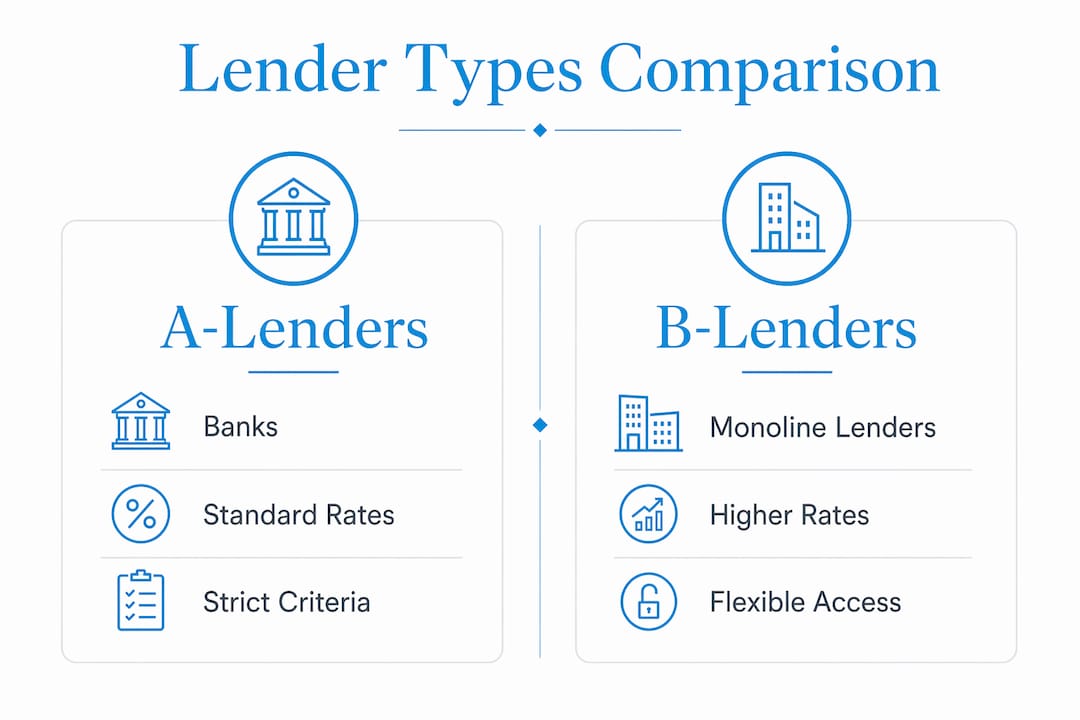
Monoline lenders are worth highlighting. They carry lower overhead than big banks and frequently advertise some of the market's lowest starting rates, but they work almost exclusively through brokers. If you go directly to a bank, you will never see a monoline offer. That alone is a strong argument for the broker channel.
For B-lender mortgage options in Alberta, the criteria are meaningfully less strict than A-lenders, making them the practical route for self-employed borrowers or those rebuilding credit.
How mortgage rates and borrower costs actually work in Canada
The rate on your mortgage statement is rarely the rate your lender started with. Banks post a "posted rate" that serves as a reference point for penalty calculations; the rate you actually pay is negotiated down from there. Brokers negotiate using volume, meaning the discounts they secure reflect the total business they send a lender, not just your file.
Beyond the rate, your all-in cost includes several other items:
| Cost item | Typical range | Who pays |
|---|---|---|
| Mortgage default insurance | — | Borrower (when down payment < 20%) |
| Home appraisal | $500 | Borrower |
| Legal / notary fees | $2,500 | Borrower |
| Lender/broker fee (complex files) | Varies; often around 1% of mortgage value | Borrower (confirm in writing) |
| Prepayment penalty (if breaking early) | 3 months' interest or IRD, whichever is greater | Borrower |
The 20% down payment threshold is the single most important cost trigger in Canadian mortgage financing. Cross it, and you avoid default insurance entirely, which on a $500,000 mortgage can save more than $15,000 added to your balance. Always factor penalties into your comparison, particularly if you anticipate selling or refinancing within your term.
Why an independent mortgage broker often finds the best deal
Banks can only offer their own products. A broker accesses the full market and submits your file once, letting multiple lenders compete for your business. That structure is especially valuable for complex files.
Brokers have specific expertise for self-employed borrowers, newcomers to Canada, and investment-property financing. Their lender relationships increase both approval odds and the likelihood of competitive terms that a borrower negotiating alone at a branch simply cannot replicate.
Brokers are typically paid by the lender upon successful placement, so their advisory service costs you nothing in most cases. For private placements or unusually complex files, a broker may charge a direct client fee, often around 1% of the mortgage value. Always confirm the fee structure in writing before you engage.
The practical scenario: a self-employed borrower with two years of incorporated income gets declined by their bank because the branch underwriter applies salaried-income rules. A broker identifies two B-lenders and one monoline with stated-income programs, presents the file with the right documentation, and secures approval at a rate the borrower could not have found independently.
What to expect from pre-approval to closing
A typical Canadian mortgage timeline runs roughly four to six weeks from pre-approval to funding, though complex files or competitive markets can stretch that.
A mortgage pre-approval is not a guarantee of funding. Final approval depends on a satisfactory property appraisal and up-to-date income verification at the time of the offer. Conditions can change between pre-approval and closing — protect yourself by keeping your finances stable throughout.
Documents you will need to gather:
- Two recent pay stubs and a letter of employment (salaried borrowers)
- Two years of T1 Generals and Notices of Assessment (self-employed)
- 90 days of bank statements showing down payment source
- Government-issued photo ID
- Rental income documentation if applicable (lease agreements, T776)
Your mortgage pre-approval in Canada locks in a rate hold, typically for 90–120 days, which protects you if rates rise while you shop. Use that window to finalize your property search and keep your credit activity quiet.
Red flags when choosing a lender or broker
Most lenders and brokers operate with integrity, but a few warning signs are worth knowing:
- Upfront broker fees without written scope: Legitimate brokers confirm any client fees in writing before you commit.
- Pressure toward private lending without exploring alternatives: Private mortgages are appropriate in specific situations; they should never be a first recommendation for a borrower who qualifies for A or B-lender products.
- Vague lender access claims: Ask for a written list of lender partners. A broker who cannot or will not provide one is a concern.
- Unusually high prepayment penalties: Read the penalty clause before you sign, particularly with smaller lenders.
- Unverifiable licensing: In Alberta, mortgage brokers must be licensed through the Real Estate Council of Alberta (RECA). Verify any broker's registration at reca.ca before you proceed.
Practical next steps for Albertans to secure a competitive mortgage
Getting a competitive mortgage in Alberta comes down to preparation and channel selection. Here is what to do now:
- Pull your credit report and address any errors before applying. A score above 680 opens the most competitive pricing.
- Gather your core documents: income proof, down payment source, and ID.
- Get a written pre-approval with a rate hold from a broker who accesses multiple lenders.
- Compare at least three channels: a broker quote, an online lender, and your existing bank.
- Review the full cost of each offer, including penalties, portability, and fees, not just the rate.
Alberta borrowers benefit from local broker relationships. Lenders active in the Edmonton and Calgary markets often have specific programs for oil-and-gas sector workers, contract employees, and newcomers, and a local broker knows which lenders are most receptive to those profiles right now.
Pro Tip: If you are renewing a mortgage, treat it like a new purchase. Explore your mortgage renewal options with a broker before your lender's renewal offer arrives. Lenders count on borrower inertia at renewal time.

Key takeaways
Working with an independent mortgage broker who accesses 50+ Canadian lenders is the most reliable route to a competitive mortgage for the majority of Canadian borrowers, particularly those with complex income or credit profiles.
| Point | Details |
|---|---|
| No single best lender | The right lender depends on your credit, down payment, income type, and property use. |
| Broker advantage | Brokers access the full lender market and negotiate volume discounts unavailable to individual borrowers. |
| 20% down payment threshold | Dropping below 20% triggers mandatory default insurance, adding 2.8%–4.0% to your mortgage balance. |
| Pre-approval is not a guarantee | Final funding depends on appraisal and current income verification at closing. |
| Deneenoel for Alberta borrowers | Deneenoel accesses 50+ lenders and specialises in complex files, pre-approvals, and renewals across Alberta. |
A broker-first approach is the right call for most Albertans
Most borrowers spend more time comparing phone plans than mortgage lenders, and the cost of that inattention is real. What I see consistently is that Albertans who come to a broker early, before they have committed to a property or a lender, end up with better rates, fewer surprises at closing, and a clearer understanding of what they actually signed.
The conventional wisdom says to start with your bank because it is familiar. The problem is that familiarity limits you to one set of underwriting rules and one product shelf. A broker's job is to find the lender whose criteria fit your file, not to fit your file into one lender's criteria. For self-employed borrowers, newcomers, or anyone with a non-standard income history, that distinction changes outcomes.
My 2026 guides for Alberta clients cover credit scores, pre-approvals, B-lenders, and work-permit mortgages in detail. The goal is always the same: make sure you walk into any lender conversation knowing exactly where you stand and what your options are.
How Deneenoel helps Alberta borrowers get started
Choosing the right mortgage route is straightforward when you have access to the full market. Deneenoel works with 50+ Canadian lenders across every tier, from A-lenders and monolines to B-lenders and private options, so your file goes to the lender most likely to approve it at the best available terms.

Services include written pre-approvals with rate holds, refinancing, renewal support, and complex-file placement for self-employed borrowers and newcomers to Canada. The commission model means lender-paid advice in most cases, with full transparency on any client fees before you commit. Whether you are buying your first home in Edmonton or refinancing an investment property in Calgary, the process starts with a straightforward conversation about your situation.
Edmonton mortgage clients and Calgary mortgage clients can reach out directly to get a written pre-approval and a clear comparison of lender options. No pressure, no surprises.
Useful sources and further reading
- CMHC Home Buying Step by Step: Canada Mortgage and Housing Corporation's official guide covering affordability, pre-approval, and closing steps.
- Choosing a mortgage: Canada.ca: The Financial Consumer Agency of Canada's plain-language overview of mortgage types, terms, and lender obligations.
- Types of mortgage lenders in Canada: WealthNorth: Detailed breakdown of A-lenders, B-lenders, private lenders, and MICs with rate ranges and use cases.
- Mortgage broker vs bank vs online lender: WealthNorth: Side-by-side comparison of the three main mortgage channels in Canada.
- Mortgage broker vs bank: MoneySense: Analysis of broker compensation, fee transparency, and when each channel saves money.
- Mortgage process in Canada: RE/MAX Canada: Step-by-step walkthrough of the Canadian mortgage process including pre-approval limits and closing requirements.
- Credit score for mortgage in Canada: Deneenoel blog: Alberta-focused guide to credit score thresholds and improvement strategies for mortgage qualification.
- Mortgage pre-approval in Canada: Deneenoel blog: Practical guide to pre-approvals, rate holds, and document preparation for Alberta buyers.
This article is general information only, not professional financial or legal advice. Confirm current rates, programs, and eligibility with a licensed mortgage professional or the relevant government authority for your specific situation.