
Getting a mortgage pre-approval in Canada is the single most practical step you can take before you start touring homes. It tells you exactly how much a lender is willing to lend you, locks in an interest rate for a protected period, and signals to sellers that you are a serious buyer. Think of it as a conditional commitment: the lender reviews your finances and says, "Based on what we see today, here is your borrowing limit and your rate." It is not a guarantee of final approval, but it puts you in a far stronger position than arriving at an offer table empty-handed.
Pre-approval and pre-qualification are related but distinct. Pre-qualification is a quick, informal estimate based on self-reported information, with no credit check and no documentation. Pre-approval goes deeper: the lender pulls your credit report, verifies your income and debts, and issues a written commitment with a rate hold of 90–120 days. In Alberta's active housing market, that difference matters.
Here is what a standard pre-approval covers:
- Maximum borrowing amount based on your verified finances
- A rate hold that protects you if rates rise while you shop
- A clear picture of your estimated monthly payments
- Written confirmation you can present alongside an offer
Providers across Alberta offering pre-approval services include True North Mortgage, Canadian Mortgage Professionals, the Mortgages for Less team, Mojgan Pasyar (BMO Mortgage Specialist), The Mortgage Force Team Edmonton (Dominion Lending Centres Mortgage Force), Scotiabank, First Foundation, First National Financial LP, NextDoor Mortgages (DLC Brokers For Life), National Bank, Mortgage Collective, Alberta Mortgage Professionals, Canada Mortgage Source, MCAP, and Alberta Mortgage Source.
How do you get a mortgage pre-approval in Canada?
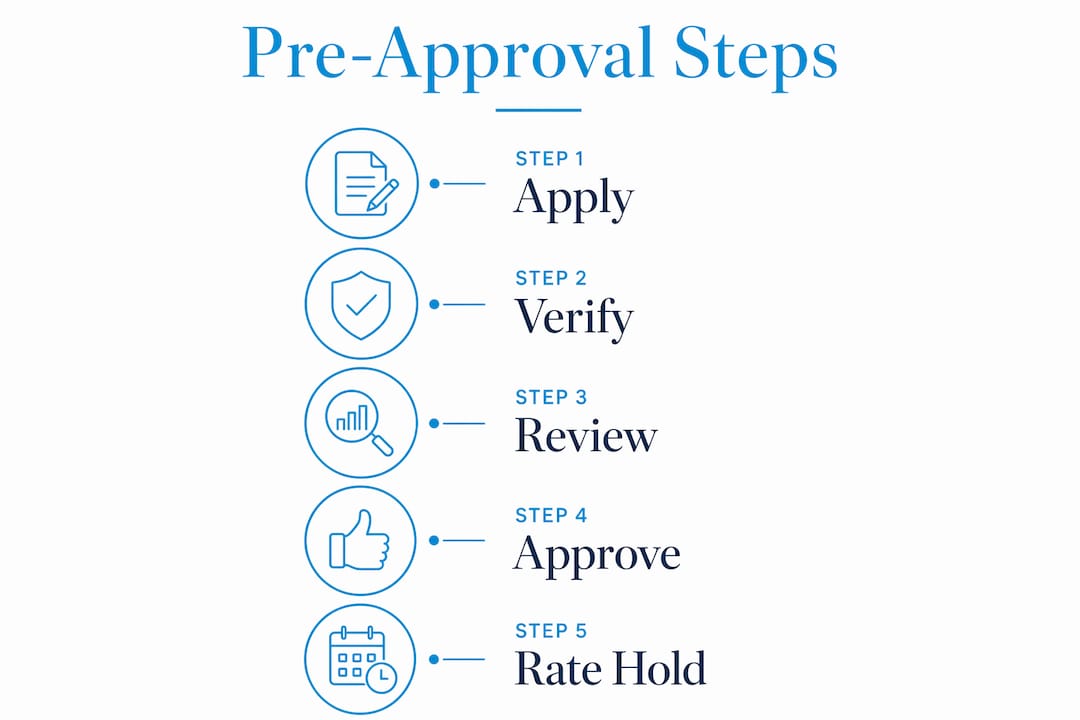
The process is straightforward when you know what to expect. Most lenders and brokers can move quickly once your documents are in order.
Step-by-step walkthrough
- Gather your documents. Collect proof of employment, recent pay stubs, two years of tax assessments from the Canada Revenue Agency (especially if you are self-employed), bank statements, and government-issued identification. Common required documents are consistent across Alberta lenders.
- Choose your application channel. You can apply directly through a bank, use an online tool like Scotiabank's eHOME platform (which can reduce approval time to minutes), or work with a mortgage broker who shops multiple lenders on your behalf.
- Submit your application. Your lender or broker reviews your assets, income, and debt load as outlined by the Financial Consumer Agency of Canada.
- Consent to a credit check. The lender pulls your credit report. This is a hard inquiry, so avoid applying with multiple lenders simultaneously.
- Receive your pre-approval letter. If approved, you get a written confirmation with your maximum amount, rate hold, and expiry date.
Pro Tip: Gather all your documents before you submit anything. A complete application moves faster and reduces the back-and-forth that delays so many files.
The documents you will typically need include:
- Government-issued photo identification
- Recent pay stubs or proof of current salary
- Two years of CRA Notices of Assessment (critical for self-employed buyers)
- Recent bank and investment account statements
- Details on existing debts: credit cards, car loans, lines of credit, student loans, and any support obligations
What financial factors determine your pre-approval eligibility?
Lenders look at several factors together, not just your credit score. Understanding each one helps you walk into the process with realistic expectations.
Credit score thresholds
Conventional mortgage lenders generally require a credit score of 680 or higher. Insured mortgages, where your down payment is less than 20%, may accept scores as low as 600, though most A-lenders still apply their own internal minimum of 680. Scores between 600 and 679 narrow your lender options considerably and often push you toward credit unions or B-lenders with higher rates.
A credit score of 680 is the practical threshold for standard A-lender access in Canada. Scores below that do not close the door, but they do change the terms significantly.
Income and employment stability
Lenders want to see consistent, verifiable income. Salaried employees have the easiest path. Self-employed buyers, contractors, and new Canadians face more scrutiny and typically need two full years of income history. Lenders also apply the federal stress test, which requires you to qualify at the higher of your contract rate plus 2%, or 5.25%, whichever is greater.

Debt-to-income ratio
High debt loads can lead to refusal even when your credit score is solid. Lenders calculate your Gross Debt Service (GDS) and Total Debt Service (TDS) ratios to cap how much of your income goes toward housing and total debt payments. Carrying a large car loan or high credit card balances directly reduces the mortgage amount you qualify for.
Down payment
A down payment of 20% or more eliminates the need for mortgage default insurance and opens access to uninsured mortgage products. Below 20%, your mortgage must be insured through CMHC, Sagen, or Canada Guaranty, which adds a premium to your loan. The size of your down payment also directly affects your maximum purchase price in Alberta's market.
Statistic callout: CMHC sets the credit score floor for insured mortgages at 600, but most A-lenders apply their own minimum of 680, meaning the practical threshold for most buyers is higher than the regulatory floor.
Why getting pre-approved gives you a real advantage
Pre-approval shifts the dynamic in your favour from the moment you start making offers. Sellers take pre-approved buyers more seriously because the financing risk is largely removed. In a competitive Alberta market, that can be the difference between an accepted offer and a missed opportunity.
The practical benefits go beyond negotiating power:
- Budget clarity. You know your ceiling before you fall in love with a home you cannot afford.
- Rate protection. Your rate hold guards you against increases for 90–120 days while you search.
- Faster closing. Much of the lender's verification work is already done, so the final approval moves quicker.
- Early problem detection. If something in your file needs attention, you find out before you are under contract, not after.
First-time buyers especially benefit from the process. Working through a first-time buyer mortgage with a broker before you shop means you understand your options, not just your limit.
Alberta-specific questions about mortgage pre-approval
How long is a mortgage pre-approval valid in Alberta?
Pre-approvals in Alberta typically carry a rate hold of 90–120 days. If your home search runs longer, you will need to reapply. The good news is that reapplying with the same broker is usually quick if your financial situation has not changed.
What credit score do you need for a mortgage in Alberta?
The standard threshold is a credit score of 680 for conventional and most insured mortgages. Scores between 600 and 679 may still qualify through credit unions or B-lenders, though these typically come with higher rates and limited product options.
How much income do you need to qualify for a $500,000 mortgage?
The exact figure depends on your down payment, current rates, and existing debts. As a general guide, lenders apply the stress test rate to your qualifying income, so your required gross household income varies accordingly, depending on your debt load. A broker can run the precise numbers for your situation.
What is the difference between pre-approval and final approval?
Pre-approval is conditional on the property you eventually purchase meeting the lender's standards. Final approval happens after the lender appraises the specific home and confirms all conditions are met. A pre-approval does not guarantee final approval.
| Factor | Pre-approval | Final approval |
|---|---|---|
| Based on | Your finances | Your finances + the property |
| Rate hold | Yes, 90–120 days | Rate confirmed at closing |
| Guarantee | No | Yes, subject to conditions |
| Timing | Before home search | After accepted offer |
Local brokers such as Canadian Mortgage Professionals and the Mortgages for Less team offer tailored guidance through both stages, particularly for buyers navigating complex files or tight timelines.
Expert advice from an Alberta mortgage broker
Working with a broker who has access to over fifty Canadian lenders, as Deneenoel does, means your file goes to the lender most likely to approve it on the best available terms, not just the first one willing to say yes. That access is particularly valuable for self-employed buyers, new Canadians, and anyone with a non-traditional income history.
Pro Tip: Do not make any major financial changes between your pre-approval and your final closing. New debt, a job change, or a large purchase can alter your qualifying ratios and put your approval at risk.
A few practical steps that consistently improve pre-approval outcomes:
- Pay down revolving credit balances before applying to lower your utilisation ratio
- Avoid applying for new credit in the months leading up to your mortgage application
- Keep your employment situation stable; lenders want to see continuity
- Work with a broker early, even if you are six months away from buying, so you have time to address any issues
Proactive document gathering and applying through a trusted broker minimises delays and strengthens your file before it ever reaches a lender's desk.
Key takeaways
Mortgage pre-approval in Canada requires verified income, a suitable credit score for most A-lenders, a manageable debt load, and a documented down payment before a lender will issue a written commitment.
| Point | Details |
|---|---|
| Rate hold duration | Pre-approvals in Alberta typically include a rate hold of 90 to 120 days. |
| Credit score threshold | Conventional mortgage lenders require a credit score of 680 or higher; insured mortgages set the regulatory floor at 600. |
| Pre-approval vs. pre-qualification | Pre-qualification is informal; pre-approval involves a credit check and verified documents. |
| Key eligibility factors | Lenders assess credit score, income stability, debt ratios, and down payment together. |
| Broker advantage | A broker with access to multiple lenders finds the best fit for your specific financial profile. |
Ready to get pre-approved and start your Alberta home search with confidence? Deneenoel works with over fifty Canadian lenders to find the right mortgage for your situation, whether you are buying your first home in Edmonton or looking for tailored advice in Calgary. Reach out today for a personalized pre-approval consultation at no cost to you.