
When your mortgage term ends, you have three core choices: renew with your current lender, switch to a new one, or pay off the balance entirely. That decision shapes your interest costs, monthly payments, and financial flexibility for the next several years. Most Albertans renew without negotiating, and that habit quietly costs them thousands.
Here are the essential facts every homeowner should know before renewal:
- Lenders must send a renewal statement at least 21 days before term end for federally regulated institutions.
- The initial renewal offer is almost always above market rate. It is a starting position, not a final one.
- You can lock in a renewal rate well before maturity without penalty.
- Paying off your mortgage in full at term maturity triggers no prepayment penalty.
- Switching lenders at renewal is penalty-free, though legal, discharge, and appraisal fees may apply.
- If you do nothing, your mortgage may automatically renew at a posted rate that is noticeably above negotiated market rates.
- Renewal is also the right moment to reassess your amortization, payment frequency, and whether refinancing better serves your goals.
Deneenoel works with Alberta homeowners through every stage of this process, with access to over fifty Canadian lenders and no cost to you as a client.
Table of Contents
- When should you start the mortgage renewal process?
- What are your mortgage renewal options?
- How to negotiate your mortgage renewal effectively
- What renewal rates can you expect in Canada?
- Can you pay off or refinance your mortgage at renewal without penalty?
- Mortgage renewal vs. refinancing: what is the difference in cost and benefit?
- Choosing the right renewal term for your long-term financial goals
- Deneenoel makes your mortgage renewal work harder for you
- Key takeaways
When should you start the mortgage renewal process?
Starting four to six months before your term expires is the standard recommendation from the Financial Consumer Agency of Canada, and for good reason. That window gives you time to gather competing offers, assess your financial position, and negotiate from a position of strength rather than urgency.
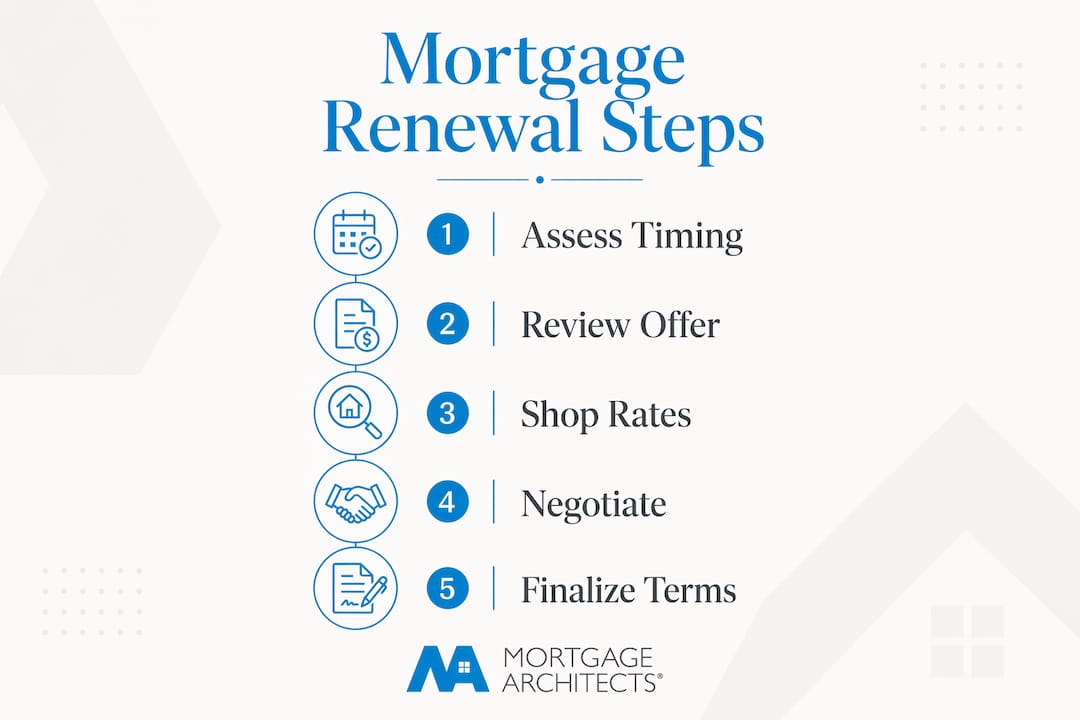
The practical starting point is the 120-day mark. Locking in a rate 120 days before maturity is allowed without penalty, which means you can secure today's rate while still shopping around. If rates drop before your term ends, you can often renegotiate downward. If they rise, you are protected.
Steps to take four to six months out:
- Pull your credit report and address any errors before lenders review your file.
- Gather recent pay stubs, T4s or Notice of Assessment, and a current mortgage statement.
- Review your current mortgage terms: remaining balance, amortization left, and any prepayment privileges.
- Contact a mortgage broker and at least two or three direct lenders to compare offers.
- Monitor the Bank of Canada's rate announcements, which directly influence variable and fixed mortgage pricing.
Pro Tip: Do not wait for your lender's renewal letter to arrive before you start shopping. That letter typically arrives 21 days before term end, which leaves almost no time to negotiate or switch. By the time it lands in your mailbox, you should already have competing offers in hand.
The renewal trap is real: homeowners who accept the first offer out of convenience consistently pay more. Starting early creates genuine competition for your business, and lenders respond to that.
What are your mortgage renewal options?
At term maturity, you have more flexibility than most homeowners realise. The three main paths are renewing with your current lender, switching to a new lender, and refinancing. Each carries different processes, costs, and trade-offs.

Renewing with your current lender
This is the path of least resistance, and it does not have to mean accepting whatever rate you are offered. Your lender wants to keep your business. Renewing in place requires no new application, no legal fees, and no appraisal. The downside is that your lender knows you may not want the hassle of switching, and initial offers reflect that assumption.
Switching lenders at renewal
You are free to move your mortgage to a new lender at term end without paying a prepayment penalty. The new lender processes your file as a fresh application, which means you will need to qualify again, including passing the mortgage stress test. Costs to budget for include:
- Legal fees to register the new mortgage (sometimes covered by the new lender as an incentive).
- Discharge fee from your current lender to release the mortgage.
- Appraisal fee if the new lender requires a property valuation.
Ask any lender you are considering whether they will cover these costs. Many do, particularly for borrowers with strong credit profiles.
Refinancing at renewal
Refinancing at renewal goes beyond a simple rate change. It allows you to adjust your loan amount, extend or shorten your amortization, consolidate higher-interest debt, or access home equity. This involves a new mortgage application and typically more paperwork than a straight renewal, but the financial benefits can be significant. If you are carrying high-interest debt or planning a major renovation, renewal time is the right moment to consider this option. You can explore how this connects to broader financial planning through debt consolidation with mortgage strategies.
Blend-and-extend
Some lenders offer a blend-and-extend option before your term ends. They blend your existing rate with the current market rate and extend your term. This avoids a prepayment penalty and can lower your rate mid-term, but the blended rate is usually not as competitive as what you could negotiate at full maturity. It is worth calculating the numbers carefully before agreeing.
Pro Tip: If your mortgage is registered as a collateral charge rather than a standard charge, switching lenders is more complex and costly. Check your mortgage documents or ask your broker, because this distinction affects your options at renewal.
How to negotiate your mortgage renewal effectively
The initial renewal offer your lender sends is not the final word. It is a starting position, and lenders expect negotiation. The key is knowing who to talk to and what to bring to the conversation.

The retention team is your real contact. Most major lenders have dedicated mortgage retention departments with discretionary authority to lower rates modestly below the initial offer. Branch staff typically do not have that flexibility. When you call, ask specifically to speak with the retention or mortgage renewal team.
Steps for an effective negotiation:
- Gather two or three competing written offers from other lenders or through a broker before you call.
- Contact your lender's retention team 90 to 60 days before maturity, when they have the most incentive to act.
- Present the competing offers directly and ask your lender to match or beat the best rate.
- Negotiate beyond rate: ask about prepayment privileges, payment frequency options, and whether fees can be waived.
- Get any improved offer in writing before committing.
Pro Tip: Retention teams respond to competition. A written offer from another lender carries far more weight than simply saying you are thinking of switching. Print it out or have it ready to reference when you call.
Comparing lenders is considered important by nearly 80% of Canadian mortgage holders, yet a significant share still do not shop around. That gap is where money is left on the table. Working with a broker like Deneenoel means someone is doing that comparison work on your behalf, across more than fifty lenders at once.
What renewal rates can you expect in Canada?
Renewal rates vary based on your credit profile, the lender, current market conditions, and the term you choose. What lenders advertise as their posted rate is almost never what a well-prepared borrower actually pays.
Posted rates versus negotiated rates: Posted rates are the lender's public starting point. Negotiated or discounted rates, which are what most borrowers with solid credit receive, sit meaningfully below posted rates. The gap between the two can be substantial, particularly for five-year fixed terms.
Factors that affect your renewal offer:
- Credit score: A higher score signals lower risk and typically results in better rate offers. Lenders review your credit at renewal, particularly if you are switching.
- Loan-to-value ratio: More equity in your home generally means better pricing.
- Income stability: Salaried borrowers often receive more competitive offers than self-employed applicants, though a broker can help present a self-employed file effectively.
- Term selection: Shorter terms (one to two years) and longer terms (five years) carry different rate profiles depending on the yield curve at the time of renewal.
| Renewal scenario | Typical rate outcome |
|---|---|
| Accepted first offer without negotiation | Posted rate or close to it |
| Shopped with broker across multiple lenders | Competitive discounted market rate |
| Auto-renewed without action | Posted rate, often noticeably above market rates |
2026 rate context: Canadians renewing five-year fixed mortgages in 2026 are generally facing higher rates than those who locked in before 2021. The Bank of Canada's rate decisions continue to influence variable-rate pricing directly. For a current rate comparison, tools like the refinance calculator can help you model different scenarios before committing to a term.
Your credit score and financial profile directly affect the offers lenders extend at renewal. Reviewing your credit report before the process starts is one of the simplest ways to protect your position.
Can you pay off or refinance your mortgage at renewal without penalty?
Yes, and this is one of the most underused options at renewal time.
Paying off at renewal: When your mortgage term reaches its maturity date, the contract ends. Paying off your mortgage in full at that moment triggers no prepayment penalty because there is no contract left to break. This applies whether you are using savings, proceeds from a property sale, or funds from another source. The process involves discharging the mortgage with your lender and clearing the title through a lawyer or notary.
Mid-term prepayment is different. If you want to pay off your mortgage before the term ends, penalties apply. For fixed-rate mortgages, the penalty is typically the greater of three months' interest or the interest rate differential. That calculation can run into thousands of dollars, so the timing of any payoff matters considerably.
Common questions at renewal:
Can I pay off part of my mortgage at renewal without penalty? Yes. Most mortgages include annual prepayment privileges that allow lump-sum payments of 10% to 20% of the original principal without penalty. Using these before or at renewal reduces your balance and your future interest costs.
What does discharging a mortgage involve? Your lender releases its claim on your property, and a lawyer or notary registers the discharge with the land titles office. There is typically a discharge fee from the lender and legal costs to budget for.
Can I refinance instead of renewing? Refinancing at renewal is a clean option because you avoid the mid-term penalty. You can access equity, restructure your debt, or change your amortization. The trade-off is a more involved application process and additional fees. For Albertans considering this path, reviewing mortgage approval criteria beforehand helps you understand what lenders will assess.
Mortgage renewal vs. refinancing: what is the difference in cost and benefit?
These two options are often confused, but they serve different purposes and carry different costs.
Renewal is a straightforward continuation of your mortgage under new terms. You are renegotiating your rate and term on the existing loan balance. The process is relatively simple, fees are minimal if you stay with your current lender, and no new stress test is required when renewing with the same lender. Switching lenders at renewal does trigger a new qualification process.
Refinancing replaces your existing mortgage with a new one, often for a different amount or with a restructured amortization. The benefits can be significant: accessing home equity for renovations or investments, consolidating higher-interest debt, or extending the amortization to reduce monthly payments. The costs are also higher. You will typically pay legal fees, a possible appraisal, and potentially a discharge fee. If you refinance mid-term, add a prepayment penalty on top of that.
| Factor | Renewal | Refinancing at renewal |
|---|---|---|
| New application required | Only if switching lenders | Yes |
| Stress test required | Only if switching lenders | Yes |
| Access to additional funds | No | Yes |
| Legal and appraisal fees | Possible if switching | Yes |
| Amortization change | No | Yes |
| Prepayment penalty | None at term end | None at term end |
The right choice depends on your goals. If your priority is simply securing a better rate on your existing balance, renewal with negotiation is usually the more cost-effective path. If you want to restructure your finances, access equity, or consolidate debt, refinancing at renewal is worth the added complexity. Reviewing current mortgage rates from multiple lenders helps you benchmark what is realistic before you decide.
Choosing the right renewal term for your long-term financial goals
The term you select at renewal is not just about today's rate. It is a bet on where rates are headed and a commitment that shapes your financial flexibility for the next one to five years.
Short terms (one to two years) make sense when you expect rates to fall, when your financial situation may change significantly, or when you anticipate selling the property. The trade-off is uncertainty: you will be back at the renewal table sooner, and rates could move in either direction.
Five-year fixed terms have historically been the most popular choice in Canada, accounting for roughly 40% of all mortgages according to the Bank of Canada. They offer payment stability and protection against rate increases, which suits homeowners who prioritise predictability in their budget.
Variable-rate terms move with the Bank of Canada's overnight rate. They have historically offered lower rates over time, but they carry real risk in rising-rate environments. If your cash flow can absorb payment fluctuations, a variable rate at renewal can save money. If it cannot, the certainty of a fixed rate is worth the premium.
Questions to ask yourself before choosing a term:
- Do you plan to sell or move within the next few years?
- Is your income stable enough to handle potential payment increases on a variable rate?
- Are you carrying other high-interest debt that would benefit from being consolidated now?
- Does your current amortization align with when you want to be mortgage-free?
Renewal is also the right moment to consider strategies like the Smith Manoeuvre, which converts mortgage interest into a tax-deductible investment loan for eligible borrowers. That kind of planning works best when it is built into the renewal structure from the start, not added as an afterthought.
Deneenoel makes your mortgage renewal work harder for you
Approaching renewal without a broker means negotiating with one lender at a time, on their terms, with their rate sheet in front of you. Deneenoel gives Alberta homeowners a different position: access to over fifty Canadian lenders, independent advice, and a broker who does the comparison work on your behalf at no cost to you.

Whether you are renewing a straightforward five-year fixed, considering a switch to a new lender, or weighing whether refinancing makes more sense for your situation, Deneenoel provides clear, personalised guidance through every step. There are no fees to you as a client. Lenders pay the commission upon successful placement, which means the advice you receive is genuinely independent. For Edmonton homeowners, the Edmonton mortgage broker service is built around exactly this kind of renewal support. Calgary homeowners can access the same level of guidance through Denée's Calgary service. Reach out to Deneenoel before your renewal window closes to get a clear picture of what your best options actually are.
Key takeaways
Starting your mortgage renewal process four to six months before term end, negotiating with your lender's retention team, and comparing offers across multiple lenders are the three steps most likely to save you money.
| Point | Details |
|---|---|
| Start early | Begin shopping 4 months before term end; lock in a rate up to 120 days before maturity without penalty. |
| Negotiate the rate | Retention teams can reduce initial offers modestly; always present competing written offers. |
| Auto-renewal costs you | Doing nothing at renewal risks an automatic posted rate noticeably above negotiated market rates. |
| Renewal vs. refinancing | Renewal adjusts rate and term; refinancing changes loan amount or amortization and involves more fees. |
| Deneenoel for Alberta homeowners | Deneenoel compares over fifty lenders on your behalf at no cost, covering renewal, switching, and refinancing options. |