
In Canada, the minimum credit score for a conventional mortgage at a major bank is typically 680, while CMHC-insured mortgages allow scores as low as 600 through Canada's three authorized mortgage default insurers: CMHC, Sagen, and Canada Guaranty. Your credit score is the gatekeeper that determines which lenders will talk to you, but income, down payment, and debt ratios ultimately decide how much you can borrow.
Here is a quick summary of where you stand by lender type:
- A-lenders (major banks, monoline lenders): 680 minimum for uninsured mortgages; 600 for CMHC-insured
- B-lenders (alternative lenders): accept scores from 550 to 679, at rates 0.50%–2.00% above A-lender levels
- Private lenders: no set minimum; approval based on property equity; rates of 8%–14%+
- Credit unions: often more flexible, with manual underwriting allowing exceptions down to 650
What credit score ranges mean for Canadian homebuyers
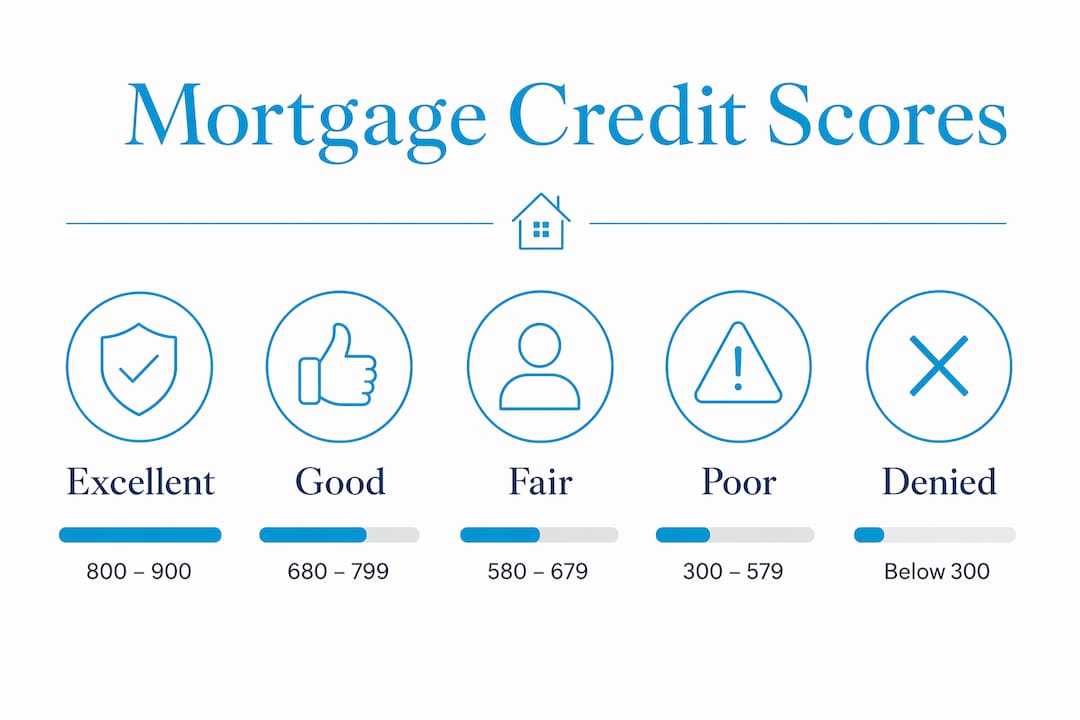
Canadian credit scores run from 300 to 900. Where you fall on that scale shapes not just whether you get approved, but what rate you pay and which products you can access.
| Score range | Rating | Lender access | Typical rate impact |
|---|---|---|---|
| 800–900 | Excellent | All A-lenders; best rates | Lowest rates, strongest terms |
| 720–799 | Very good | All A-lenders | Near-best rates |
| 660–719 | Good | Most A-lenders | Standard A-lender rates |
| 600–659 | Fair | Some A-lenders, all B-lenders | Higher A-lender or low B-lender rates |
| Below 600 | Poor | Private lenders | 8%–14%+ |
Beyond the raw number, lenders also weigh:
- Credit history length: a longer track record of responsible borrowing carries real weight
- Recent inquiries: multiple applications in a short window signal financial stress
- Credit utilisation: keeping balances below 30% of your limit strengthens your profile
- Payment history: even one missed payment can pull a score down noticeably
A score in the mid-600s in Alberta is considered fair, with mortgage options often available through B-lenders or credit unions rather than major banks.
How down payments across Canada affect your mortgage qualification
Down payment minimums depend on the purchase price and province. For homes under $500,000, the minimum is 5%. For homes priced between $500,000 and $999,999, it is 5% on the first $500,000 and 10% on the remainder. Homes at $1 million or more require 20% down, with no mortgage insurance available.

| Purchase price | Minimum down payment | Insurance required |
|---|---|---|
| Under $500,000 | 5% | Yes (CMHC, Sagen, or Canada Guaranty) |
| $500,000–$999,999 | 5%–10% blended | Yes |
| $1 million or more | 20% | No |
In Alberta, where median home prices in many markets sit below the national average, the 5% threshold is commonly accessible. A larger down payment does more than reduce your loan size. It can offset a lower credit score, reduce or eliminate mortgage insurance premiums, and open doors to better terms. Borrowers below 680 who put 20% or more down can bypass the insurer's score floor entirely and work directly with B-lenders.
Fixed rate versus variable rate: which suits your credit profile?
Your credit score influences the rate you receive on both fixed and variable mortgages, but the dynamics differ.
- Fixed rate mortgages lock in your interest rate for the term. Borrowers with scores above 760 access the lowest advertised fixed rates. Those near the 680 threshold pay a modest premium, while B-lender borrowers face rates meaningfully higher.
- Variable rate mortgages are priced as prime plus or minus a spread. A-lender variable rates are typically prime minus a discount for strong-credit borrowers; B-lender variable rates run prime plus a premium that rises as the score falls.
- Borrowers with scores below 680 often find fixed-rate B-lender products more predictable and easier to budget around during a credit-rebuilding period.
- A strong credit profile gives you genuine negotiating power on the spread, especially when a mortgage broker shops multiple lenders simultaneously.
Pro Tip: If your score sits between 660 and 679, delaying your application by two to four months to push above 680 can shift you from B-lender to A-lender territory, saving thousands over a five-year term.
Amortization, mortgage terms, and how credit score fits in
Amortization is the total length of time you take to pay off your mortgage. In Canada, insured mortgages allow amortization periods up to 25 years; uninsured mortgages can extend to 30 years. A longer amortization lowers your monthly payment but increases total interest paid.
Your mortgage term, typically one to five years, is the period your rate and conditions are locked in. At renewal, lenders reassess your full financial profile, including your credit score. A higher score at renewal can unlock better rates and more lender options.
- Borrowers with scores below 680 may be limited to shorter terms through B-lenders, typically one to two years, designed as a bridge while credit is rebuilt
- Credit score indirectly affects which amortization periods lenders will approve, since lower scores raise the lender's risk calculation
- A 25-year amortization on an insured mortgage requires meeting CMHC's 600-point floor, plus the lender's own internal minimum
How to qualify for the best mortgage rates in Canada
Improving your mortgage credit rating before you apply is one of the highest-return financial moves you can make. On a $500,000 mortgage, an 80-point credit score improvement can save $2,500–$5,000 per year in interest.
- Pay on time, every time: payment history is the single largest factor in your score
- Reduce credit card balances: aim for utilisation below 30% on each card
- Avoid new credit applications: each hard inquiry can temporarily lower your score
- Keep older accounts open: credit history length works in your favour
- Manage your GDS and TDS ratios: lenders cap the gross debt service ratio at 39% and total debt service ratio at 44%; staying well below these limits strengthens your full file
- Work with a mortgage broker: brokers access multiple lender tiers simultaneously and know which lenders apply manual underwriting exceptions
Pro Tip: Build a complete file before applying. Stable employment, a solid down payment, and low debt ratios can compensate for a score that sits just below the ideal threshold.

Alberta mortgage credit score guidance from Deneenoel
Alberta's mortgage market has its own rhythm. Home prices in Edmonton and Calgary remain more accessible than Vancouver or Toronto, which means the 5% down payment threshold is within reach for many buyers. That said, credit score expectations from major lenders are consistent with national standards: 680 for conventional mortgages, 600 for insured.
Working with a mortgage broker in Alberta means your application reaches over 50 lenders at once, not just the one bank where you hold a chequing account. For borrowers with bruised credit, that breadth of access is often the difference between an approval and a decline.
Automated underwriting systems at the major banks enforce hard score cutoffs. A personal relationship with a branch manager does not override these systems. Deneenoel works with clients across the credit spectrum, using compensating factors such as strong income, low debt ratios, and larger down payments to build files that lenders approve. For Albertans with scores below 680, the path often runs through a B-lender first, then a refinance to an A-lender once the score has recovered. For those below 600, private lending provides a short-term bridge while credit is rebuilt.
How long does mortgage approval take in Canada?
A pre-approval typically takes one to three business days once your documents are submitted. Full mortgage approval after an accepted offer generally takes five to ten business days, though complex files or appraisal requirements can extend this. Working with a broker who has your documents organised in advance compresses the timeline considerably. Rate holds through a pre-approval lock in your rate for 90 to 120 days, protecting you while you shop.
Mortgage insurance costs and provincial differences in Alberta
Mortgage default insurance premiums are set nationally by CMHC, Sagen, and Canada Guaranty, so the premium rates themselves do not vary by province. What varies is the provincial sales tax applied to the premium at closing. Alberta has no provincial sales tax, which means Albertan borrowers pay no additional tax on their mortgage insurance premium at closing. This is a genuine cost advantage over buyers in Ontario or Quebec, where provincial taxes apply to the premium.
The premium itself is calculated as a percentage of the mortgage amount: 4% for a 5% down payment, stepping down as the down payment increases toward 20%.
How to compare mortgage offers and get the best terms
Shopping your mortgage across multiple lenders is the most direct way to reduce your rate. A mortgage broker does this on your behalf without triggering multiple hard inquiries, since lenders treat mortgage rate shopping within a short window as a single inquiry.
When comparing offers, look beyond the rate itself:
- Prepayment privileges: the ability to pay down principal faster reduces total interest
- Penalty calculations: fixed-rate penalties based on the interest rate differential can be steep; variable-rate penalties are typically three months' interest
- Portability: can you take the mortgage with you if you move before the term ends?
- Lender fees: B-lenders charge fees of 0.50%–1.50% of the mortgage amount, which add to your total cost
What 2025-2026 mortgage regulation changes mean for your credit score
The federal government extended the 30-year amortization option for insured mortgages on new construction and for first-time buyers in 2024, with the change taking effect in late 2024 and carrying into 2026. This expands borrowing capacity for qualifying buyers, but the credit score floor of 600 for insured mortgages remains unchanged. The mortgage stress test, which requires qualification at your contract rate plus 2% or 5.25%, whichever is higher, continues to apply at all federally regulated lenders regardless of credit score.
Common pitfalls that can derail approval despite a good credit score
A strong credit score does not guarantee approval. Lenders assess your full financial picture, and several common issues trip up otherwise well-qualified buyers:
- High debt ratios: a GDS above 39% or TDS above 44% will trigger a decline even with a 750 score
- Recent job change: lenders prefer two years of stable employment in the same field
- Large undocumented deposits: unexplained cash in your account raises compliance flags
- Co-signing existing debt: co-signed loans count against your TDS ratio
- Applying for new credit before closing: a new credit card or car loan between approval and closing can change your debt profile and void the approval
Key takeaways
A credit score of 680 is the standard threshold for A-lender mortgage access in Canada, but your income, down payment, and debt ratios determine how much you can borrow and on what terms.
| Point | Details |
|---|---|
| Minimum score for A-lenders | 680 for uninsured mortgages; 600 for CMHC-insured high-ratio mortgages |
| B-lender territory | Scores of 550–679 qualify, with rates 0.50%–2.00% above A-lender levels |
| Alberta advantage | No provincial tax on mortgage insurance premiums at closing |
| Score improvement payoff | An 80-point improvement on a $500,000 mortgage can save $2,500–$5,000 per year |
| Broker access matters | Brokers reach 50+ lenders and can navigate compensating factors for sub-680 borrowers |
Ready to find out exactly where you stand? Deneenoel works with Albertans across the full credit spectrum, from first-time buyers with strong files to clients rebuilding after financial setbacks. Whether you are in Edmonton or Calgary, getting a clear picture of your mortgage options starts with a conversation.