
If your current fixed rate is meaningfully below today's market rates and you can re-qualify with your lender, porting your mortgage is usually the right move. You carry your existing terms to the new property, sidestep prepayment penalties, and hold onto the rate you locked in.
A few things to know upfront:
- CMHC mortgage loan insurance is portable to a new property under specific conditions, and a premium credit may apply if you port within two years of your original closing.
- Most lenders give you a window of time to complete the transfer, typically between one and four months, so timing matters.
- You must re-qualify on the new property, even when staying with the same lender. A change in income or debt load since your original approval can derail the process.
Porting is not always the answer. If your current rate is higher than what the market offers today, or if you cannot re-qualify, breaking and refinancing may serve you better. The math, not the assumption, should drive the decision.
Table of Contents
- What does porting a mortgage mean in Canada?
- When does porting a mortgage actually save you money?
- What types of porting options will your lender offer?
- What do lenders and CMHC check before approving a port?
- How to port your mortgage: a step-by-step checklist
- What does porting cost, and what pitfalls should you watch for?
- When should you not port? Alternatives worth comparing
- How a mortgage broker helps you port — and why Deneenoel is a practical choice
- Key takeaways
- What brokers see most often with porting
- Ready to assess your port? Deneenoel can help
- Useful sources and further reading
What does porting a mortgage mean in Canada?
Porting a mortgage means transferring your existing mortgage terms — your interest rate, remaining term, and prepayment privileges — to a new property, with the same lender. You are not technically breaking your mortgage contract, so the lender does not charge a prepayment penalty for the transfer itself.
What stays the same: your rate, your term, and most of your existing privileges. What may change: the loan amount (if you need to borrow more or less), the property type, and any conditions tied to the new purchase.
How porting compares to the alternatives:
- Porting: No prepayment penalty; rate and term preserved; must re-qualify; lender and property must meet portability conditions.
- Breaking and refinancing: Penalty applies (often the interest rate differential on a closed fixed mortgage); you can shop any lender for a new rate; full re-qualification required.
- New mortgage with a new lender: Full penalty on the old mortgage; fresh application and rate negotiation; maximum flexibility.
Most fixed-rate closed mortgages are portable, subject to the lender's specific rules. Many variable-rate products are not portable, so check your mortgage agreement before assuming the option is available.
When does porting a mortgage actually save you money?
The financial case for porting is strongest when your existing rate sits well below current market rates. Paying a prepayment penalty to break a closed fixed mortgage and then borrowing at a higher rate rarely makes sense, and porting lets you avoid both problems at once.
Situations where transferring your home loan typically works in your favour:
- Your fixed rate is noticeably lower than the five-year rates lenders are quoting today.
- The prepayment penalty on your current mortgage is large enough that breaking it would cost more than any rate savings you could capture.
- You want to preserve prepayment privileges you negotiated in your original mortgage.
- You are upsizing and need only a modest top-up on top of your existing balance.
- You are buying a similarly priced home and the balances align closely.
The timing window matters too. If you sell your current home and need to close on the new one within the lender's portability period, porting is straightforward. Miss that window and you may face a penalty regardless.
Pro Tip: Before accepting any port, ask your lender for the blended rate calculation in writing. Blended-rate formulas vary by lender, and the difference can be material. Compare the total cost, including any fees, against what you would pay if you broke the mortgage and refinanced at today's best rate.
What types of porting options will your lender offer?
Not every port looks the same. Lenders structure mortgage portability options in several ways depending on whether your new purchase is larger, smaller, or roughly equivalent to your current home.

Straight port: The simplest scenario. Your new purchase price and remaining mortgage balance align closely, so you transfer the existing terms one-to-one. Rate, term, and payment structure carry over with minimal adjustment.
Port with increase (top-up): You are upsizing and need to borrow more than your current balance. The existing balance ports at your original rate; the additional amount is offered at the lender's current market rate. The two portions are then blended into a single rate for the remaining term. This is the most common scenario for Albertans moving from a starter home to a larger property.
Port with decrease: Your new home costs less than your current one. You pay down the difference at closing, reducing your outstanding balance. Some lenders treat this reduction as a prepayment, which may trigger a partial penalty, so confirm the terms in advance.
Delayed or reverse port: You buy the new property before your current home sells. This usually requires bridging financing to cover the gap between your purchase closing date and the proceeds from your sale. The port is conditional on completing the sale within the lender's window.
Blend-and-extend: Rather than a straight port, the lender rewrites your mortgage at a blended rate and extends the term. This avoids a prepayment penalty and can suit borrowers who want rate stability, though it may lock you in for longer than you planned. Blend-and-extend can outperform breaking and refinancing when penalties are large, but it removes flexibility if rates fall further and the blended rate formula varies by lender.
What do lenders and CMHC check before approving a port?
Think of a port as a fresh credit assessment. Staying with the same lender does not exempt you from underwriting. Here is what lenders and insurers typically review:
Borrower re-qualification:
- Current income verification (pay stubs, Notice of Assessment, employment letter)
- Credit score and credit report review
- Gross Debt Service (GDS) and Total Debt Service (TDS) ratios
- Stress test, which may apply depending on the scenario and whether the mortgage is insured
Property requirements:
- The new property must meet the lender's acceptable property criteria (type, condition, occupancy)
- An independent appraisal is usually required
- The port must be completed within the lender's timing window (commonly 30 to 120 days, though this varies by lender)
- Your existing mortgage must be in good standing with no arrears
CMHC portability rules:
If your mortgage is CMHC-insured, the insurer's consent is required for the port. CMHC portability criteria include limits on loan-to-value ratio and remaining amortization. A premium credit is available if the port is completed within two years of your original closing, which can reduce or eliminate the need for a new mortgage loan insurance application.
If your financial situation has changed since you first qualified, a port can be declined even if your rate is excellent. A job change, new debt, or reduced income can push your debt service ratios above the lender's threshold. Treat the re-qualification step as seriously as your original mortgage application.
Pro Tip: Pull your credit report before contacting your lender. Errors or unexpected accounts can slow the re-qualification process. The mortgage approval process in Alberta follows the same documentation standards whether you are porting or applying fresh.

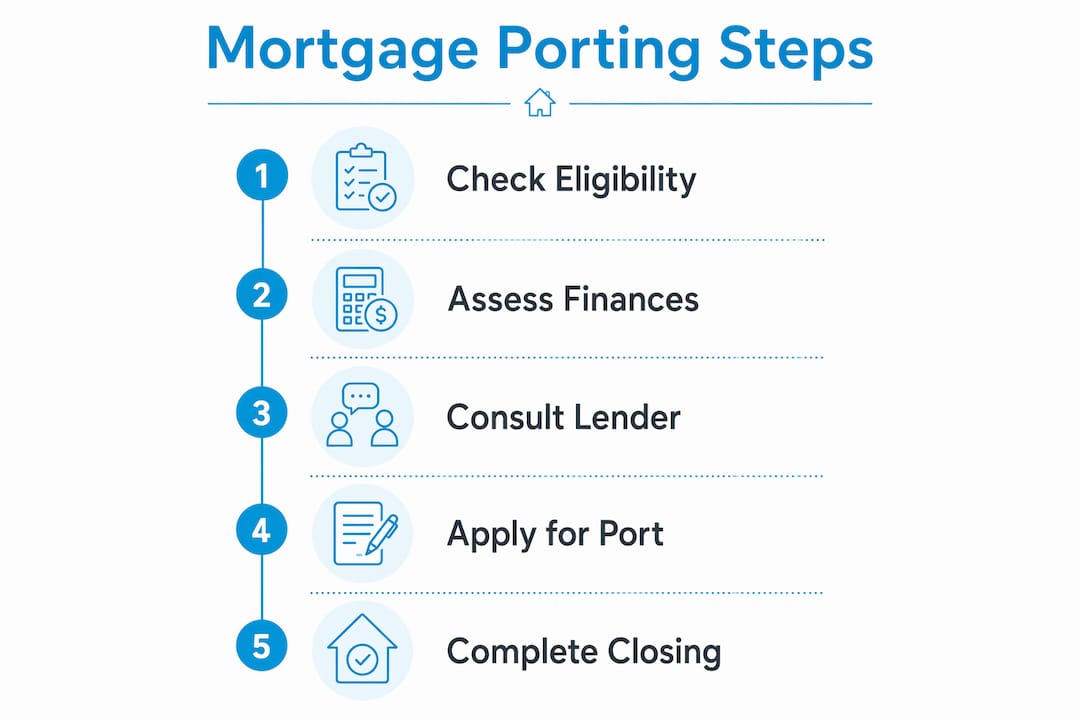
How to port your mortgage: a step-by-step checklist
Follow these steps in order to keep the process on track and avoid timing surprises.
- Contact your lender or mortgage broker as soon as you know you are selling and buying. Confirm that your mortgage is portable and ask for the lender's specific conditions and timing window.
- Get a port pre-approval in writing. Ask the lender to confirm the rate, term, and any blended-rate calculation before you make an offer on the new property.
- Collect your documents. You will need: recent pay stubs, a current Notice of Assessment, an employment confirmation letter, statements for any existing debts, the purchase agreement for the new property, and any rental or investment income documentation.
- Order an appraisal. Most lenders require an independent appraisal of the new property. Book this early, as appraisal lead times can add days to your timeline.
- Confirm CMHC portability if your mortgage is insured. Request the premium credit calculation and confirm that the port meets CMHC's LTV and amortization criteria.
- Arrange bridging financing if needed. If your sale and purchase closing dates do not align, a bridge loan covers the gap. Confirm the cost and terms with your lender before signing.
- Review and sign the port agreement. Read the terms carefully, particularly the blended rate, the new term length, and any prepayment conditions on the ported balance.
- Close and register the new mortgage. Your lawyer or notary handles registration; confirm all documents are in order at least a week before closing.
Documents checklist:
- Proof of income (pay stubs, T4s, Notice of Assessment)
- Employment letter or contract
- Statements for all existing debts and liabilities
- Purchase agreement or MLS listing for the new property
- Current mortgage statement
- Rental or investment income documentation (if applicable)
Typical timing windows:
| Stage | Typical Timeframe |
|---|---|
| Lender port window | 30–120 days (varies by lender) |
| Appraisal lead time | 5 business days |
| CMHC premium credit eligibility | Within 2 years of original closing |
| Bridge financing availability | Aligned to sale/purchase gap |
What does porting cost, and what pitfalls should you watch for?
Porting avoids the prepayment penalty, but it is not free. Several costs can add up if you are not prepared.
Direct costs to budget for:
- Appraisal fee (typically required for the new property)
- Administrative or legal fees for restructuring the mortgage
- Bridging loan interest if sale and purchase dates do not align
- Any lender charges for processing the port or restructuring the top-up portion
Prepayment penalty mechanics: Breaking a closed fixed mortgage triggers a penalty calculated as the greater of three months' interest or the interest rate differential (IRD). The IRD can be substantial when rates have moved significantly. Porting avoids this penalty entirely, which is often the single largest financial reason to port rather than break. If you are considering a blend-and-extend instead, note that lenders must disclose how they calculate the blended rate, and you should compare that offer against breaking and refinancing before committing.
Timeline risks: Appraisal bottlenecks, delayed closing dates, or a buyer's financing falling through on your current home can push you outside the lender's portability window. If that happens, the port may no longer be available and a penalty could apply.
Common pitfalls:
- Assuming portability without confirming CMHC insurer consent when your mortgage is insured
- Failing to re-qualify because of income changes or new debt since the original mortgage
- Accepting a top-up blended rate without comparing it to a fresh mortgage offer
- Underestimating bridging costs when sale and purchase dates do not line up
Pro Tip: Use a mortgage offset calculator or ask your broker to model the total cost of porting versus breaking and refinancing over your expected time horizon in the new home. A lower blended rate is not always the cheaper option once fees and term length are factored in.
When should you not port? Alternatives worth comparing
Porting is not always the best path. Three alternatives are worth running the numbers on before you decide.
| Option | Best When | Key Trade-off |
|---|---|---|
| Port existing mortgage | Current rate well below market; can re-qualify | Rate and term preserved; lender and property conditions apply |
| Break and refinance | Current rate is at or above market; large equity gain | Prepayment penalty applies; full flexibility on lender and rate |
| Blend-and-extend | Within one year of renewal; want rate stability | No penalty; may lock you into a longer term |
| New mortgage, new lender | Current lender's terms are uncompetitive | Penalty on old mortgage; maximum rate-shopping flexibility |
Decision checklist:
- Is your current rate lower than the best five-year fixed rate available today? If not, porting preserves a disadvantage.
- How long do you plan to stay in the new home? A longer horizon favours locking in a good rate; a shorter one may favour flexibility.
- Can you re-qualify with your current lender? If not, a new lender may be the only option.
- What is the total cost of porting (including any top-up rate and fees) versus breaking and refinancing? Get both figures in writing.
When a full refinance or lender switch typically outperforms porting: your current rate is at or above today's market five-year rates, the prepayment penalty is modest relative to the rate savings available, or you need to restructure your debt significantly. Consolidating higher-interest debt into a new mortgage structure is one scenario where breaking and refinancing often wins on total cost.
How a mortgage broker helps you port — and why Deneenoel is a practical choice
A mortgage broker adds real value during a port because the process involves more moving parts than a standard renewal. Here is what a broker does that your lender's branch representative typically does not:
- Validates whether your mortgage is actually portable under your specific contract terms
- Runs the blended-rate math and compares it against competing offers from other lenders
- Sources third-party quotes so you know whether porting or breaking gives you the better outcome
- Manages the paperwork, appraisal coordination, and CMHC insurer steps
- Flags timing risks early so you can arrange bridging financing before it becomes urgent
The most common mistake borrowers make is calling only their own lender. Your lender has one set of products to offer you. A broker with access to fifty or more lenders can tell you whether that blended rate is competitive or whether you would be better served by breaking and refinancing elsewhere.
Deneenoel works with over fifty Canadian lenders and serves homeowners across Alberta, including Edmonton and Calgary. Whether you are upsizing, downsizing, or navigating a delayed port with bridging, Deneenoel can validate your portability, run the numbers on every option, and manage the process from first call to closing. An initial assessment is free.
Key takeaways
Porting a mortgage is the right move when your current fixed rate is below market and you can re-qualify — but the decision should always rest on a full cost comparison, not an assumption.
| Point | Details |
|---|---|
| Re-qualification is mandatory | Even with the same lender, you must pass a full income, credit, and debt-service review. |
| CMHC consent required if insured | Insured mortgages need insurer approval; a premium credit applies if ported within two years. |
| Timing window is firm | Most lenders allow 30–120 days to complete a port; missing it can trigger a penalty. |
| Get the blended rate in writing | Lenders' blending formulas vary materially; always compare against a fresh-market offer. |
| Deneenoel for Alberta ports | Deneenoel accesses multiple lenders to validate your port and compare all options at no cost to you. |
What brokers see most often with porting
The clients who benefit most from porting are usually the ones who locked in a strong fixed rate two or three years ago and are now upsizing. They have a rate worth keeping, a reasonable balance to carry over, and a top-up need that is manageable. The port makes obvious financial sense for them.
Where it gets complicated is the delayed port. A sale falls through, or the purchase takes longer than expected, and suddenly the lender's portability window is at risk. That is when having someone who knows the lender's specific rules, and can move quickly on bridging, makes a real difference.
The rule of thumb I come back to consistently: if your current rate is meaningfully below market and you can re-qualify, porting usually wins. If either of those conditions is missing, run the full comparison before you decide.
Ready to assess your port? Deneenoel can help
Porting a mortgage involves more variables than most lenders will walk you through on a single call. Deneenoel provides a free initial assessment for Alberta homeowners and homebuyers, covering whether your mortgage is portable, what your blended rate would look like, and how that compares to breaking and refinancing with a different lender.

Serving Edmonton, Calgary, and communities across Alberta, Deneenoel has access to over fifty Canadian lenders, which means the comparison is real, not theoretical.
What to bring to your consultation:
- Recent pay stubs and your most recent Notice of Assessment
- Your current mortgage statement (showing rate, balance, and remaining term)
- The purchase agreement for the new property (or a draft if you are still shopping)
- Statements for any existing debts or lines of credit
- Rental or investment income documentation, if applicable
Book a free assessment with Deneenoel today and know exactly where you stand before you sign anything.
Useful sources and further reading
The following Canadian authorities are the primary sources for the rules and criteria covered in this article.
Key references:
- CMHC mortgage loan insurance portability — official portability criteria, LTV limits, amortization rules, and premium credit conditions
- Breaking your mortgage contract — Canada.ca — federal guidance on prepayment penalties and blend-and-extend disclosure requirements
- Porting a mortgage in Canada — NerdWallet Canada — practical explainer on portability mechanics and re-qualification requirements
- Blend and extend mortgage Canada — WealthNorth — scenario comparisons for blend-and-extend versus breaking and refinancing
- Denée Noel Mortgages — Alberta mortgage broker — free assessments and port analysis for Alberta homeowners
CMHC mortgage loan insurance portability: premium credit overview
| Condition | CMHC Rule |
|---|---|
| Port timing for premium credit | Within 2 years of original closing |
| Premium credit | Applied to reduce or offset new insurance premium |
| LTV requirement | Must meet CMHC's maximum LTV at time of port |
| Amortization | Must not exceed remaining amortization limits |
| New application required? | May be reduced or waived if portability criteria are met |
CMHC portability rules are subject to change. Confirm current criteria directly with CMHC or through a licensed mortgage broker before making decisions based on premium credit eligibility.
This article is general information, not professional financial or legal advice. Confirm current rules with CMHC, your lender, or a licensed mortgage professional for your specific situation.