
Canadian lenders typically require bank statements covering a recent period for personal chequing and savings accounts, and a longer period for business accounts or self-employed income verification. That applies whether you're buying your first home, refinancing, or investing. A standard lookback period is typically used for insured mortgages to trace large deposits and confirm your down payment wasn't borrowed. The one action to take right now: consolidate your down payment funds into a single account and leave them there, untouched, for at least 90 days before you apply.
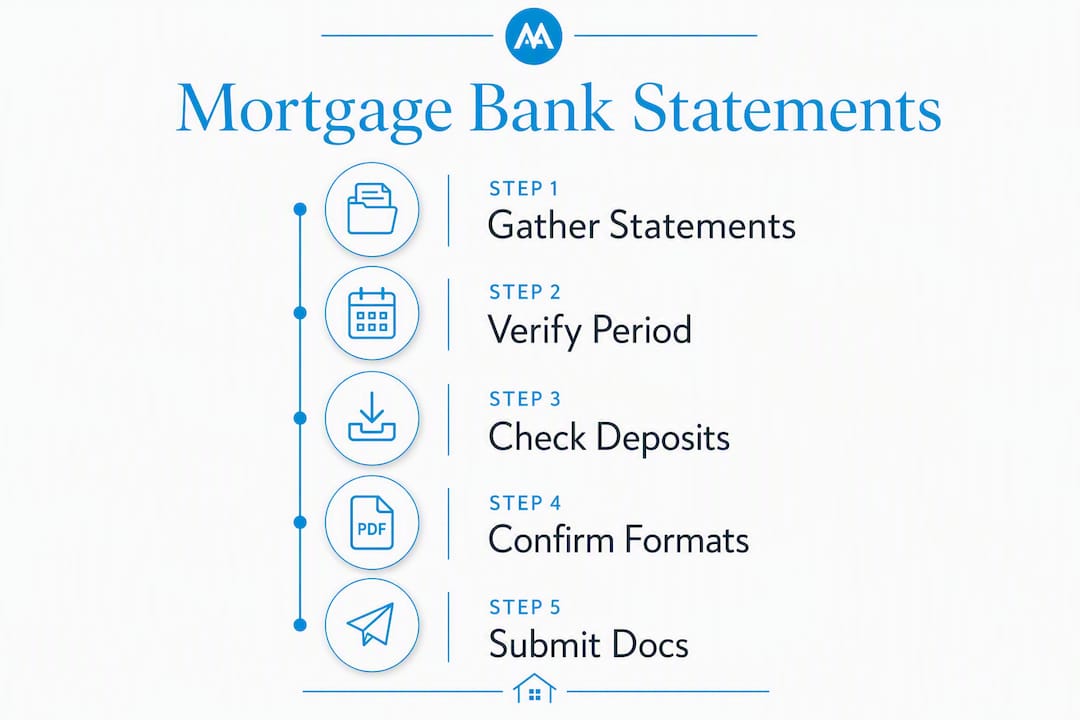
Here's what you'll need to gather:
- Personal chequing and savings accounts require official PDF e-statements covering recent months.
- Joint accounts require statements for a similar recent period, plus source account statements if funds were transferred in.
- Business accounts (self-employed) generally require a longer history of statements.
- TFSA or investment accounts used for the down payment require statements covering the withdrawal and the period before it.
- All statements must show your full name, account number, institution branding, and complete transaction history — no pages missing
Table of Contents
- What bank statements do lenders actually require?
- What underwriters are actually checking on your statements
- What formats will lenders accept — and what gets rejected?
- Common red flags on bank statements and how to explain them
- If you're self-employed: what lenders expect beyond standard statements
- How to prepare your bank statements: a practical timeline
- Sample documents and annotated examples
- When lenders will ask for extra paperwork
- How a mortgage broker helps you prepare your bank statement package
- Key takeaways
- What I see most often — and the fixes that actually work
- Ready to get your mortgage documents in order?
- Useful Canadian sources and sample forms
What bank statements do lenders actually require?
The account type determines how far back lenders look. Most personal accounts fall under the standard 90-day window, but that window can expand quickly once funds start moving between accounts.
| Account type | Typical statement period | Notes |
|---|---|---|
| Personal chequing | 90 days | Rolling window; must show all transactions |
| Personal savings | 90 days | Include if used for down payment or closing costs |
| Joint account | 90 days | Provide for both account holders if applicable |
| TFSA / registered account | 90 days or to date of withdrawal | Required if funds transferred to chequing for down payment |
| Business account (self-employed) | 6 months | Longer history expected; corporate accounts may require more |
| Investment / non-registered account | 90 days or to date of liquidation | Include if proceeds used for down payment |
Every statement must be a full PDF e-statement downloaded directly from your bank's online portal. That means institution logo, page numbers, date range, account number, and every transaction visible. Partial statements, summaries, or anything that omits the running balance will be sent back.
If you transferred funds between your own accounts during the 90-day window, lenders will request statements for both accounts. Consolidating funds four to five months before applying avoids this chain entirely. For insured mortgages, the Canada Mortgage and Housing Corporation specifically asks for recent financial statements covering the past several months to confirm the down payment source.
For newcomers to Canada or borrowers with non-standard income, some lenders extend the lookback period or request additional account history. The same applies to uninsured (conventional) mortgages, where lenders often want to see a larger reserve cushion and may ask for more months of history as a result.
What underwriters are actually checking on your statements
Underwriters aren't just confirming a balance. They're building a picture of your financial behaviour, and four things get the most scrutiny.

Source of down payment is the primary concern. Every large deposit during the 90-day window needs a traceable origin: a payroll deposit, a sale of an asset with supporting paperwork, a gift with a signed gift letter, or documented inheritance. If the source isn't clear, the funds may not count toward your down payment at all.
Income pattern matters for salaried borrowers too, not just the self-employed. Regular payroll deposits on consistent dates support your employment letter and T4. Irregular or inconsistent deposits prompt questions, and lenders may ask for additional tax returns or a letter from your employer. For a deeper look at what lenders expect from your employer, the employment letter requirements are worth reviewing before you apply.
Reserves and closing costs are the third check. Lenders want to see that you'll have funds left over after the down payment clears. A chequing account that drops to zero the day the down payment is confirmed raises concerns about your ability to cover legal fees, land transfer costs, and the first mortgage payment.
Behavioural patterns are the fourth. Repeated overdrafts, payday loan repayments, or gambling transactions don't just raise a single flag — they suggest a pattern of financial strain. One overdraft in three months is manageable. A pattern of three or four signals something lenders take seriously.
- Large deposits without a paper trail
- Frequent overdrafts or returned payments
- Payday loan activity
- Gambling transactions from online platforms
- Unexplained transfers from unverified sources
- New debt payments appearing mid-application
Pro Tip: Before you submit anything, print your last 90 days of statements and read them the way an underwriter would. If a deposit or transfer makes you pause, document it now — not after the lender asks.
Understanding how these patterns influence a decision is covered in detail in this mortgage underwriting guide, which explains how account irregularities affect the approval process.
What formats will lenders accept — and what gets rejected?
The format of your statements matters as much as the content. Lenders want official bank e-statements in PDF format, downloaded directly from your bank's online banking portal. That's the standard, and most lenders won't accept anything else.
What's accepted:
- Full PDF e-statements downloaded from your bank's portal (not generated by a third-party app)
- Statements that include the institution's name and logo, account holder name, account number, full date range, and every transaction with running balances
- Bank letters confirming current balance, when a lender specifically requests one
- Account printouts from a branch, if they include the institution header and are stamped or signed
What gets rejected:
- Screenshots of your banking app or online portal
- PDFs that have been edited, redacted, or cropped to remove certain transactions
- Summary pages that show only totals without individual transactions
- Statements missing pages (even a single missing page will trigger a re-request)
- Third-party account aggregator exports (e.g., from budgeting apps)
Submission tips:
- Name each file clearly:
TD_Chequing_Jan-Mar2026.pdfis far easier to process thanstatement_final_v3.pdf - Include the account type and date range in every filename
- Keep a secure digital folder with all statements organized by account and date so you can supply updated versions quickly if the lender's rolling window moves forward
- If submitting by email, use a secure file-sharing method rather than unencrypted attachments
Common red flags on bank statements and how to explain them
Most red flags on bank statements aren't disqualifying on their own. What matters is whether you can document them clearly and quickly.
Large unexplained deposits are the most common trigger. A deposit over a lender's threshold (often around $1,000, though this varies) that has no obvious source will prompt a documentation request. Acceptable explanations include a signed gift letter, a bill of sale for a vehicle or other asset, a settlement statement for a property sale, or a copy of an inheritance document. The key is having the paperwork ready before the lender asks.
Frequent overdrafts tell a different story depending on frequency. One overdraft in a 90-day window is rarely a problem if your overall balance is stable. Three or more, especially near the end of the month, suggest cash flow issues that underwriters flag as a risk for missed mortgage payments.
Cash deposits are the most difficult to use toward a down payment. Unexplained cash deposits are frequently excluded from the down payment calculation entirely unless you can provide a clear paper trail: a notarized bill of sale, probate documentation, or receipts. Even with documentation, lenders prefer that cash was deposited well before the 90-day window. Depositing a large amount of cash two weeks before applying and then trying to explain it is a difficult position to be in.
Transfers between your own accounts look straightforward to you but create work for underwriters. When funds move from a savings account to a chequing account during the 90-day window, lenders will request statements for the savings account too. That chain can extend further if the savings account received a transfer from a third account. The cleanest solution is to consolidate funds early and stop moving them.
- Gift funds: Require a signed gift letter from the donor confirming no repayment is expected, along with proof of the transfer
- Vehicle or asset sale: Bill of sale plus proof the funds were deposited
- International transfers: Additional documentation tracing the foreign source, plus currency exchange records
- Inheritance: Probate documents or a letter from the estate lawyer
If you're self-employed: what lenders expect beyond standard statements
Self-employed borrowers face a more involved documentation process, and the bank statement requirements are only part of it.
The standard package for a self-employed applicant includes:
| Document | Typical requirement |
|---|---|
| T1 General tax returns | 2–3 years |
| CRA Notice of Assessment (NOA) | 2–3 years, matching T1 returns |
| Business bank statements | 6 months |
| Personal bank statements | 90 days |
| Corporate financial statements | 2 years (if incorporated) |
| T2 corporate tax return | 2 years (if incorporated) |
| Corporate bank statements | 6 months (if incorporated) |
Self-employed borrowers often need an extended period of business bank statements and multiple years of tax returns and NOAs. Lenders expect longer histories for business income, and if you're incorporated, they'll want corporate financials and T2 returns alongside your personal documents.
Business transfers into personal accounts are a specific concern. When revenue flows from your business account to your personal account, underwriters will ask for invoices, contracts, or bookkeeping records to confirm the transfers represent legitimate business income rather than a loan or temporary movement of funds. Keep those records organized and accessible.
- Deposit patterns must be consistent — irregular or declining revenue over the statement period raises questions about income stability
- If your business is seasonal, be prepared to explain the pattern with prior-year comparisons
- Lenders will cross-reference your bank deposits against the income declared on your T1 returns; significant discrepancies require explanation
Bank-statement mortgage programs exist for self-employed borrowers who can't fully document income through traditional tax returns. These programs accept deposit history as a proxy for income but typically require consistent patterns over a longer period and stricter reserve requirements than standard salaried programs. Not every lender offers them, which is where having access to a broad lender network makes a real difference.
For a full breakdown of the mortgage approval process in Alberta, including how self-employed income is assessed, that guide covers the local considerations in detail.
How to prepare your bank statements: a practical timeline
The single most effective thing you can do is start early. Industry professionals advise managing accounts with underwriting in mind several months before applying. That window gives you time to consolidate funds, document any unusual deposits, and let the account settle into a clean, stable pattern.
Pro Tip: Create a labelled digital folder now. Name it something like "Mortgage Documents 2026" and save every PDF with the account type and date range in the filename. When the lender asks for updated statements, you'll have a system rather than a scramble.
- 4–6 months before applying: Consolidate your down payment into one account. Stop moving funds between accounts. If you're receiving a gift, get the signed gift letter now and document the transfer as soon as it arrives.
- 3–4 months before applying: Download your first set of official PDF e-statements. Review them as an underwriter would. Flag any large deposits or unusual transactions and gather supporting documentation for each one.
- 2–3 months before applying: Confirm your employment letter is current and matches your payroll deposits. If self-employed, confirm your most recent NOA is available through your CRA My Account and that your T1 returns are filed and up to date.
- 1–2 months before applying: Download fresh statements. Verify the 90-day window is clean. Contact your broker to review the package before submission.
- At application: Provide the full set of PDFs, labelled and organized. Be ready to supply updated statements if closing is delayed, since lenders use a rolling window and may request a refresh.
Lenders use rolling 90-day windows, which means if your approval or closing is delayed by even a few weeks, you may need to provide updated statements. Having your folder organized means this takes minutes, not hours.
Sample documents and annotated examples

Having the right supporting documents ready before the lender asks is what separates a smooth approval from a conditional one that drags on for weeks.
Gift letter: A signed letter from the donor confirming the amount, the date of transfer, the relationship to the borrower, and a clear statement that no repayment is expected. Most lenders have a preferred template; ask your broker for the version your lender accepts.
Bill of sale (vehicle or personal property): A signed document showing the buyer's name, seller's name, asset description, sale price, and date. This is paired with the deposit entry on your bank statement to confirm the funds came from the sale.
Property settlement statement: If you sold a home and are using the proceeds, the lawyer's trust ledger or final statement of adjustments confirms the net amount you received.
CRA Notice of Assessment: Downloadable from your CRA My Account. Lenders want the most recent one or two years. The NOA confirms your declared income and whether you have any outstanding tax balance.
What an acceptable payroll deposit looks like on a statement: A recurring deposit on the same date each pay period, from the same employer, matching the net pay on your most recent pay stub. Consistency is the signal.
What a flagged cash deposit looks like: A round-number cash deposit (e.g., $5,000) with no corresponding transaction description. Without a bill of sale or other documentation, this will be excluded from the down payment calculation.
What to request from your bank:
- Full e-statement PDFs for each account, covering the required period
- A bank letter confirming current balance (if the lender requests one separately)
- Branch-stamped account printouts as a backup if your online portal has a technical issue
For additional guidance on how mortgage documents fit into the broader home loan process, that resource covers document preparation in practical terms.
When lenders will ask for extra paperwork
Even a well-prepared file will sometimes generate follow-up requests. Knowing what to expect makes it easier to respond quickly and keep your file moving.
Typical follow-up requests include:
- Source letters for any deposit over the lender's threshold during the 90-day lookback
- Proof of sale documents (bill of sale, settlement statement) for asset-sale deposits
- Updated NOAs or business financials if the file takes longer than expected to close
- Additional months of statements if funds moved between accounts during the window
- A statutory declaration or notarized letter for cash deposits or informal loans
When these requests usually arrive: Most follow-ups come after the initial underwriter review, which typically happens within a few business days of submission. If a large deposit appears in a refreshed statement (because the rolling window moved forward), a new request may arrive even late in the process.
How to respond effectively:
- Provide original PDFs, not re-scanned copies
- Use clear filenames that match the request (e.g.,
Gift_Letter_Signed_March2026.pdf) - Include a short cover note that names the transaction, explains it in one or two sentences, and lists the supporting documents attached
- Respond within 24–48 hours where possible; delays in responding are one of the most common reasons files miss closing dates
A complete, clearly organised file from day one is the fastest route to approval. Every hour spent organizing documents before submission saves multiple hours of back-and-forth during underwriting.
How a mortgage broker helps you prepare your bank statement package
Preparing bank statements correctly is one area where working with a broker pays off in concrete, practical ways. Deneenoel reviews your statements before they go to a lender, which means red flags get addressed before they become conditions.
What Deneenoel does with your documents:
- Reviews your statements for the same issues an underwriter would flag: large deposits, overdraft patterns, transfers, and cash activity
- Prepares or reviews gift letters and source documentation to confirm they meet lender requirements
- Selects lenders whose underwriting policies are a good fit for your specific file — including lenders who accept bank-statement income programs for self-employed borrowers
- Handles follow-up requests directly with the lender, so you're not navigating underwriting questions on your own
- Advises on timing: if your statements aren't clean yet, Deneenoel will tell you when to apply rather than submitting a file that will generate unnecessary conditions
Broker advantages for bank-statement files:
- Access to over fifty Canadian lenders means routing your file to the lender most likely to approve it cleanly, not just the one with the lowest posted rate
- Experience with underwriting expectations across multiple lender types (banks, credit unions, monoline lenders, alternative lenders) means knowing which lenders are more flexible on certain documentation issues
- Pre-screening your file before submission reduces the number of conditions and shortens the time between application and approval
What to bring to your first meeting:
- Government-issued photo ID
- 90 days of bank statements for all personal accounts (PDFs)
- 6 months of business statements if self-employed
- Most recent T4s or NOAs
- Employment letter (if salaried)
- Any documentation for large deposits you already know are in the statements
The mortgage pre-approval process in Canada involves more than a credit check. Having your bank statements organized before that first conversation puts you ahead of most applicants.
Key takeaways
Lenders require 90 days of personal bank statements and 6 months for business accounts; consolidating funds early and submitting complete, unedited PDFs is the fastest path to approval.
| Point | Details |
|---|---|
| 90-day standard for personal accounts | Keep down payment funds in one account and leave them untouched for at least 90 days before applying. |
| 6 months for self-employed and business accounts | Self-employed borrowers also need 2–3 years of T1 returns and matching NOAs alongside business statements. |
| PDF format only | Download official e-statements from your bank portal; screenshots and edited files are rejected and delay your file. |
| Document large deposits early | Prepare a signed gift letter or bill of sale for every significant deposit well before the 90-day window opens. |
| Deneenoel reviews your file first | Working with Deneenoel means your statements are pre-screened before submission, reducing conditions and speeding approval. |
What I see most often — and the fixes that actually work
The mistakes that slow mortgage approvals aren't usually financial. They're administrative. The borrower has the money, the income, and the credit. What's missing is the paper trail.
The most common issue I see is consolidation inside the 90-day window. Someone has $80,000 sitting across three accounts and moves it all into one chequing account two weeks before applying. That triggers a request for statements from all three source accounts, which then reveals another transfer from a fourth account, and suddenly a straightforward file has six sets of statements under review. The fix is simple: move the money once, early, and leave it alone.
The second most common issue is screenshots. A borrower takes a photo of their phone screen showing their account balance and sends it over. Lenders won't accept it, and the re-request adds days to the file. Official PDFs from the bank portal take about three minutes to download. There's no reason to submit anything else.
Gift funds are the third area where I see delays. A parent transfers $50,000 to their child's account, and nobody prepares a gift letter. The lender flags the deposit, asks for documentation, and the borrower scrambles to get a letter signed and formatted correctly. Getting the gift letter signed at the same time as the transfer takes ten minutes and eliminates the follow-up entirely.
The quick fixes are genuinely quick. If you moved funds recently, check whether you're still inside the 90-day window and whether reversing the consolidation and waiting is worth it. If you have large deposits without documentation, start gathering the paperwork now. And if you're not sure whether something on your statements will be a problem, call your broker before you apply — not after the lender asks.
Simple administrative preparation shortens underwriting time and reduces the number of conditions on your approval. That means a faster closing and less stress for everyone involved.
Ready to get your mortgage documents in order?
Gathering the right bank statements is only one piece of the mortgage application. Deneenoel handles the full picture: reviewing your documents before submission, selecting the right lender from a network of over fifty Canadian lenders, and managing underwriting follow-ups so your file moves forward without unnecessary delays.

Whether you're buying your first home in Edmonton, refinancing in Calgary, or navigating a self-employed file anywhere in Alberta, Deneenoel provides a personalized document review, a clear checklist of what you need, and direct lender coordination from start to finish. There are no fees to you as a client — the service is commission-based, paid by the lender on a successfully funded mortgage.
The next step is straightforward: reach out to an Edmonton mortgage broker at Deneenoel, share your current situation, and get a clear picture of exactly what your file needs before you apply.
Useful Canadian sources and sample forms
These are the primary sources to consult when preparing your mortgage documents or verifying the requirements that apply to your situation.
- Canada.ca — Getting pre-approved for a mortgage: The Financial Consumer Agency of Canada's official guidance on what lenders and brokers will ask for, including recent financial statements from bank accounts and investments.
- CMHC — Mortgage Application Tips: Canada Mortgage and Housing Corporation guidance for mortgage professionals on what documentation is required, including several months of bank and investment statements.
- CRA My Account: The Canada Revenue Agency's secure portal where self-employed borrowers can download their Notices of Assessment, T1 returns, and confirm their tax filing status.
- CRA — Employee or Self-Employed?: The CRA's publication RC4110, which clarifies the distinction between employment and self-employment income — relevant when lenders are assessing how to categorize your income for qualification purposes.
- FINTRAC and the Proceeds of Crime (Money Laundering) and Terrorist Financing Act: The federal anti-money-laundering framework that requires lenders to verify the source of down payment funds. This is the legal basis for the 90-day lookback and source-of-funds documentation requests. Lenders are reporting entities under this legislation and are obligated to collect and retain transaction records.
- Gift letter templates: Ask your mortgage broker for the version your specific lender requires. Templates vary by lender, and using the wrong format can trigger a re-request. Deneenoel provides lender-specific templates as part of the document preparation process.
- CRA NOA download: Available through CRA My Account under "Tax returns." Download the PDF version, not a screenshot, and confirm the assessment date matches what your lender is requesting.