
For most Canadian borrowers, starting with a mortgage broker is the stronger move. Brokers access numerous lenders — banks, monoline lenders, credit unions, and alternative lenders — and in many typical files they secure rates that are 0.10%–0.30% lower than what you'd find walking into a branch. The main exception: if you hold $1M+ in deposits with a major bank's private-banking division, relationship pricing can occasionally close that gap.
- Start with a broker if you're self-employed, a newcomer to Canada, an investor with multiple properties, carrying a non-standard income, or dealing with a complex credit file.
- Consider your bank first if you're a straightforward prime borrower with an existing relationship, a clean T4 income, and a strong credit score — especially when bundled-product discounts are on the table.
Table of Contents
- Mortgage broker vs bank: how they compare at a glance
- How mortgage brokers operate in Canada
- How getting a mortgage directly from a bank works
- Pros and cons: brokers and banks side by side
- Evidence: who gets better rates and the common exceptions
- How to choose: a practical decision checklist
- What to expect: application process, timeline, and costs
- Final recommendation: where Denée Noel Mortgages fits
- Key takeaways
- What I've seen working with Alberta borrowers
- Denée Noel Mortgages: personalized broker service across Alberta
- Further reading and authoritative sources
Mortgage broker vs bank: how they compare at a glance
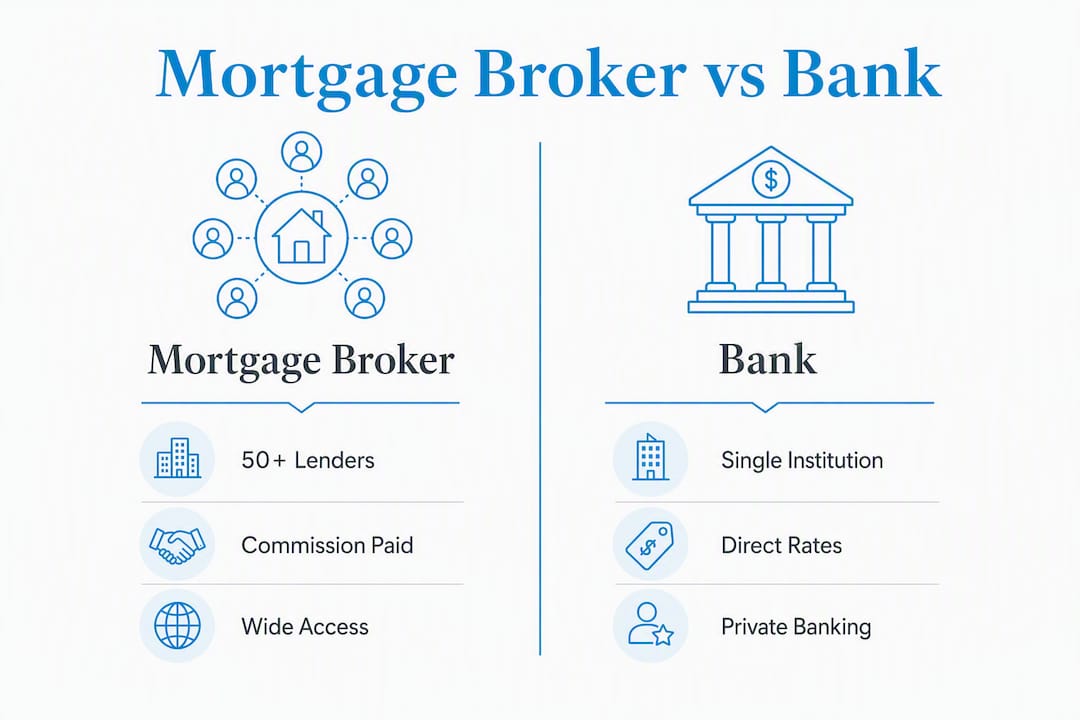
The two channels serve different borrowers in meaningfully different ways. Here's how they stack up across the dimensions that matter most.
| Dimension | Mortgage broker | Bank |
|---|---|---|
| Rate access | 50+ lenders; competitive rate shopping across the market | Single institution's product shelf only |
| Lender variety | Banks, monolines, credit unions, B-lenders | One bank's proprietary products |
| Qualification flexibility | Strong for complex files: self-employed, newcomers, investors, credit issues | Conservative underwriting; favours prime, T4 borrowers |
| Fees / compensation | Lender-paid commission (0.50%–1.10% upfront); free for most A-lender files | No broker fee; may have appraisal or admin fees |
| Speed | Varies; experienced brokers can move quickly | Branch timelines vary; relationship managers can expedite |
| Product features | Access to portability, re-advanceable, and niche products across lenders | Full suite of bank's own products; bundling with chequing, investments |
| Customer relationship | Dedicated broker; no cross-sell pressure | One-stop banking; existing relationship can add value |
| Transparency | Must disclose lender panel and commission in writing (provincially regulated) | Rate and product limited to bank's own shelf; no cross-market comparison |
| Best for | Complex files, investors, rate shoppers, newcomers | Prime borrowers valuing one-stop banking or private-banking relationships |
A few things worth noting beyond the table. Not all lenders accept broker submissions — some major banks restrict which products flow through broker networks, so a broker's panel is not always identical to the full market. And banks can offer bundled perks — a rate discount tied to your chequing account or investment portfolio — that a broker simply cannot replicate.
How mortgage brokers operate in Canada
A mortgage broker is a licensed intermediary who does not lend their own money. They gather your financial information, assess your situation, and submit your application to the lender most likely to approve you at the best available rate. That lender pool typically spans more than 50 institutions.
The borrower profiles that benefit most from this model are predictable:
- Self-employed borrowers whose income doesn't fit a standard T4 format
- Newcomers to Canada who lack Canadian credit history
- Real estate investors financing multiple properties or seeking non-owner-occupied products
- Borrowers with bruised credit who need access to B-lenders or alternative financing
- Anyone rate-shopping who wants a genuine market comparison without applying to five banks separately
How brokers are paid. In the vast majority of files, the lender pays the broker — not you. The standard structure includes an upfront finder fee of 0.50%–1.10% of the mortgage amount and, in some cases, a yearly trailer fee of around 0.10%–0.15% of the outstanding balance. On a $500,000 mortgage, that finder fee works out to $2,500–$5,500 paid by the lender. For most standard A-lender mortgages, consulting a broker costs you nothing. Borrower-paid fees do exist, but they're reserved for atypical files where lender compensation isn't available.
Pro Tip: Ask any broker upfront: "How many lenders are on your panel, and will you disclose your commission in writing?" A reputable broker will answer both questions without hesitation. Provincial regulations across Canada require brokers to provide a written disclosure of compensation — if a broker resists, that's your signal to look elsewhere.

In Alberta, mortgage brokers are licensed through the Real Estate Council of Alberta (RECA). Verify any broker's licence on the RECA registry before you proceed. The disclosure form you receive at the start of the process should name the lender, the compensation amount, and any material conflicts.
How getting a mortgage directly from a bank works
When you apply directly with a bank, you're working with a salaried mortgage specialist whose product shelf is limited to that institution's own offerings. The process is familiar and often convenient — particularly if you already bank there — but the trade-off is a narrower set of options.
Banks apply conservative underwriting standards. They favour borrowers with:
- Stable T4 employment income
- Strong credit scores (typically 680+)
- Low debt-service ratios
- An existing banking relationship that may qualify for bundled pricing
For a first-time buyer with pristine credit and a straightforward employment history, the bank experience can be smooth. A mortgage specialist can often pull your existing financial data, pre-approve you quickly, and bundle the mortgage with a chequing account or investment product for a modest rate discount. The timeline from application to conditional approval at a major bank typically runs 3–7 business days for a clean file.
Where banks genuinely win is private-banking relationships. Clients holding $1M+ in deposits may access discretionary pricing and policy exceptions that no broker network can replicate. That's a real and specific advantage — but it applies to a narrow slice of borrowers.

Pro Tip: If you're leaning toward your bank, ask the mortgage specialist directly: "Is this the best rate available to me, or is there a posted rate I'm being offered?" Banks often have room to negotiate, especially for existing customers — but only if you ask.
Pros and cons: brokers and banks side by side
Mortgage broker: pros
- Access to 50+ lenders across multiple product types
- Rate shopping across the market in a single application
- Stronger options for complex income, credit, or property situations
- Lender-paid commission means no direct cost for most A-lender files
- Brokers can sometimes buy down their commission to offer you a lower rate
- Provincially regulated with mandatory written commission disclosure
Mortgage broker: cons
- Not every lender accepts broker submissions; some products are bank-direct only
- Trailer fees at renewal can create subtle incentives — worth monitoring
- Quality varies significantly between brokers; panel size and lender relationships matter
- Atypical files may carry a borrower-paid fee
- No bundled banking products or cross-account relationship perks
- Relationship is mortgage-specific, not a long-term banking partnership
Bank: pros
- Convenient for existing customers with established relationships
- Bundled pricing (chequing, investments, credit cards) can add real value
- Private-banking clients may access discretionary rate exceptions
- Consistent underwriting process with clear timelines for prime files
- Full suite of proprietary products including re-advanceable mortgages and HELOCs
- One-stop financial management for borrowers who prefer simplicity
Bank: cons
- Limited to one institution's product shelf — no market comparison
- Stricter qualification criteria; complex files often declined or offered higher rates
- Mortgage specialists are salaried employees with no incentive to shop the market for you
- Bundled discounts can create inertia at renewal — you may not realize you're overpaying
- Less flexibility for self-employed income, newcomers, or investors
- Rate negotiation requires the borrower to initiate and push
Pro Tip: Regardless of which route you choose, get your pre-approval in writing with a confirmed rate hold. A verbal pre-approval is not a commitment. A written mortgage pre-approval with a rate hold of 90–120 days protects you while you shop for a property.
Evidence: who gets better rates and the common exceptions
The rate advantage for brokers is real in most standard files, though it's not universal. Bank of Canada analysis confirms that brokers and banks serve distinct market segments: brokers expand access for non-standard borrowers while banks remain the primary channel for conventional prime files. That segmentation matters because it explains why the rate comparison isn't the same for every borrower.
| Metric | Typical range / finding |
|---|---|
| Broker lender access | 50+ lenders (banks, monolines, credit unions, B-lenders) |
| Typical rate savings via broker | 0.10%–0.30% in many standard files |
| Upfront broker commission (lender-paid) | 0.50%–1.10% of mortgage amount |
| Trailer fee (where applicable) | 0.10%–0.15% of outstanding balance annually |
| Cost to borrower for A-lender files | $0 in most cases |
Myth: broker commissions inflate your rate. This is the most common misconception in the broker-vs-bank debate, and it's worth addressing directly. Lenders build broker compensation into their cost of distribution — the same way they budget for branch overhead. Brokers can also negotiate commission splits and sometimes accept a lower finder fee to pass a better rate to the borrower. The commission does not come out of your pocket or add a premium to your rate in a standard A-lender file.
The genuine exceptions are worth knowing. Private-banking clients at major Canadian banks can sometimes receive discretionary pricing that beats what a broker can source. And for a borrower with a very simple file and a strong existing banking relationship, the convenience of staying in one place may outweigh a marginal rate difference.
Your credit score also shapes which channel serves you better. Borrowers below 680 will find brokers far more useful — access to B-lenders and alternative financing opens doors that bank underwriting closes.
How to choose: a practical decision checklist
Work through these questions before you commit to either route.
- Is your income non-traditional? Self-employed, contract, commission-based, or rental income? Start with a broker.
- Is your credit score below 680? A broker's access to B-lenders and alternative financing is likely your best path.
- Are you a newcomer to Canada? Limited Canadian credit history makes broker access to flexible lenders critical. See the work permit mortgage guide for newcomer-specific options.
- Are you financing an investment property? Investor files often require lenders with specific rental-income policies — a broker's panel is far more likely to include them.
- Do you hold $1M+ in deposits at one bank? Private-banking relationship pricing may be worth exploring directly before engaging a broker.
- Is your file straightforward? T4 income, 680+ credit score, standard property, low debt ratios — your bank may be competitive, but still get a broker comparison first.
- Are you approaching renewal? Mortgage renewal is one of the most overlooked opportunities to save. A broker can run a market comparison at no cost.
- How time-sensitive is your purchase? An experienced broker with strong lender relationships can often match or beat bank timelines on clean files.
Questions to ask a broker:
- How many lenders are on your panel?
- Will you provide written commission disclosure?
- Can you access monoline lenders and B-lenders, or only banks?
- What rate hold will you secure on my pre-approval?
- At renewal, will you run a market comparison for me?
Questions to ask a bank mortgage specialist:
- Is this your best available rate, or is there room to negotiate?
- What bundled discounts apply to my existing accounts?
- What are the prepayment penalties on this product?
- Can I port this mortgage if I move before the term ends?
- What happens to my rate if I break the mortgage early?
Red flags to watch for:
- A broker who won't disclose their commission in writing
- Pressure to decide quickly without a written rate hold
- A broker who can't name the lenders on their panel
- A bank specialist who won't explain prepayment penalty calculations
- Any advisor who discourages you from getting a second opinion
Pro Tip: Even if you're planning to go with your bank, consult a broker first. For most A-lender files, the consultation is free, and you'll walk into your bank negotiation knowing exactly what the market looks like.
Simple decision flow:
- Self-employed or non-T4 income? → Broker
- Credit score below 680? → Broker
- Investment property or multiple properties? → Broker
- Newcomer to Canada? → Broker
- Prime borrower with $1M+ in bank deposits? → Explore bank private banking, then compare
- All other prime borrowers → Get a broker comparison, then decide
What to expect: application process, timeline, and costs
The practical experience differs between the two routes in ways that matter when you're working against an offer deadline.
Via a mortgage broker — typical steps:
- Initial consultation (same day or next business day): broker reviews income, credit, and property details
- Pre-approval submission: broker selects lender(s) and submits; rate hold confirmed in writing (typically 90–120 days)
- Conditional approval: 1–5 business days for A-lender files; longer for complex or B-lender files
- Documentation review and appraisal (if required): 3–7 business days
- Final approval and commitment letter: broker coordinates between lender and your lawyer
- Funding: coordinated with your lawyer on closing day
Via a bank — typical steps:
- Appointment with mortgage specialist (in-branch or virtual): 1–3 business days to schedule
- Pre-approval: 1–3 business days for clean files; rate hold typically 90–120 days
- Full application and documentation review: 3–7 business days
- Conditional approval and appraisal: 5–10 business days
- Final approval: 1–3 business days
- Funding: coordinated with your lawyer
| Cost item | Broker route | Bank route |
|---|---|---|
| Broker fee (A-lender files) | $0 (lender-paid) | N/A |
| Broker fee (atypical/B-lender files) | Borrower-paid; amount varies by file | N/A |
Document checklist for both routes:
- Government-issued photo ID
- Two most recent T4s (or two years of Notices of Assessment for self-employed)
- Recent pay stubs (last 30 days)
- Three months of bank statements
- Proof of down payment (90-day history)
- Purchase agreement (once accepted)
- Property tax statement (for refinances)
Self-employed borrowers should also prepare CRA-issued Notices of Assessment for the past two years and, where applicable, financial statements or business bank statements. Complex files take longer regardless of channel — but a broker with B-lender relationships will typically have more options when a bank declines.
Final recommendation: where Denée Noel Mortgages fits
Most Canadian homebuyers and investors are better served starting with a broker. The rate access, lender variety, and flexibility for complex files are advantages that a single bank simply cannot match. The borrower who should go directly to their bank is the exception, not the rule: a straightforward prime file with a strong existing relationship and, ideally, a private-banking tier that unlocks discretionary pricing.
For investors and complex-file clients specifically, the broker advantage is most pronounced. Financing a second property, structuring around rental income, or qualifying with self-employed income all require lender options that most bank branches don't carry.
Denée Noel Mortgages is a licensed mortgage brokerage serving Alberta, with access to more than 50 Canadian lenders. Here's what that means in practice:
- Written pre-approvals with confirmed rate holds
- Mortgage financing for purchases, refinances, renewals, and investment properties
- Specialist support for self-employed borrowers, newcomers to Canada, and complex files
- Full commission disclosure in writing, as required by RECA
- No cost to you for standard A-lender files
Pro Tip: If you're within 120 days of your mortgage renewal, contact a broker now — not at renewal. Lenders often offer their best rates to new business, not to renewals processed automatically. A broker-sourced market comparison at this stage can save you thousands over a five-year term.
Ready to see what's available for your file? Book a no-cost consultation with Denée Noel Mortgages and get a written pre-approval with a rate hold.
Key takeaways
For most Canadian borrowers, a mortgage broker delivers better rate access and more flexibility than going directly to a bank — especially for self-employed, investor, and complex-file situations.
| Point | Details |
|---|---|
| Brokers access more lenders | Brokers work with 50+ lenders; banks offer only their own products. |
| Rate savings are real but not universal | Brokers often secure rates 0.10%–0.30% lower in many standard files. |
| Broker fees are usually $0 | Lenders pay broker commissions on A-lender files; the cost to you is typically nothing. |
| Complex files need a broker | Self-employed, newcomers, and investors benefit most from broker lender access. |
| Deneenoel serves Alberta borrowers | Denée Noel Mortgages offers written pre-approvals, 50+ lenders, and free consultations for Alberta homebuyers and investors. |
What I've seen working with Alberta borrowers
The debate between using a broker and going straight to a bank often gets framed as a rate question. Rates matter, but the more important variable is fit. A bank's underwriting model is built for a specific borrower profile — and if you don't fit it cleanly, you'll either be declined or offered a rate that reflects the bank's risk perception of your file, not the actual market.
What I see most often in Alberta is borrowers who went to their bank first, got a number, and assumed that was the market. It rarely is. The borrower who came back after a bank decline and discovered they qualified with a monoline lender at a competitive rate — that's a common story. So is the self-employed borrower who was told their income "doesn't qualify" at a branch, when in fact two years of Notices of Assessment and a strong down payment would have satisfied several lenders on a broker's panel.
The other thing worth saying plainly: broker commissions are not a conflict of interest in the way people assume. The lender pays the commission. The broker's incentive is to place your file with a lender who will approve it and keep you as a client for renewals. That aligns reasonably well with your interests. The area to watch is renewal — trailer fees mean a broker has a financial reason to keep you with the same lender. Ask for a market comparison at every renewal, regardless of who arranged your original mortgage.
Denée Noel Mortgages: personalized broker service across Alberta
Choosing a broker over a bank means choosing access to the full market, not just one institution's shelf. Denée Noel Mortgages brings that access to Alberta homebuyers and investors, with a process built around your specific file rather than a standard underwriting checklist.

Services include written pre-approvals with rate holds, purchase mortgages, refinancing, investment property financing, mortgage renewals, and specialist support for self-employed borrowers and newcomers to Canada. Denée is compensated through lender-paid commissions — standard in the industry and disclosed in writing at the start of every file. For most A-lender mortgages, there is no cost to you.
Whether you're buying your first home in Edmonton, refinancing in Calgary, or adding a rental property to your portfolio, the starting point is the same: a clear picture of what you qualify for and what the market actually offers. Book your free consultation or connect with Denée for Calgary clients to get a written pre-approval and a real market comparison.
This article provides general information about mortgage financing options in Canada and is not a substitute for advice from a licensed mortgage professional. Rates, lender policies, and regulatory requirements change — confirm current details with a qualified broker or your lender directly.
Further reading and authoritative sources
These are the primary references used throughout this article. Each one is worth bookmarking if you want to go deeper on any section.
- Financial Consumer Agency of Canada: Mortgage shopping guide — the federal regulator's plain-language guide to comparing mortgage options, lenders, and key terms. Start here if you're new to the process.
- Financial Consumer Agency of Canada: Mortgage pre-approval — explains what a pre-approval does and doesn't guarantee, and what documentation lenders require.
- CMHC: Professionals and industry resources — Canada Mortgage and Housing Corporation's research and market data, useful for understanding insured mortgage rules and housing trends.
- Bank of Canada working paper: mortgage market segmentation — academic analysis of how brokers and banks serve different borrower segments in Canada; the most rigorous source on market structure.
- NerdWallet Canada: What is a mortgage broker? — clear consumer explainer on broker licensing, role, and how the intermediary model works.
- MoneySense: Mortgage broker vs bank — practical rate comparison analysis with discussion of commission mechanics and exceptions.
- WealthNorth: How mortgage brokers get paid — detailed breakdown of finder fees, trailer fees, and how lender-paid compensation works.
- WOWA: How mortgage brokers get paid — covers renewal trailer fees and the incentive structures borrowers should understand at renewal time.
- Ratehub: How mortgage brokers get paid — explains the free-for-borrower model and when borrower-paid fees apply.
- Denée Noel Mortgages: Best mortgage lenders in Canada — Alberta-focused guide to lender types and how brokers source products across the market.
Regulatory note: Mortgage brokers in Alberta are licensed and regulated by the Real Estate Council of Alberta (RECA). Verify any broker's licence at reca.ca before engaging their services.