
Yes, you can get a mortgage in Canada on a work permit. CMHC-insured programs cover non-permanent residents who are legally authorized to work in Canada, with no minimum residency period required. The property must be in Canada, owner-occupied, and fall within the 1-to-4 unit range. Many newcomers assume permanent residency is a prerequisite for homeownership. It is not. What lenders actually need is verified income, valid legal work authorization, and a clear paper trail on your down payment.
Here is what to know upfront:
- Non-permanent residents generally need a minimum 10% down payment under default-insured mortgage programs, compared to 5% for permanent residents and citizens
- The mortgage stress test applies to every borrower regardless of immigration status
- Canadian credit history strengthens your file, but lenders can accept international credit reports or letters from your home-country financial institution
- Mortgage pre-approval is available to work permit holders and gives you a realistic budget before you start house-hunting
- Specialized newcomer mortgage programs exist through major banks and independent brokerages across Alberta
Table of Contents
- Which Alberta mortgage brokerages help work permit holders?
- How do you qualify for a mortgage on a work permit in Canada?
- Why the right mortgage broker matters for newcomers
- Trusted local mortgage brokers in Alberta: contact details and specialties
- What if you cannot qualify for a standard mortgage?
- How does your work permit type affect mortgage eligibility?
- Deneenoel: personalized mortgage guidance for work permit holders in Alberta
- Key takeaways
Which Alberta mortgage brokerages help work permit holders?
Finding a broker who genuinely understands newcomer files makes a real difference. Not every lender accepts non-permanent residents, and the documentation requirements go well beyond what a standard Canadian applicant faces. The brokerages below serve Alberta clients and have experience with work permit and newcomer mortgages.
| Brokerage | Services offered | Specializations | Client ratings | Geographic coverage | Newcomer expertise |
|---|---|---|---|---|---|
| Canadian Mortgage Professionals | Pre-approvals, fixed/variable rate mortgages, HELOC, revenue properties, new Canadian mortgages | Mortgages for new Canadians, first-time buyers, revenue properties | Established brokerage with broad lender access | Edmonton and Alberta-wide | Dedicated "Mortgages for New Canadians" programme |
| Amanda Crowe, MortgageLine, Mortgage Architects | Mortgage planning, pre-approvals, rural financing, refinancing, newcomer mortgages, self-employed mortgages, investment mortgages | Canadian newcomers, rural properties, self-employed borrowers, new construction | Trusted Alberta mortgage planner with access to over 50 lenders | Alberta-wide including rural areas | Specific Canadian newcomer mortgage category |
| Legacy Mortgage Group | Home purchase mortgages, pre-approvals, refinancing, investment financing | Newcomer and foreign worker mortgages, complex files | Local Alberta presence | Edmonton and surrounding areas | Experience with work permit documentation and lender navigation |
What to look for in a broker:
- Confirmed experience placing mortgages for non-permanent residents
- Access to multiple lenders, not just one institution
- Transparent communication about fees and timelines
- Familiarity with alternative credit documentation for newcomers
How do you qualify for a mortgage on a work permit in Canada?
The process is straightforward once you know what lenders are evaluating. Here is a step-by-step breakdown.
Eligibility criteria
To qualify under CMHC's homeownership programs, you must:
- Hold a valid work permit authorizing you to work in Canada
- Purchase a 1-to-4 unit property where you will occupy at least one unit
- Confirm the purchase does not fall under the Prohibition on the Purchase of Residential Property by Non-Canadians Act
Down payment requirements
| Applicant type | Minimum down payment |
|---|---|
| Canadian citizen or permanent resident | 5% |
| Non-permanent resident (work permit holder) | 10% |
| Any borrower (home over $500,000) | Graduated scale applies |
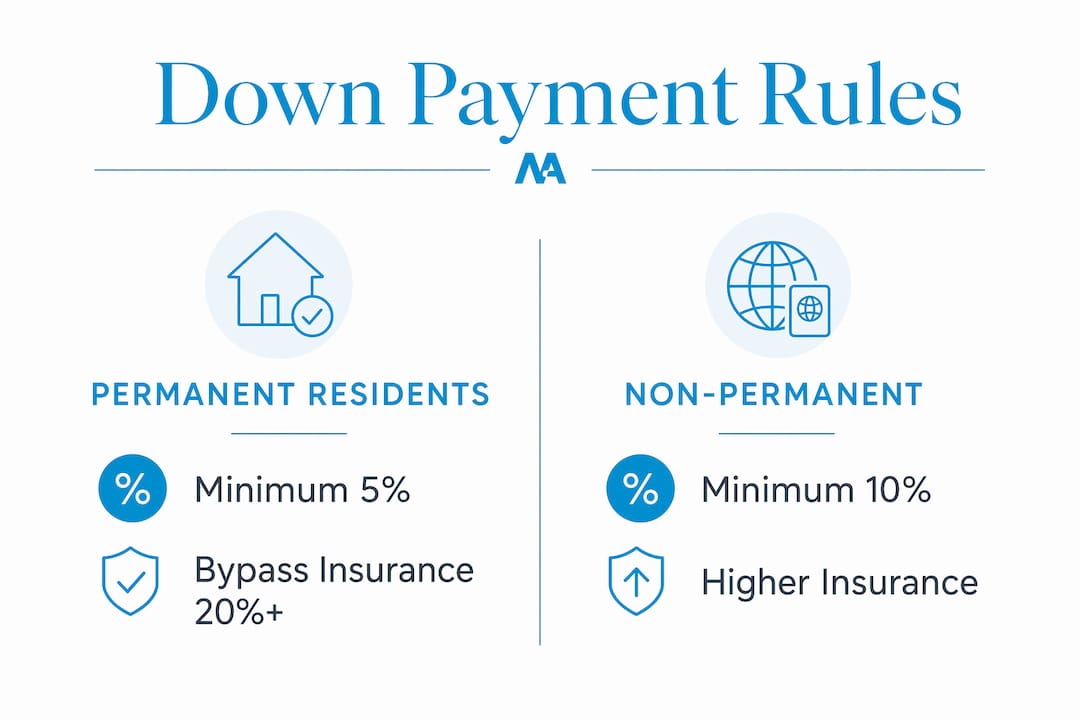
If you put down 20% or more, you bypass default mortgage insurance entirely, which opens up more lender options and removes the CMHC premium from your mortgage.
Building Canadian credit
Lenders weight Canadian credit history heavily. If you are new to Canada, start building your credit profile as early as possible: open a Canadian bank account, apply for a secured credit card, and make consistent payments. If you have not had time to establish a Canadian credit score, alternative credit verification such as an international credit report or a reference letter from your home-country bank can support your application.
Required documents
- Valid work permit (copy of current status document)
- Employment letter confirming position, salary, and employment duration
- Recent pay stubs (typically two to three months)
- 90 days of Canadian bank statements showing down payment funds
- Government-issued photo identification
- International credit report or financial institution reference letter (if no Canadian credit history)
Down payment funds need to be in a Canadian account and traceable. Gift funds require a signed gift letter and documentation of the transfer.
Typical timeline
From pre-approval to possession, the timeline for work permit mortgage files varies widely depending on lender processing times and how quickly documentation is assembled. Pre-approval itself usually takes a few business days once your broker has your full file.
Pro Tip: Get your pre-approval before you start viewing homes. It locks in a rate, confirms your budget, and signals to sellers that you are a serious buyer. For newcomers, it also surfaces any documentation gaps early, when there is still time to address them.
Why the right mortgage broker matters for newcomers
Work permit mortgage applications are more layered than a standard Canadian file. Lenders have varying appetites for non-permanent resident applicants, and the requirements go beyond what CMHC publishes. A broker who specializes in newcomer files knows which lenders are genuinely open to work permit holders and which ones will decline the file at underwriting regardless of how strong it looks on paper.
"Mortgage brokers specializing in newcomer files have crucial knowledge of which lenders accept work permit holders and the layered requirements beyond CMHC rules, making them indispensable to applicants." — Maple Syrup Money, 2026
A skilled broker does more than submit your application. They verify that your down payment documentation meets lender standards, help you present alternative credit references effectively, and manage communication with underwriters who may have questions about your immigration status or employment history.
What an experienced newcomer mortgage broker brings to your file:
- Knowledge of lenders comfortable with non-permanent resident applicants
- Ability to present alternative credit documentation persuasively
- Familiarity with Alberta's housing market and local property values
- Guidance on which mortgage products fit your income structure and permit type
- Support through the stress test qualification process
Deneenoel works with over fifty Canadian lenders and has direct experience placing mortgages for clients on work permits across Edmonton, Calgary, and surrounding Alberta communities. That lender breadth matters: when one institution declines a newcomer file, there are often several others who will approve it under the right presentation.
Trusted local mortgage brokers in Alberta: contact details and specialties
Canadian Mortgage Professionals Website: canadianmortgagepro.com Specialty: Mortgages for new Canadians, first-time buyers, revenue properties, HELOC, purchase plus improvements Coverage: Edmonton and Alberta-wide

Amanda Crowe, MortgageLine, Mortgage Architects Website: amandacrowe.ca Specialty: Canadian newcomer mortgages, rural financing, self-employed borrowers, investment and new construction mortgages, refinancing Coverage: Alberta-wide, including rural communities
Deneenoel (Denée Noel Mortgages) Website: deneenoel.com Specialty: Newcomer and work permit mortgages, pre-approvals, refinancing, investment financing, complex files, access to 50+ lenders Coverage: Edmonton, Calgary, and surrounding Alberta areas
When contacting any broker, ask directly whether they have placed mortgages for non-permanent residents in the past 12 months. That single question tells you more than any marketing description.
What if you cannot qualify for a standard mortgage?
Not every work permit holder will qualify for a CMHC-insured mortgage on their first attempt, particularly if Canadian credit history is thin or employment is recent. There are practical alternatives worth knowing.
Private lenders operate outside the federally regulated system and set their own criteria. They typically charge higher interest rates and fees, but they can approve files that major banks and credit unions decline. Private lending works best as a short-term bridge while you build Canadian credit and employment history.
Credit unions sometimes have more flexible underwriting policies than chartered banks, particularly for borrowers with strong income and a solid down payment. Policies vary by institution, so a broker with credit union relationships is useful here.
Larger down payments change the equation significantly. At 20% or more, you exit the insured mortgage space entirely, which removes CMHC's non-permanent resident rules from the picture. Some lenders who would not touch a 10% down payment file will readily approve a conventional mortgage with 20% or 25% down.
Co-signers who are Canadian citizens or permanent residents can strengthen a file, though lenders will assess both parties' finances and the co-signer takes on legal responsibility for the debt.
Exploring debt consolidation with mortgage options can also free up cash flow to reach a stronger down payment position before applying.
How does your work permit type affect mortgage eligibility?
Not all work permits carry equal weight with lenders. The type and remaining duration of your permit directly affect how lenders assess risk on your file.

Open work permits (such as those issued to spouses of skilled workers or post-graduation permit holders) are generally viewed more favourably because they are not tied to a single employer. Losing one job does not immediately void the permit.
Employer-specific (closed) work permits create more scrutiny. If your permit is tied to one employer, lenders want to see stable employment with that employer and ideally a renewal or extension in progress.
Permit duration is a key underwriting consideration. Most lenders want to see at least 12 months of remaining validity on your work permit at the time of application, though some will work with shorter timelines if a renewal is already in process. A permit expiring in three months with no renewal documentation is a significant obstacle.
Pathways to permanent residency matter too. If you are actively in an Express Entry pool, a Provincial Nominee Programme, or another PR pathway, documenting that status can reassure lenders about your long-term ties to Canada. It does not guarantee approval, but it addresses one of the risk questions underwriters ask.
For a full breakdown of mortgage approval in Alberta including permit-specific considerations, that resource covers the 2026 lending environment in detail.
Deneenoel: personalized mortgage guidance for work permit holders in Alberta
Getting a mortgage on a work permit in Alberta is entirely achievable, but the path looks different from a standard Canadian application. You need a broker who knows which lenders will actually say yes, how to present your documentation, and how to position your file for the best possible rate.

Deneenoel works exclusively with Alberta clients and has access to over fifty Canadian lenders, including those with established programmes for newcomers and non-permanent residents. Whether you are in Edmonton, Calgary, or a surrounding community, the process starts with a straightforward conversation about your situation: your permit type, your income, your down payment, and your timeline. From there, Deneenoel identifies the lenders most likely to approve your file and guides you through every step, from pre-approval to possession.
Ready to find out what you qualify for? Book a consultation with Deneenoel and get a clear picture of your mortgage options in Alberta.
Key takeaways
Work permit holders in Canada can qualify for CMHC-insured mortgages with valid legal work authorization, a minimum 10% down payment, and proper documentation, making homeownership accessible without permanent residency.
| Point | Details |
|---|---|
| CMHC eligibility confirmed | Non-permanent residents with valid work permits qualify for insured mortgages on 1-to-4 unit owner-occupied properties. |
| 10% minimum down payment | Work permit holders need at least 10% down under insured programs, compared to 5% for permanent residents. |
| Credit alternatives accepted | International credit reports or home-country bank reference letters can substitute for Canadian credit history. |
| Permit type and duration matter | Open work permits and longer remaining validity improve lender confidence; 12+ months remaining is the common benchmark. |
| Deneenoel for Alberta newcomers | Deneenoel connects work permit holders to 50+ lenders across Edmonton, Calgary, and Alberta with personalized guidance. |