
A cashback mortgage usually suits you if you need cash at closing and you're confident you'll ride out the full term without breaking or refinancing early. It usually doesn't suit you if there's any real chance you'll sell, refinance, or renegotiate before the term ends, because that's when the trade-off turns expensive.

Here's the quick math on why: lenders hand you a lump sum, commonly 1% to 7% of your mortgage principal, in exchange for locking into a higher fixed rate for the whole balance, not just the cash portion. CMHC oversees the insurance rules that shape which lenders can offer these products and under what conditions, so availability isn't universal across every mortgage type.
A cashback mortgage is a reasonable choice when:
- You need cash for closing costs, moving expenses, or renovations and don't want to tap a separate loan.
- You're certain you'll keep the mortgage for its full term without breaking, porting, or refinancing early.
It's usually the wrong move when:
- You expect to sell the home or refinance within the next few years.
- You can access cheaper short-term credit, like a low-rate line of credit or family loan, without the long-term rate penalty.
Pro Tip: The real risk isn't the cash. It's the clawback. Most lenders can demand repayment of some or all of that cashback, sometimes with a penalty on top, if you break the mortgage early. Get the exact clawback formula in writing before you sign anything.
Working through this with a broker like Denée Noel Mortgages before you commit can save you from locking into a product that costs more than it delivers.
Key Takeaways
Cashback mortgages trade immediate cash for a higher fixed rate across your entire term, and the total interest cost usually outweighs the payout unless you hold the mortgage full term.
| Point | Details |
|---|---|
| Cash need vs term certainty | Only take cashback if you need the funds now and won't break the mortgage early. |
| Rate premium adds up | Extra interest from the premium often exceeds the cashback amount over five years. |
| Clawback risk is real | Breaking or refinancing early can force you to repay some or all of the cashback. |
| Tax-free cash | Cashback received is not taxable income in Canada. |
| Get terms in writing | Confirm the clawback formula and rate premium in your commitment letter before signing. |
| Broker support | Denée Noel Mortgages compares cashback offers across fifty-plus lenders to find the best trade-off. |
Table of Contents
- What is a cashback mortgage in Canada?
- How much cash can you get from a cashback mortgage?
- When do you receive the cashback, and what happens if you break the mortgage?
- Pros and cons of a cashback mortgage vs a traditional mortgage
- Worked example: does the cashback rate premium cost more than it pays out?
- Who qualifies for a cashback mortgage and how do you apply?
- What are the alternatives to a cashback mortgage?
- How Denée Noel Mortgages helps you evaluate a cashback offer
- Cashback mortgage Canada: when the upfront cash is worth the trade-off
- Get a cashback mortgage comparison built around your numbers
- Frequently asked questions about cashback mortgages in Canada
- Sources
What is a cashback mortgage in Canada?
A cashback mortgage gives you cash at closing in exchange for accepting a higher fixed interest rate for your entire term. That's the whole concept in one sentence, but the mechanics are worth understanding before you sign.
The lender doesn't hand you a gift. It finances the cash back by charging you a higher rate across the full mortgage balance, not just on the portion tied to the cashback amount. According to NerdWallet Canada, this rate premium applies to every dollar you borrow, which is why the true cost of cashback often surprises first-time buyers who assumed it was a no-strings bonus.
The core mechanics work like this:
- Banks and credit unions are the most common providers, though not every lender offers cashback products.
- The cash typically lands in your account as a lump sum on closing day, ready to use for moving costs, furniture, or your down payment shortfall.
- Cashback mortgages are almost always tied to fixed-rate terms; variable-rate cashback products are rare in the Canadian market.
- Insured (high-ratio) mortgages sometimes have restrictions on cashback availability, since CMHC's lender programs shape which products insurers will back.
| Point | Details |
|---|---|
| Cash timing | Delivered as a lump sum at closing, not spread across the year. |
| Rate impact | Premium applies to the full mortgage balance, not just the cashback amount. |
| Term type | Almost exclusively offered on fixed-rate mortgages. |
| Insured mortgage note | Availability can be limited on high-ratio, CMHC-insured products. |
How much cash can you get from a cashback mortgage?
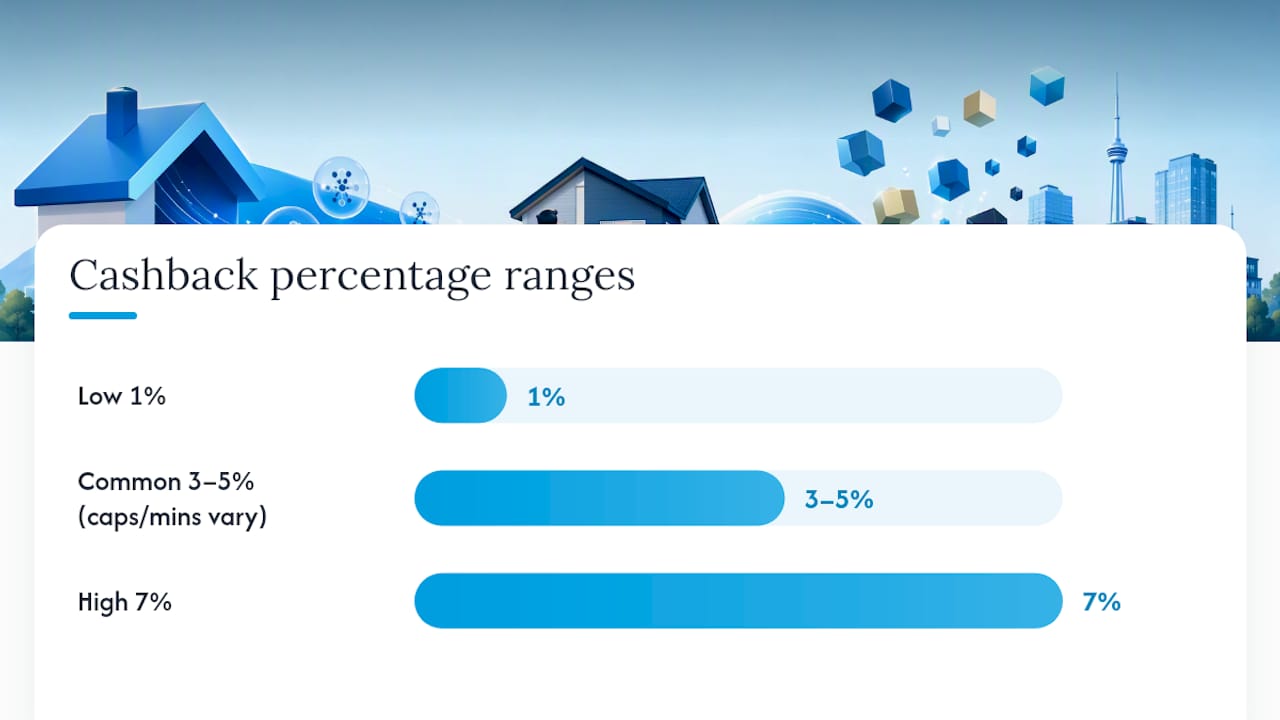
Most Canadian lenders offer cashback in a range of 1% to 7% of your mortgage principal, with 3% to 5% being the most common sweet spot advertised in the market. Some lenders cap the dollar amount regardless of your mortgage size, and others set a minimum mortgage amount before you qualify for any cashback offer at all.
Promotional offers sometimes swap the percentage model for a flat dollar figure, like a capped several thousand dollar bonus tied to specific eligibility conditions and an expiry date, similar to the format banks use for other product promotions. Always read the fine print on caps and minimums before assuming your mortgage qualifies for the top-end percentage.
Here's what typical cashback payouts look like across common mortgage sizes:
To work out your own numbers:
- Multiply your total mortgage principal by the cashback percentage your lender is offering (for example, $350,000 × 0.03 = $10,500).
- Check whether that figure exceeds any lender-imposed cap, since promotional fixed-dollar offers can pay out less than a percentage-based calculation would suggest on larger mortgages.
When do you receive the cashback, and what happens if you break the mortgage?
You receive the cashback at closing, deposited alongside your mortgage funds when the property transaction finalizes with your lawyer or notary. There's no waiting period and no separate application step. It arrives with the rest of your mortgage disbursement.
The catch shows up if you break the mortgage before the term ends. Lenders commonly build in a clawback provision requiring you to repay some or all of the cashback, often pro-rated according to how many months remain in your term, on top of any standard prepayment penalty. A borrower who breaks a five-year term after 18 months might owe a much larger share of the cashback back than someone who breaks in year four.
Questions worth asking your lender before you accept a cashback offer:
- Is the clawback calculated as a flat repayment or pro-rated by remaining term?
- Does refinancing with the same lender trigger the clawback, or only switching lenders?
- What happens if you port the mortgage to a new property instead of breaking it outright?
- Can you get the clawback formula in writing as part of your commitment letter?
Roughly half a percentage point to a full point and a half of extra interest is a common range for the rate premium lenders attach to cashback products, and that premium compounds over your whole term. Confirm every clawback term in writing before you sign. Verbal assurances from a lender's front-line staff don't hold up if a dispute arises later.
Pros and cons of a cashback mortgage vs a traditional mortgage
The trade-off is straightforward: you get cash now, but you pay more in interest later, and you lose flexibility if your plans change. Whether that trade works in your favour depends entirely on how certain you are about staying put for the full term.
| Factor | Cashback mortgage | Traditional mortgage |
|---|---|---|
| Upfront liquidity | Lump sum at closing | None |
| Interest rate | Higher, applies to full balance | Lower, standard market rate |
| Flexibility to break/refinance | Limited by clawback risk | Standard prepayment rules only |
| Total interest over term | Generally higher | Generally lower |
| Tax treatment of cash | Not taxable income | Not applicable |
Cashback tends to make sense for:
- Buyers who are tight on closing costs and don't want to draw down savings meant for an emergency fund.
- Homeowners planning renovations right after taking possession who'd rather avoid a second loan.
- Borrowers using the cash to pay off higher-interest debt, provided they're locked into the mortgage term regardless.
It tends to backfire for:
- Anyone who suspects they'll relocate for work or family reasons within the term.
- Buyers who could qualify for a lower rate without cashback and cover their cash needs through savings or a smaller short-term loan instead.
Worked example: does the cashback rate premium cost more than it pays out?
In most typical scenarios, the extra interest you pay over a five-year term exceeds the cash you received, unless you're certain you'll hold the mortgage full term and the cash prevented you from taking on more expensive debt elsewhere. That's the central math every buyer needs to run before accepting an offer.
Here's a simplified walkthrough for a $400,000 mortgage on a five-year fixed term:
- Baseline scenario: No cashback, standard fixed rate, 25-year amortization. This is your reference point for comparison.
- Cashback scenario: 3% cashback ($12,000 upfront) at a rate premium commonly falling in the 0.5% to 1.5% range above the standard rate.
- Estimate the extra interest: A premium in that range on a $400,000 balance typically adds several thousand dollars in extra interest cost over five years, depending on exactly where in that range your lender sets the rate.
- Compare net position: If the extra interest paid over the five years is close to or higher than the $12,000 you received, the cashback only makes sense if it kept you from borrowing at an even higher cost elsewhere, like a high-interest personal loan or credit card.
Assumptions here matter. The math shifts depending on your exact rate premium, your amortization length, and whether you hold the mortgage for the entire term. Run your own numbers through a lender payment calculator before deciding, since even small rate differences compound meaningfully over five years on a mortgage this size.
Above that, run the actual numbers before you sign.*
Who qualifies for a cashback mortgage and how do you apply?
Most lenders expect a credit score in the 620 to 700 range as a baseline for cashback products, with stronger scores unlocking better rates and sometimes higher cashback caps. Income verification and a manageable debt load matter just as much as your score, since lenders are underwriting a higher-rate product and want confidence you'll carry it comfortably.
The application steps look like this:
- Get pre-approved with a broker or lender to confirm your budget and rate hold before house hunting.
- Gather your documents (see checklist below) and submit them for underwriting review.
- Receive a commitment letter outlining the cashback amount, the rate premium, and the clawback terms in writing.
- Finalize the mortgage with your lawyer, and receive the cashback lump sum on closing day.
Documents most lenders will ask for:
- Government-issued photo ID.
- Proof of income (pay stubs, T4s, or Notice of Assessment for self-employed applicants).
- An employment letter confirming position and salary.
- Recent bank statements showing your down payment source and savings.
- A signed purchase agreement, once you have one.
A written pre-approval with a rate hold protects you from rate increases while you shop for a home, and a broker can secure that hold across multiple lenders simultaneously rather than betting on one institution. If your credit score needs work before you apply, it's worth addressing that first, since it directly affects both your rate and your cashback eligibility.
Insured, high-ratio mortgages backed by CMHC sometimes restrict cashback availability or cap the amount, so confirm with your broker whether your down payment size puts you in insured or conventional territory before assuming a cashback offer applies to your file.
What are the alternatives to a cashback mortgage?
If your main goal is cash at closing rather than a specific mortgage structure, a secured line of credit is usually your cheapest option, followed by a personal loan, with credit cards and cashback mortgages sitting at the more expensive end depending on your situation.
- HELOC: Lower interest than a cashback mortgage's rate premium, flexible repayment, but requires sufficient home equity, which a new buyer usually doesn't have yet.
- Secured personal loan: Reasonable rates if you have collateral to offer, with no impact on your mortgage rate.
- Unsecured personal loan: Higher rate than secured options, but no clawback risk if your plans change.
- Credit card: Fast access but the highest ongoing interest cost of any option here if you carry a balance.
- Vendor or builder credits: Sometimes negotiated directly into a purchase agreement, avoiding financing costs entirely.
- Payment cashback fintech programs: These reward your ongoing mortgage payments over time rather than paying a lump sum, and they avoid the rate premium and clawback risk that come with a traditional cashback mortgage. Comparing access to these newer financing channels often means understanding open banking in Canada, which is reshaping how fintechs verify income and account data for approval.
A HELOC or personal loan tends to beat a cashback mortgage whenever you value flexibility, since none of them lock you into a rate premium across your entire mortgage term.
How Denée Noel Mortgages helps you evaluate a cashback offer
A broker helps you figure out whether cashback is actually the right move for your situation, and just as importantly, finds you a better trade-off across lenders if it isn't. That's the core value: comparing options you'd never see if you walked into a single bank branch.
Denée Noel Mortgages works with more than fifty lenders across Alberta, which means comparing cashback structures, rate premiums, and clawback terms side by side rather than accepting whatever one institution offers. Here's what that looks like in practice:
- Rate shopping across dozens of lenders to find the smallest rate premium for the cashback amount you actually need.
- Written pre-approvals with rate holds, so you're protected from rate increases while you finalize your decision.
- Clear explanations of clawback terms before you sign, not buried in fine print you discover later.
- Structuring alternatives, like a HELOC or a smaller cashback amount, if the math doesn't favour the full offer.
- Full application support from document collection through closing day.
Bringing recent pay stubs, your last Notice of Assessment, and a rough idea of your down payment to a first consultation speeds up the process considerably. Pro Tip: Ask your broker to run the five-year total cost comparison between a cashback offer and a standard rate before you commit. That single number tells you more than the cashback percentage ever will.
Cashback mortgage Canada: when the upfront cash is worth the trade-off
Cashback mortgages get marketed as free money, and that framing is where most buyers go wrong. The cash isn't free. It's financed through a rate premium that follows you for the entire term, and the industry rarely leads with that fact in its advertising.

Where I think conventional advice falls short is treating cashback as a simple yes or no decision based on whether you "need the cash." That's the wrong first question. The right first question is whether you're genuinely certain you'll hold this mortgage for its full term without breaking, refinancing, or porting. Life changes. Jobs move. Relationships shift. A five-year commitment is a long time to bet against those odds, and the clawback provisions exist precisely because lenders know borrowers often break that promise.
What's underrated in most explainers is the comparison to fintech payment-cashback programs. These reward ongoing payments without touching your mortgage rate at all, and for homeowners who want the psychological benefit of cashback without gambling on term certainty, that structure deserves more attention than it gets. It won't hand you a lump sum on day one, but it also won't punish you for changing your mind in year two.
My honest read: cashback mortgages are a legitimate tool for a narrow slice of buyers who have real cash needs and real certainty about their timeline. For everyone else, the math usually favours a standard rate paired with a smaller, cheaper source of short-term credit. The only way to know which camp you're in is to run the actual numbers against your own situation, not the marketing brochure's.
Get a cashback mortgage comparison built around your numbers
Deneenoel gives you something a single bank branch can't: a side-by-side comparison of cashback offers, rate premiums, and clawback terms across more than fifty Canadian lenders, so you're not stuck evaluating one institution's pitch in isolation.
That matters because the difference between a good cashback offer and a costly one often comes down to a half-point rate premium buried in the fine print, exactly the kind of detail a broker is trained to catch before you sign. Whether you're weighing a lump sum against a lower rate, or wondering if a HELOC would serve you better, Denée Noel Mortgages walks through the real five-year cost comparison with you before you commit to anything. If you're in Edmonton, book a consultation through the Edmonton mortgage broker page to start comparing your options, or reach out through the Calgary mortgage broker page if you're in southern Alberta. Either way, you'll get a written pre-approval with a rate hold before you have to decide anything.
Frequently asked questions about cashback mortgages in Canada
Is cashback from a mortgage taxable in Canada? No. Cashback received through a mortgage is generally not treated as taxable income in Canada.
Can I get a cashback mortgage on a high-ratio insured mortgage? Sometimes, but availability and caps vary since CMHC's programs influence which insured products lenders can structure with cashback built in. Confirm directly with your broker or lender.
What's the difference between cashback vs a lower rate mortgage? A cashback mortgage gives you money upfront in exchange for a higher rate across the full term. A lower rate mortgage skips the cash but saves you more in interest over time, which usually wins unless you have an urgent, specific need for cash at closing.
How is the clawback amount calculated if I break my mortgage early? Most lenders pro-rate the repayment based on how many months remain in your term, though some require full repayment. Get the exact formula in writing before signing, since it varies by lender.
Does a mortgage broker cost extra if I want a cashback mortgage? No. Brokers, including Denée Noel Mortgages, are typically paid by the lender upon a successfully funded mortgage, so comparing cashback offers across lenders costs you nothing extra.
This article is general information, not a substitute for advice from a qualified financial advisor. Consult a qualified financial professional about your own circumstances before acting on anything here.
Sources
These sources cover the rates, rules, and calculators worth bookmarking as you weigh a cashback offer against a standard mortgage.
- Cash Back Mortgage Canada: 2026 Guide & Best Alternatives
- How a Cash Back Mortgage Works - NerdWallet Canada
- Ratehub
- CMHC — mortgage loan insurance and lender programs