
A readvanceable mortgage is defined as a hybrid home financing product that combines an amortizing mortgage and a home equity line of credit (HELOC) under a single collateral charge, automatically increasing your available HELOC credit as you pay down your mortgage principal. For Alberta homebuyers seeking flexible borrowing options, this structure removes the need to repeatedly apply for new credit as your home equity grows. The HELOC portion is capped at 65% of your home's appraised value, with the combined mortgage and HELOC limited to 80% loan-to-value (LTV). Understanding how this product works, and where it can go wrong, is the difference between a well-managed mortgage and a costly mistake.
How does a readvanceable mortgage work in Canada?
A readvanceable mortgage links your mortgage repayment directly to your available HELOC credit. Every dollar of principal you repay frees up a corresponding amount of credit in the HELOC portion, giving you ongoing access to your growing home equity without a new application.
The HELOC starts at zero on closing day. As you make monthly mortgage payments, the principal portion of each payment increases your HELOC limit. The interest portion of your payment does not affect your credit availability at all. Only principal repayment drives the re-advance.

OSFI's Guideline B-20 sets the regulatory framework for this product. The HELOC component cannot exceed 65% LTV, and the total secured borrowing (mortgage plus HELOC combined) cannot exceed 80% LTV. This means a homebuyer with a $600,000 home can hold a maximum HELOC of $390,000 and total secured debt of $480,000.
One detail many homebuyers miss: OSFI's recent rules mean the HELOC limit does not advance dollar-for-dollar with principal repayment. Lenders currently implement re-advance ratios between 75% and 80%. If your combined borrowing is above 65% LTV, principal payments reduce your overall debt first before the HELOC limit increases again. You receive roughly $0.75 to $0.80 of new HELOC credit per $1.00 of principal repaid, not a full dollar.
Key mechanics at a glance
| Feature | Detail |
|---|---|
| HELOC cap | 65% of appraised home value |
| Combined LTV cap | 80% mortgage plus HELOC |
| HELOC starting balance | $0 at closing |
| Re-advance trigger | Principal repayment only |
| Re-advance ratio | Approximately $0.75–$0.80 per $1.00 repaid |
| Registration type | Collateral charge |
The collateral charge registration is a structural detail worth understanding early. Unlike a standard charge mortgage, a collateral charge ties the property to the lender's full credit facility. This has real implications when you want to switch lenders at renewal.
What are the benefits and risks of a readvanceable mortgage?
Readvanceable mortgages provide revolving credit without repeated credit applications, making them well-suited for homeowners with staged spending needs such as renovations, investment purchases, or education costs. The credit grows quietly in the background as you repay your mortgage, ready when you need it.
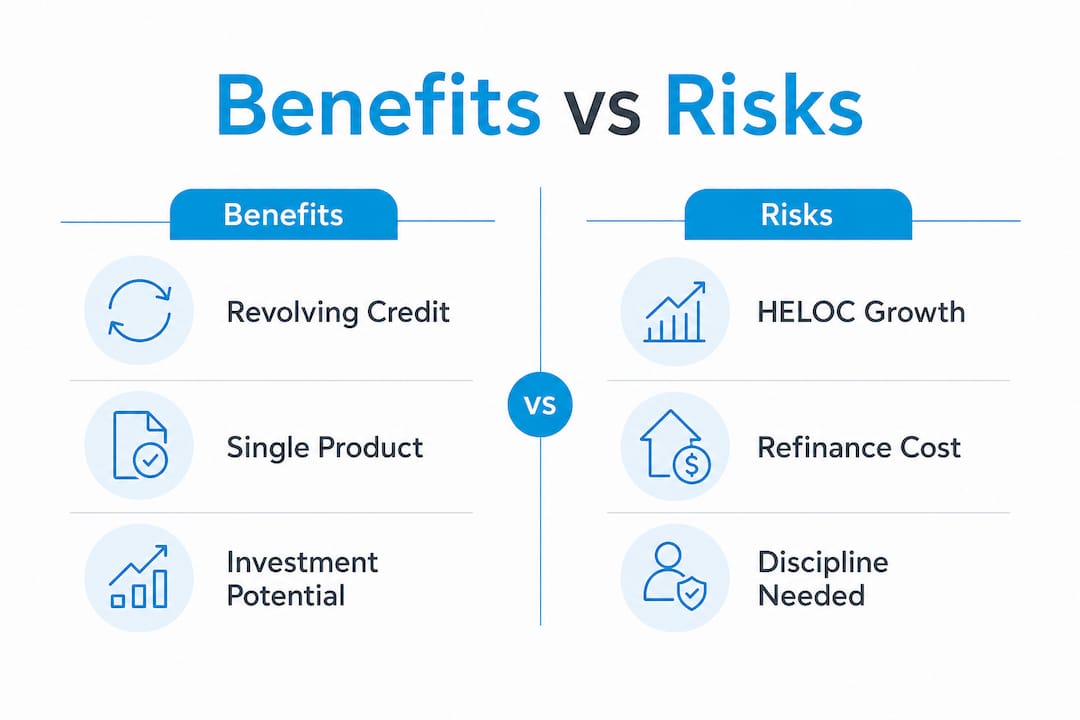
The benefits are real, but so are the risks. Here is a clear breakdown:
Benefits:
- Automatic credit growth as principal is repaid, with no new application required
- Single product covering both mortgage and equity access
- Supports tax-efficient strategies like the Smith Manoeuvre (more on this below)
- Useful for staged projects where you draw funds in phases rather than all at once
Risks:
- HELOC interest rates are variable, tied to prime, and can rise unpredictably, increasing your borrowing costs
- Easy credit access can lead to financial drift if you borrow without a clear plan
- Collateral charge registration creates switching costs at renewal
- The product rewards discipline and punishes impulsive borrowing
Pro Tip: Treat the HELOC portion like a business line of credit, not a spending account. Set a clear purpose for every draw before you make it.
The switching cost issue deserves attention. Switching lenders with a collateral charge requires a full refinance and legal fees ranging from $1,000 to $3,000. A standard mortgage transfer to a new lender at renewal is far simpler and cheaper. This means your current lender holds more negotiating power at renewal time, which can affect the rate you receive.
How does a readvanceable mortgage compare to a standalone HELOC or traditional mortgage?
These three products serve different borrowers. Understanding the distinctions helps you choose the right structure for your financial goals.
A traditional mortgage is a straightforward amortizing loan. You make fixed payments, your balance drops, and your equity grows. You cannot access that equity without refinancing or applying for a separate product. It suits homebuyers who want simplicity and have no near-term plans to borrow against their home.
A standalone HELOC gives you a fixed credit limit based on your existing equity, but the limit does not grow as you repay your mortgage. You apply once, receive a set limit, and draw from it as needed. It is flexible but static in terms of credit growth.
A readvanceable mortgage combines both. The credit limit grows automatically, and you manage one product instead of two. The trade-off is the collateral charge registration and the complexity that comes with it.
| Feature | Traditional mortgage | Standalone HELOC | Readvanceable mortgage |
|---|---|---|---|
| Credit grows with repayment | No | No | Yes |
| Requires new application for equity access | Yes | No | No |
| Registration type | Standard charge | Standard charge | Collateral charge |
| Lender switching cost | Low | Low | High ($1,000–$3,000) |
| Suits investment strategies | No | Partially | Yes |
| Rate type | Fixed or variable | Variable | Both (split) |
Pro Tip: If you plan to switch lenders at renewal for a better rate, a standard charge mortgage or standalone HELOC gives you more flexibility. A readvanceable product makes more sense when you plan to stay with one lender and actively use the equity.
How to use a readvanceable mortgage for investment and wealth strategies
The Smith Manoeuvre is the most well-known strategy built around a readvanceable mortgage. It converts non-deductible mortgage debt into tax-deductible investment debt over time. Here is how it works in practice:
- Make your regular mortgage payment. The principal portion reduces your mortgage balance and increases your HELOC limit by a corresponding amount.
- Borrow from the HELOC. Draw the newly available credit and invest it in income-producing assets such as Canadian dividend stocks or equity funds.
- Claim the interest deduction. HELOC interest is tax-deductible in Canada only when the borrowed funds are used to earn investment income. CRA requires proper documentation and tracking for this deduction to hold up.
- Use the tax refund. Apply your annual tax refund as a lump-sum prepayment on your mortgage principal, which accelerates the cycle.
- Repeat each year. Over time, your mortgage shrinks faster and your investment portfolio grows using borrowed, tax-deductible funds.
For a detailed breakdown of how this works in an Alberta context, the Smith Manoeuvre guide from Deneenoel covers the mechanics and CRA requirements clearly.
HELOC rates for this strategy typically run at Prime plus 0.50%, which placed borrowing costs near 4.95% in 2026 with a Prime rate around 4.45%. That rate is variable, so your cost of borrowing can shift with Bank of Canada decisions.
Pro Tip: Keep a separate bank account for all Smith Manoeuvre transactions. CRA audits on interest deductibility look for clean, traceable records. Mixing personal and investment draws from the same HELOC account creates problems.
Not all lender systems support clean transaction tracking equally well. Some platforms make it difficult to separate investment draws from personal draws, which creates audit risk. Choosing the right lender platform matters as much as choosing the right rate.
What should you consider when choosing a readvanceable mortgage in Canada?
Selecting this product requires more than comparing interest rates. The lender's platform, their implementation of OSFI's B-20 rules, and the collateral charge implications all affect your long-term experience.
Key considerations before you commit:
- Lender platform quality. Banks implement OSFI's Guideline B-20 differently. Some systems automate the re-advance cleanly; others require manual steps that slow down your access to credit. For the Smith Manoeuvre, a clean system is not optional.
- Re-advance ratio. Confirm whether your lender advances credit at the full ratio or applies a lower rate. The difference between $0.75 and $0.80 per dollar repaid adds up over a 25-year amortisation.
- Collateral charge costs. Budget for $1,000 to $3,000 in legal and discharge fees if you ever want to switch lenders. Factor this into your renewal strategy from day one.
- Rate negotiation at renewal. Because switching is costly, your lender knows you are less likely to leave. Negotiate your renewal rate proactively, ideally with a broker who has access to competing offers.
- Your financial discipline. The HELOC portion is always available. Homebuyers who borrow without a plan tend to accumulate HELOC debt that offsets their mortgage repayment progress entirely.
Pro Tip: Review your HELOC balance every six months alongside your mortgage balance. If the HELOC is growing while the mortgage shrinks slowly, your net debt position may not be improving as much as you think.
For Alberta homebuyers working through the mortgage approval process, understanding how a readvanceable product affects your qualification ratios is worth discussing with a broker before you apply.
Key takeaways
A readvanceable mortgage is best suited for disciplined borrowers with a clear plan for their growing equity, not for homebuyers who simply want more credit available.
| Point | Details |
|---|---|
| Core structure | Combines a mortgage and HELOC under one collateral charge with automatic credit growth. |
| Regulatory caps | HELOC is capped at 65% LTV; combined borrowing cannot exceed 80% LTV under OSFI B-20. |
| Re-advance ratio | Expect $0.75–$0.80 of new HELOC credit per $1.00 of principal repaid, not a full dollar. |
| Switching costs | Collateral charge registration means lender switches cost $1,000–$3,000 in legal fees. |
| Best use case | Tax-efficient investment strategies like the Smith Manoeuvre reward the product's structure most. |
Why I think most homebuyers misread this product
Most clients I speak with in Alberta assume a readvanceable mortgage is simply a better version of a regular mortgage. It is not. It is a different tool entirely, and it performs well only in specific hands.
The homebuyers who get the most from this product are the ones who come in with a plan. They know they want to use the Smith Manoeuvre, or they have a renovation phased over several years, or they are building a rental portfolio and need staged equity access. The product fits their goals precisely.
The homebuyers who struggle are the ones who chose it because it sounded flexible. Flexible credit without a purpose becomes debt. I have seen clients whose HELOC balance grew steadily while their mortgage barely moved, leaving their net equity position almost unchanged after years of payments.
The lender selection piece is also underestimated. Not every platform handles re-advances cleanly, and for anyone using this product for investment purposes, a clunky system creates real CRA risk. I always ask clients to think about the platform before the rate.
Readvanceable mortgages are tools best suited for borrowers with disciplined plans. They are not automatically better than a traditional mortgage or a standalone HELOC. The right product depends entirely on what you plan to do with your equity and how you manage credit under pressure.
— Denee
Flexible mortgage options with Deneenoel in Alberta
Choosing the right mortgage structure is one of the most consequential financial decisions you will make as an Alberta homebuyer. A readvanceable product can work exceptionally well when it matches your goals, your discipline, and the right lender platform.

Deneenoel works with over fifty Canadian lenders and provides independent advice tailored to your specific situation. Whether you are in Edmonton, Calgary, or anywhere across Alberta, Denée can clarify which product structure fits your plans, explain the lender differences that matter, and help you avoid the switching-cost traps that catch many homebuyers off guard. Reach out to an Edmonton mortgage broker or a Calgary mortgage broker from Deneenoel to get personalised guidance on flexible home financing.
FAQ
What is a readvanceable mortgage in Canada?
A readvanceable mortgage combines an amortizing mortgage and a HELOC under one collateral charge, automatically increasing your available credit as you repay your mortgage principal. The HELOC is capped at 65% of your home's appraised value under OSFI's Guideline B-20.
How is a readvanceable mortgage different from a standalone HELOC?
A standalone HELOC has a fixed credit limit that does not grow as you repay your mortgage. A readvanceable mortgage automatically increases your HELOC limit with each principal payment, without requiring a new application.
Is HELOC interest tax-deductible in Canada?
HELOC interest is tax-deductible only when the borrowed funds are used to earn investment income. CRA requires clear documentation and transaction tracking to support the deduction.
What are the costs of switching lenders with a readvanceable mortgage?
Because these mortgages are registered as collateral charges, switching lenders requires a full refinance and legal fees typically ranging from $1,000 to $3,000, which is significantly more than a standard mortgage transfer.
What is the Smith Manoeuvre and how does it use a readvanceable mortgage?
The Smith Manoeuvre is a Canadian tax strategy that uses a readvanceable mortgage to convert non-deductible mortgage interest into tax-deductible investment borrowing. Each principal payment frees up HELOC credit, which is then invested in income-producing assets, with the interest claimed as a tax deduction.