
Mortgage approval in Alberta is a conditional lender commitment based on verified financial data, confirming how much you can borrow and at what rate. It is the foundation of any serious home purchase. Without it, you are shopping blind in markets like Calgary and Edmonton, where pre-approval letters signal genuine buying power and help sellers take your offer seriously. Understanding the Alberta mortgage process, from pre-qualification through to final approval, gives you a clear path forward and removes the guesswork before you ever set foot in an open house.
What are the key stages of mortgage approval in Alberta?
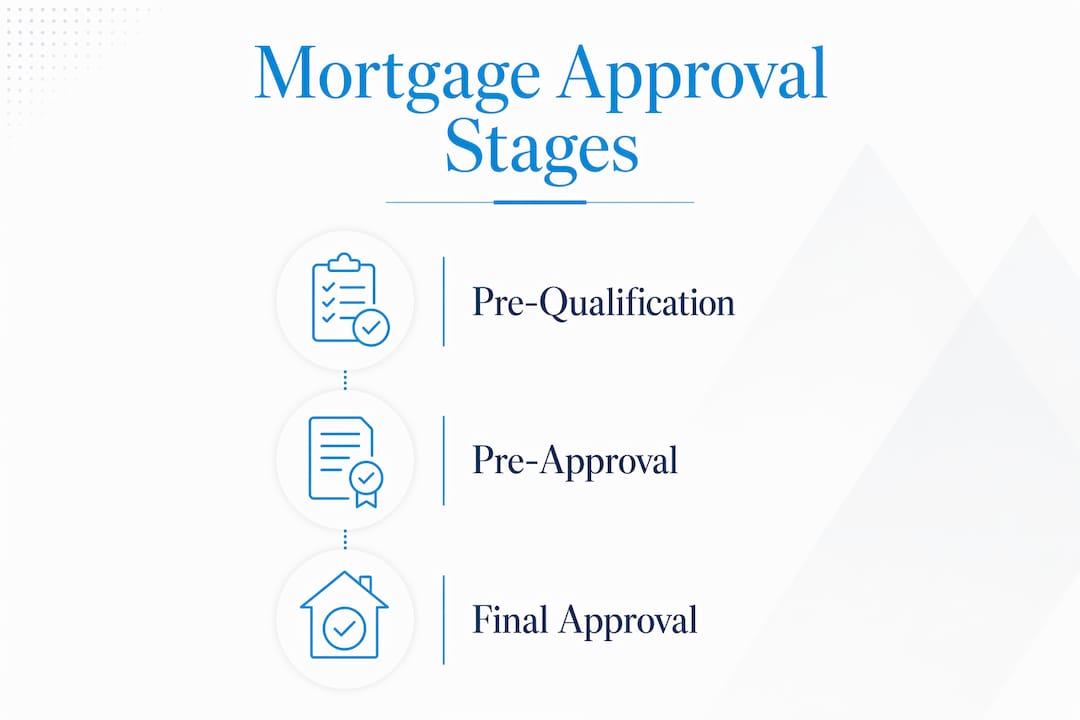
The Alberta mortgage process moves through three distinct stages, and confusing them costs buyers time and money.
Pre-qualification is a fast, informal estimate. You share your income, debts, and assets verbally or through a short online form. The lender runs a soft credit check and gives you a rough borrowing range. No documents change hands. The number is useful for budgeting but carries no weight with sellers.

Pre-approval is a different process entirely. Pre-approval involves document review and a hard credit inquiry, producing a conditional written commitment from the lender. It takes roughly 30–60 minutes of document review and gives you a rate hold for a set period. That rate hold protects you if rates rise while you search.
Final approval comes after you have an accepted offer on a specific property. The lender orders an appraisal and re-verifies your financial situation. A pre-approval is not a final guarantee. If your income drops, you take on new debt, or the property appraises below the purchase price, the lender can revise or withdraw the commitment.
| Stage | Verification level | Output |
|---|---|---|
| Pre-qualification | Soft credit check, self-reported data | Rough borrowing estimate |
| Pre-approval | Hard credit pull, full document review | Conditional written commitment with rate hold |
| Final approval | Property appraisal, re-verification of finances | Formal mortgage commitment |
Pro Tip: Get pre-approved before you start viewing homes, not after you fall in love with one. Sellers in Calgary and Edmonton move fast, and an offer without pre-approval rarely wins in a multiple-offer situation.
What documents and financial criteria are required?
Lenders in Alberta need proof that you can repay the loan. The document list is predictable, but gaps in it are the most common cause of delays.
Standard documents for salaried borrowers
A complete document checklist for salaried Alberta borrowers typically includes:
- Government-issued photo ID (two pieces)
- Recent pay stubs (last 30 days)
- T4 slips and Notice of Assessment for the past two years
- Employment confirmation letter stating salary and tenure
- 90 days of bank statements showing your down payment
- Mortgage statements or property tax documents if you own property
Self-employed and commissioned borrowers face a higher bar. Lenders require two years of T1 Generals, business financial statements, and proof of business registration. Commissioned workers must show a two-year average of variable income.
Credit score thresholds
Credit scores of 680 or above qualify borrowers for the best rates with major banks and credit unions. Scores between 600 and 679 narrow your lender options and typically raise your rate. Below 600, you are looking at alternative lenders, which charge higher rates, or you need a co-borrower with stronger credit.
Debt service ratios and the stress test
Two ratios govern how much you can borrow. The Gross Debt Service (GDS) ratio measures housing costs against gross income and must stay at or below 39%. The Total Debt Service (TDS) ratio adds all debt payments and must stay at or below 44%. The mortgage stress test requires you to qualify at the higher of your contract rate plus 2%, or 5.25%. That rule reduces your maximum borrowing capacity, sometimes significantly.
Pro Tip: Pay down revolving credit card balances before applying. A lower credit utilisation ratio improves your score and reduces your TDS, both of which directly affect the rate and amount a lender will offer.
The 90-day seasoning rule
Down payment funds must sit in your account for a minimum of 90 days before application. This is an anti-money laundering requirement. Lenders exclude large recent deposits that lack a clear paper trail. If a family member is gifting part of your down payment, you need a signed gift letter and proof the funds have been transferred and settled.
How long does mortgage approval take in Alberta?
Realistic timelines depend heavily on how clean and complete your file is.
- Standard salaried file: Lenders typically issue pre-approval within 1–3 business days for borrowers with straightforward employment, strong credit, and a complete document package.
- Complex file: Self-employed borrowers, those with bruised credit, or applicants with multiple income sources can expect up to 7 business days. Lenders need more time to verify irregular income and assess risk.
- Document gaps: Missing or incorrect documents are the most common cause of delays. A single missing T4 or unsigned employment letter can add days to the process.
- Rate hold period: Once approved, your pre-approval is valid for 90–120 days with a rate hold. If you do not find a property within that window, you reapply. Timing your pre-approval to align with your active home search prevents unnecessary reapplications.
- Final approval: After an accepted offer, final approval typically takes 5–10 business days, depending on appraisal scheduling and lender workload.
The single most effective way to speed up the process is to submit a complete, accurate document package on day one. Every back-and-forth request for a missing document adds time.
What causes mortgage denial in Alberta and how do you avoid it?
Denial is almost always preventable. The causes are consistent, and each one has a clear fix.
Credit issues are the leading cause. A low score, missed payments in the past two years, or a recent collection account all raise red flags. Pull your credit report through Equifax or TransUnion before applying. Dispute any errors. Pay down balances to below 30% of your credit limit.
Down payment problems trip up many first-time buyers. Large cash deposits without a paper trail fail the 90-day seasoning rule. Borrowed down payments, such as funds from a personal line of credit, are treated as debt and raise your TDS ratio.
Undisclosed debts cause serious problems. Lenders pull your credit report and see every liability. If you have a car loan, student debt, or a co-signed loan you did not mention, the lender recalculates your TDS and may decline the file.
Unstable employment is a red flag, particularly for borrowers who recently changed jobs or moved from salaried to contract work. Lenders want to see at least two years in the same field. A probationary period at a new employer can complicate approval, even with strong income.
Property issues can also trigger denial at the final stage. Condominiums with high special assessments, rural properties, or homes with structural deficiencies may not meet lender appraisal standards. This is why mortgage brokers familiar with Alberta's lender network matter. They know which lenders are comfortable with which property types.
Key takeaways
Mortgage approval in Alberta requires verified financial documentation, a credit score of at least 680 for the best rates, and a down payment seasoned for 90 days, with final approval always contingent on a satisfactory property appraisal.
| Point | Details |
|---|---|
| Pre-approval beats pre-qualification | Only pre-approval provides a conditional written commitment and a rate hold. |
| 90-day seasoning rule | Down payment funds must sit in your account for at least 90 days before application. |
| Stress test reduces borrowing capacity | You must qualify at your contract rate plus 2%, or 5.25%, whichever is higher. |
| Complete documents speed approval | Missing paperwork is the most common cause of delays; submit a full package upfront. |
| Credit score shapes your options | A score of 680 or above opens access to the best rates with major lenders. |
What I have learned about mortgage approval after years in Alberta
One thing I tell every client is this: the mortgage approval process rewards preparation, not speed. I have seen buyers rush into applications with incomplete documents and spend weeks in back-and-forth with lenders. The buyers who get approved fastest are the ones who spend two hours gathering everything before they submit anything.
The stress test surprises people every time. Qualifying at a rate significantly above your actual contract rate feels unfair, but it protects you from overextending. I have watched clients who were initially frustrated by their reduced borrowing limit actually feel relieved six months into homeownership when their payments were genuinely comfortable.
Rate shopping is another area where buyers leave money on the table. Most do not realise that multiple credit inquiries within a 14–30 day window count as a single hard pull. You can approach several lenders or work with a broker who accesses multiple lenders at once, without any damage to your credit score. That knowledge alone can save you thousands over the life of your mortgage.
My strongest advice for first-time buyers in Alberta is to review your credit report at least three months before you plan to apply. That gives you time to correct errors, pay down balances, and address any surprises before a lender sees them. Waiting until you find a property you love is too late.
— Denee
How Deneenoel can help with your Alberta home loan approval
Getting mortgage approval right the first time saves you time, stress, and money. Deneenoel works with homebuyers across Alberta, with dedicated services for both Calgary homebuyers and Edmonton homebuyers, providing personalised guidance through every stage of the approval process.

With access to over fifty Canadian lenders, Deneenoel compares rates and products across the market to find the right fit for your financial situation. Whether you are a first-time buyer building your document package, a self-employed borrower navigating complex income verification, or a repeat buyer looking to secure the best available rate, Deneenoel provides clear, independent advice at every step. Reach out to start your pre-approval and move forward with confidence.
FAQ
What credit score do I need for mortgage approval in Alberta?
A credit score of 680 or above qualifies you for the best rates with major lenders. Scores between 600 and 679 limit your options and typically result in higher rates.
How long is a mortgage pre-approval valid in Alberta?
Pre-approval is valid for 90–120 days and includes a rate hold. After that period, you need to reapply, and your rate may change.
What is the mortgage stress test and how does it affect me?
The stress test requires you to qualify at the higher of your contract rate plus 2%, or 5.25%. This reduces the maximum amount you can borrow.
Can I shop multiple lenders without hurting my credit score?
Yes. Multiple mortgage credit inquiries within a 14–30 day window count as a single hard pull, so rate shopping does not damage your credit score.
What is the difference between pre-qualification and pre-approval in Alberta?
Pre-qualification is a quick, unverified estimate based on self-reported data. Pre-approval involves full document review and a hard credit inquiry, producing a conditional written commitment from the lender.