
The Smith Manoeuvre mortgage strategy is defined as a legal Canadian financial method that converts non-deductible mortgage interest into tax-deductible investment loan interest under the Canadian Income Tax Act, paragraph 20(1)(c). Developed by financial planner Fraser Smith, the strategy uses a readvanceable mortgage paired with a home equity line of credit (HELOC) to borrow and invest in income-producing assets. At a 5% HELOC interest rate and a 43.41% marginal tax bracket, the effective after-tax borrowing cost can be as low as 2.83%. That figure shows how much the tax refund subsidises your borrowing cost, making the strategy particularly attractive for high-income Alberta homeowners.
How does the Smith Manoeuvre mortgage strategy work?
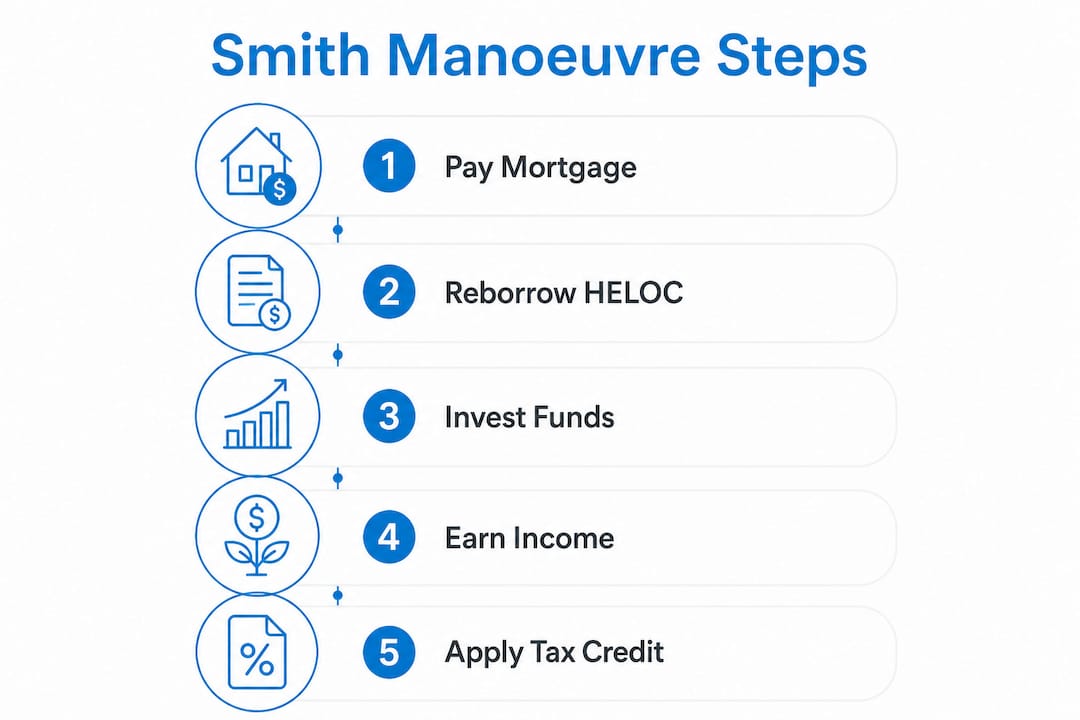
The Smith Manoeuvre works in a repeating cycle tied directly to your regular mortgage payments. Each payment reduces your non-deductible mortgage principal while simultaneously freeing up credit on the HELOC portion of your readvanceable mortgage. You then reborrow that freed credit and invest it in qualifying income-producing assets. The interest you pay on the HELOC portion becomes tax-deductible because the borrowed funds serve a clear income-earning purpose.

The cycle compounds over time. As your mortgage principal falls, your available HELOC credit grows. You invest more, generate more deductible interest, and receive larger annual tax refunds. Reinvesting those refunds back into your mortgage or investment account accelerates the entire process.
Here is how the mechanics work step by step:
- Make your regular mortgage payment. Your payment reduces the mortgage principal by, say, $500 this month.
- Reborrow the freed equity. Draw $500 from the HELOC portion of your readvanceable mortgage.
- Invest in qualifying assets. Purchase Canadian dividend stocks, REITs, bonds, or income-focused ETFs with the $500.
- Claim the interest deduction. At tax time, deduct the HELOC interest on Line 22100 of your T1 return.
- Reinvest the tax refund. Apply the refund to your mortgage principal or purchase additional investments.
Pro Tip: Keep the HELOC sub-account used for investments completely separate from any personal spending. Mixing personal and investment use in one account breaks the CRA's direct tracing requirement and can cost you the entire deduction.
The accelerated Smith Manoeuvre can reduce a 25-year mortgage by 6–8 years when executed correctly. That acceleration comes from consistently reinvesting tax refunds and dividends rather than spending them.
What are the eligibility criteria and investment requirements?
The Smith Manoeuvre is not available to every homeowner. Meeting the following criteria is the starting point before you consider any investment decisions.
Eligibility requirements:
- Minimum 20% home equity. Lenders require sufficient equity to approve a readvanceable mortgage with a HELOC component.
- Stable, verifiable income. You need consistent income to service both the mortgage and HELOC interest payments without strain.
- Long investment horizon. The strategy works best over 10 or more years. Short timelines reduce the compounding benefit significantly.
- Qualifying investment accounts. You need a dedicated non-registered investment account funded exclusively by HELOC advances.
Investment requirements under the CRA:
The CRA's Income Tax Act paragraph 20(1)(c) requires a clear income-earning purpose for borrowed funds. Only investments with a reasonable expectation of generating income qualify. Typical qualifying assets include Canadian dividend stocks and ETFs, bonds, REITs, and income-focused mutual funds.
- Registered accounts like RRSPs and TFSAs do not qualify. CRA policy disallows interest deductions on loans used to fund registered accounts.
- Capital gains-only investments generally disqualify interest deductibility. The investment must produce income, not just appreciation.
- Selling investments without immediately reinvesting the proceeds breaks the deductibility chain. You must maintain a continuous link between the HELOC borrowing and the income-producing asset.
Pro Tip: Dividend-paying Canadian ETFs are a practical starting point for most homeowners. They provide income for CRA compliance, broad diversification, and lower volatility than individual stocks over a 10-plus year horizon.
What are the risks and compliance considerations?
The Smith Manoeuvre carries real financial and administrative risks. Understanding them before you start protects both your finances and your tax position.
Key risks to assess:
- Leverage risk. You are investing borrowed money. If your portfolio drops 30%, your HELOC debt does not drop with it. You still owe the full amount.
- Interest rate risk. HELOC rates are variable. Rising rates increase your monthly interest cost and reduce the net benefit of the strategy.
- CRA audit risk. The CRA enforces a strict purpose test. Borrowed funds must be used exclusively for income-earning investments, with clear records linking each advance to a purchase.
- Record-keeping burden. Every HELOC advance and investment purchase must be tracked. Selling without reinvesting breaks the deductibility nexus.
- Psychological commitment. Investors consistently underestimate the long-term tracking and psychological commitment required for a 20-to-25-year strategy.
"Administrative compliance is often the biggest hurdle rather than investment performance. Strict audit-proof records via dedicated accounts are vital to the strategy's long-term success. Without meticulous documentation, even a well-executed investment plan can fail a CRA review."
The CRA requires direct tracing of HELOC funds to income-producing investments, with records linking each borrow to a specific purchase. This is reported on Line 22100 of your T1 return. Mixing personal and investment use in a single account is the most common compliance mistake, and it can invalidate your deductions retroactively.
How can homeowners practically implement the strategy?
Setting up the Smith Manoeuvre correctly from the start saves significant trouble later. The structure of your accounts and mortgage product determines whether you can maintain CRA compliance over the long term.
-
Secure a readvanceable mortgage. Not all mortgage products qualify. You need a product that automatically increases your HELOC credit as you pay down the mortgage principal. Work with a mortgage broker who understands these products. Deneenoel has access to over fifty Canadian lenders and can identify qualifying products suited to your financial situation.
-
Set up dedicated sub-accounts. Open a HELOC sub-account used only for investment advances. Open a separate non-registered investment account funded only from that HELOC sub-account. Never use either account for personal expenses.
-
Invest consistently and immediately. Each time you draw from the HELOC, invest the funds right away. Holding cash in the HELOC sub-account without investing breaks the income-earning purpose test.
-
Reinvest tax refunds and dividends. Apply your annual tax refund to your mortgage principal or purchase additional investments. Reinvesting dividends compounds the strategy's effect over time.
-
Review annually with professionals. Tax rules, interest rates, and your personal financial situation change. An annual review with a mortgage broker and a tax professional keeps the strategy on track.
The table below summarises the key account structure for a compliant setup:
| Account type | Purpose | Key rule |
|---|---|---|
| Readvanceable mortgage | Primary mortgage with auto-increasing HELOC | Must reduce principal with each payment |
| HELOC sub-account | Funds investment purchases only | No personal transactions permitted |
| Non-registered investment account | Holds income-producing assets | Funded exclusively by HELOC advances |
| Tax refund account | Receives CRA refunds | Refunds applied to mortgage or reinvested |
For Alberta homeowners considering a readvanceable mortgage, the approval process involves standard income verification, a property appraisal, and confirmation of at least 20% equity.
What are the nuanced tax rules and advanced considerations?
The legal foundation for the Smith Manoeuvre is solid, but the boundaries matter. The Supreme Court of Canada's decision in Lipson v. Canada (2009) confirmed lawful use of the strategy when properly implemented without abusive tax avoidance tactics. That decision is the key precedent every tax professional references when advising on this strategy.
Key tax rules to understand:
- The purpose test is absolute. The CRA does not care how sophisticated your investment plan is. If the borrowed funds do not serve a clear income-earning purpose at the time of borrowing, the interest is not deductible.
- Accelerated and synthetic variations carry higher risk. Some advisors promote structures that use lump-sum borrowing or leverage additional debt instruments to speed up the process. Tax professionals caution that complex accelerated or synthetic structures risk CRA challenges or tax avoidance allegations.
- Higher interest rates increase the tax benefit for high earners. Higher 2026 rates subsidise borrowing costs via larger tax refunds for taxpayers in high marginal brackets. This makes the current rate environment more favourable for the strategy than many homeowners realise.
- The Smith Manoeuvre does not replace registered savings. Maximising your RRSP and TFSA contributions first is generally the right order of operations. The Smith Manoeuvre works best as a complement to registered savings, not a replacement.
Pro Tip: Get a written opinion from a qualified tax professional before starting any accelerated or synthetic variation. The standard Smith Manoeuvre is well-established. Modified versions require independent legal and tax review.
Key takeaways
The Smith Manoeuvre converts non-deductible mortgage interest into deductible investment loan interest, but it requires strict CRA compliance, qualifying investments, and a long-term commitment to deliver its full tax and wealth-building benefits.
| Point | Details |
|---|---|
| Core mechanism | Reborrow freed HELOC credit each month and invest in income-producing assets to create deductible interest. |
| Eligibility baseline | You need at least 20% home equity, stable income, and a 10-plus year investment horizon. |
| Qualifying investments | Use dividend stocks, REITs, bonds, or income ETFs. Registered accounts and capital-gains-only assets do not qualify. |
| Compliance is non-negotiable | Keep dedicated sub-accounts, trace every HELOC advance, and never mix personal and investment transactions. |
| Professional guidance matters | Work with a mortgage broker and tax professional annually to maintain compliance and adjust the strategy. |
My honest view on the Smith Manoeuvre after years of working with Alberta homeowners
I have seen the Smith Manoeuvre work beautifully for disciplined, patient homeowners. I have also seen it create real stress for people who underestimated the administrative commitment. The strategy is not a passive wealth builder. It demands consistent action every month, meticulous records every year, and the emotional resilience to hold investments through market downturns while still carrying HELOC debt.
The homeowners I have worked with who benefit most share a few traits. They have stable, high incomes that put them in a meaningful marginal tax bracket. They are genuinely comfortable with investment risk over a long horizon. They treat the record-keeping as a non-negotiable part of the plan, not an afterthought.
What I tell every client considering this path: the tax refund is real, the compounding is real, and the mortgage acceleration is real. But none of it materialises without the right mortgage product, the right account structure, and the right professional team around you. The strategy complements your RRSP and TFSA. It does not replace them.
If you are an Alberta homeowner with solid equity and a long runway, the Smith Manoeuvre deserves serious consideration. If you are looking for a quick fix or a way to avoid financial discipline, this is not the right tool. Start with a conversation with a mortgage broker and a tax professional before you commit to anything.
— Denee
Working with Deneenoel to set up your Smith Manoeuvre
Implementing the Smith Manoeuvre starts with the right mortgage product. Not every lender offers a readvanceable mortgage, and not every broker understands the specific account structure the CRA requires.

Deneenoel works with over fifty Canadian lenders across Alberta to find readvanceable mortgage products suited to your equity position and income profile. Whether you are in Edmonton, Calgary, or the surrounding areas, Deneenoel offers a personalised assessment to determine whether you qualify and which product structure fits your situation. Connect with an Edmonton mortgage broker or a Calgary mortgage broker at Deneenoel to get a clear, no-obligation picture of your options before you take the first step.
FAQ
What is the Smith Manoeuvre mortgage strategy?
The Smith Manoeuvre is a legal Canadian strategy that converts non-deductible mortgage interest into tax-deductible investment loan interest using a readvanceable mortgage and HELOC. Borrowed funds must be invested in income-producing assets to qualify under Income Tax Act paragraph 20(1)(c).
Does the Smith Manoeuvre work in Alberta?
Yes. Alberta homeowners qualify under the same federal CRA rules as all Canadian residents. The strategy works in any province, and Alberta's higher average incomes often place homeowners in marginal tax brackets where the tax refund benefit is most significant.
What investments qualify for the Smith Manoeuvre?
Qualifying investments include Canadian dividend stocks, ETFs, bonds, REITs, and income-focused mutual funds. Registered accounts like RRSPs and TFSAs do not qualify, and capital-gains-only investments generally fail the CRA's income-earning purpose test.
How long does the Smith Manoeuvre take to show results?
The strategy is designed for a 10-to-25-year horizon. The accelerated version, which reinvests tax refunds and dividends consistently, can reduce a 25-year mortgage by 6–8 years when executed correctly.
Is the Smith Manoeuvre legal and CRA-approved?
The standard Smith Manoeuvre is legal and accepted by the CRA when strictly compliant with the purpose test and record-keeping requirements. The Supreme Court's Lipson v. Canada (2009) decision confirmed its lawful use. Complex accelerated or synthetic variations require independent professional review before implementation.