
What is an employment letter for a mortgage?
An employment letter for a mortgage is an official document your employer issues to confirm your job title, salary, and employment status. Canadian lenders treat it as one of the most critical pieces of your mortgage application documents, because your credit score tells them whether you've repaid debt in the past, but this letter tells them whether you can repay it now.
Lenders use the letter to assess income consistency and job security before approving your file. Under OSFI's residential mortgage underwriting guidelines, bank statements alone are not sufficient proof of income. A formal, employer-issued letter on official letterhead fills that gap.
The letter must typically include:
- Your job title and a brief description of your duties
- Your start date and length of service
- Your employment type (permanent full-time, part-time, seasonal, or contract)
- Your gross annual salary or guaranteed hourly wage and minimum weekly hours
- Your probation status, since completion of probation increases lender confidence
- Employer contact information and an authorized signature
Table of Contents
- What information must your employment letter include?
- How do you get an employment letter from your employer?
- How do you make sure your letter meets lender requirements?
- What if you are self-employed?
- Sample employment letter for a mortgage application
- What should you do if your letter is rejected?
- Top mortgage brokers in Alberta for employment letter assistance
- Do employment letter requirements differ between Canadian lenders?
- The bottom line on employment letters for mortgages
- Common mistakes to avoid when submitting your employment letter
- Deneenoel: personalized mortgage guidance for Alberta applicants
- Key takeaways
What information must your employment letter include?
Every Canadian lender has a checklist, and missing even one item can stall your approval. The letter must appear on official company letterhead showing the business's legal name, address, and phone number. It must state your exact start date, your current role, and your compensation in precise terms. If you earn commissions or bonuses, the letter should note a guaranteed annual average for those earnings.
Employment type matters more than most applicants expect. A letter that says "employed" without specifying permanent or contract status leaves underwriters guessing, and they tend to guess conservatively. Your letter should state explicitly: "permanent full-time employee" or the applicable equivalent.

Pro Tip: Request a freshly dated letter every time you apply. Many lenders automatically reject letters older than 60 days, and the safest practice is to keep your letter within 30 days of your application submission date.
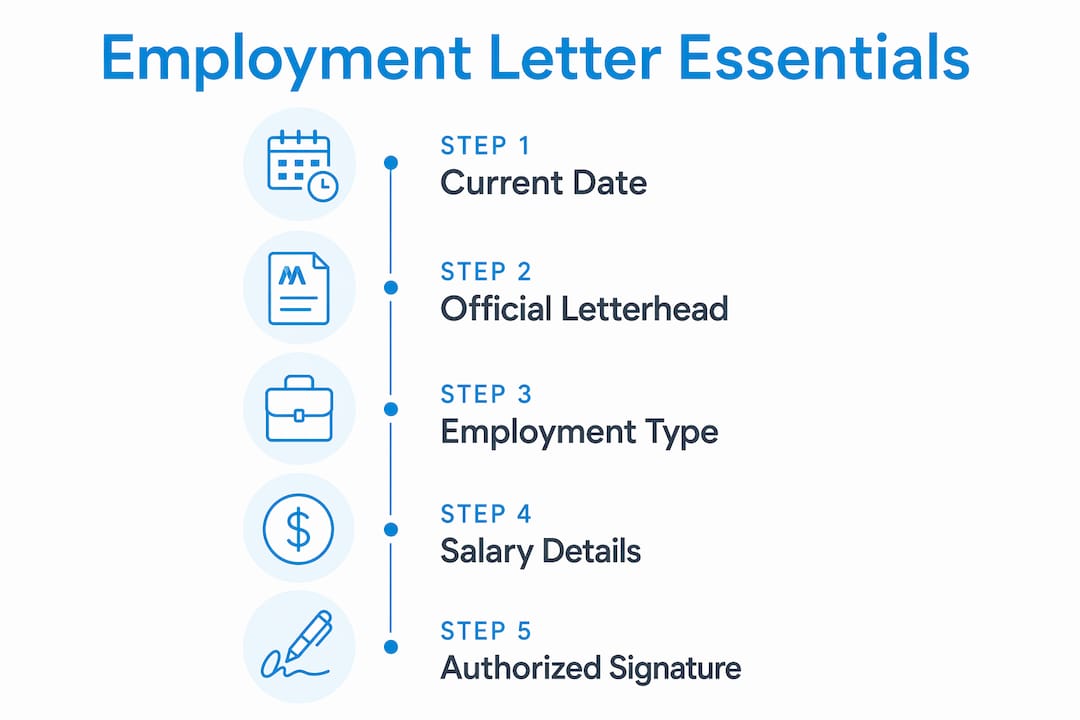
The authorized signature is non-negotiable. An HR manager, a director, or a direct supervisor must sign by hand. A typed name at the bottom of an email printout does not satisfy most lenders.

How do you get an employment letter from your employer?
Getting the letter is usually straightforward, but the way you ask shapes how quickly you receive something usable.
- Contact HR or your direct manager. HR departments at larger companies handle these requests routinely. At smaller businesses, go directly to your manager or owner.
- Explain the purpose clearly. Tell them it is for a mortgage application and that the lender requires specific details. Vague requests produce vague letters.
- Provide a checklist. Share the list of required elements from your lender or mortgage broker so your employer knows exactly what to include. You can use the sample template in the section below as a guide.
- Set a clear deadline. Give your employer at least three to five business days, but ask for the letter to be dated as close to your application date as possible.
- Review the letter before submitting. Check every field: your name, job title, salary figure, start date, and the signature. A single typo can trigger a request for corrections and delay your closing.
- Follow up if needed. If you haven't received the letter within the agreed timeframe, a polite follow-up email is appropriate. Delays happen, and lenders will not wait indefinitely.
Keep in mind that lenders often call your employer directly, sometimes within 24–48 hours before closing, to verbally confirm your employment details. Let your HR contact or manager know this call may come so they are prepared to respond promptly.
How do you make sure your letter meets lender requirements?
Submitting the letter is only half the job. Verifying it before it reaches the lender saves you from avoidable delays.
- Confirm the letter is printed on official company letterhead, not a blank page with a typed header
- Check that the date on the letter is within 30 days of your planned submission date
- Verify your salary figure matches what you stated on your mortgage application exactly
- Confirm your employment type is written out in full, not abbreviated
- Check that the signatory's name, title, and contact information are included beneath the signature
Pro Tip: Ask your mortgage broker to review the letter before you submit it to the lender. Brokers know each lender's specific requirements and can flag issues before they cause a rejection.*
Probation status deserves special attention. If you started a new job recently and are still within a probationary period, most prime lenders will pause or decline your application. The exception is when you remain in the same industry with a comparable or higher salary and no gap in employment. In that case, some lenders may waive the restriction, provided your letter explicitly states the terms of your new role.
What if you are self-employed?
Self-employed applicants cannot provide a standard employment letter, and lenders know it. Instead, you need to demonstrate income stability through a different set of documents. CMHC's Self-Employed mortgage programme accepts alternative documentation and recommends at least 24 months of business operation or experience in the same field.
Acceptable alternatives typically include:
- CRA Notices of Assessment for the past two to three years
- T1 General tax returns with a Statement of Business Activities (T2125)
- Business bank statements covering six to twelve months
- Articles of incorporation or a business licence
- Financial statements accompanied by a review engagement report signed by a practising accountant
- An accountant's letter confirming business income and stability
Variable income is the central challenge. Lenders look for a consistent two-year average, not a single strong year. A mortgage broker who works regularly with self-employed clients can help you organise your documentation in the format lenders prefer, which reduces back-and-forth with underwriters considerably.
Sample employment letter for a mortgage application
A well-structured letter covers every required field clearly. The table below shows what each section of the letter should contain.
| Letter section | Required content |
|---|---|
| Letterhead | Company legal name, logo, address, and phone number |
| Date | Current date, within 30 days of application |
| Recipient | Lender name or "To Whom It May Concern" |
| Subject line | "Employment Verification for [Employee Full Name]" |
| Employment start date | Exact date: Month, Day, Year |
| Job title | Specific role title and one-sentence duty description |
| Employment type | Permanent full-time / permanent part-time / contract |
| Probation status | Confirmation that probation is completed |
| Compensation | Gross annual salary or hourly wage with guaranteed minimum hours |
| Variable income | Annual average of commissions or bonuses, if applicable |
| Closing statement | Confirmation of continued stable employment |
| Signature | Hand-signed by HR manager, director, or supervisor with contact details |
A sample letter body reads as follows:
"This letter is to confirm that [Employee Full Name] has been employed with [Company Legal Name] since [Start Date]. Currently, [Employee Name] holds the position of [Job Title] on a permanent full-time basis and has successfully completed all probationary requirements. [Employee Name] is paid a gross annual salary of $[Amount]. We anticipate [Employee Name]'s continued employment with our firm to remain stable. Please contact [Signatory Name, Title, Phone, Email] with any questions."
What should you do if your letter is rejected?
Rejection is more common than most applicants expect, and it is almost always fixable.
- Identify the specific reason. Ask your lender or broker exactly what is missing or incorrect. "The letter was not accepted" is not enough information to act on.
- Request a corrected letter promptly. Contact your employer the same day and provide the lender's exact feedback. Most corrections take one to two business days.
- Supplement with additional documents. Recent pay stubs, bank statements showing regular salary deposits, and your most recent T4 slip can support or reinforce the letter while corrections are being made.
- Consult your mortgage broker. Brokers know which lenders are more flexible on documentation and can sometimes redirect your file to a lender whose requirements your current documents already meet.
- Communicate proactively with your lender. A brief email confirming that corrections are in progress keeps your file active and prevents it from being closed due to inactivity.
Top mortgage brokers in Alberta for employment letter assistance
Choosing the right broker makes a real difference when your employment situation is anything but straightforward. These eight Alberta brokers cover the range of needs most applicants face.
| Broker | Services offered | Specialisations | Recognition / certifications | Locations served | Rating |
|---|---|---|---|---|---|
| Mortgage Connection | Residential, construction, private, commercial mortgages | Residential and commercial buyers | Strong local reputation | Calgary, Edmonton | 5★ (over 1,000 reviews) |
| Canadian Mortgage Professionals | Purchase, refinance, pre-approval, HELOC, credit improvement | First-time buyers, new Canadians, credit improvement | Comprehensive mortgage steps programme | Alberta-wide | 4.9★ (472 reviews) |
| Collin Bruce Mortgage Team | Purchase, refinancing, renewal, spousal buyout, CHIP reverse mortgage, mortgage protection | First-time buyers, refinancing, new Canadians | Dominion Lending's #1 Mortgage Broker in Canada, 16 years running | Multiple provinces | 4.7★ (407 reviews) |
| First Foundation | Mortgage brokerage, financial planning, insurance | Wealth management, insurance brokerage | Certified Financial Planner (CFP) Alberta | Western Canada | 4.7★ (131 reviews) |
| The Mortgage Centre - Mortgage Worx Inc. | Pre-approval, refinance, renewal | Southern Alberta clients | Established since 1991 | Lethbridge, Southern Alberta | 4.9★ (109 reviews) |
| Indi Mortgage | Purchase, renewal, refinancing, reverse mortgages, credit improvement, new-to-Canada | First-time buyers, new Canadians, reverse mortgages | Tailored advice across Canada | Canada-wide | 5★ (59 reviews) |
| Kane Kardash Mortgages | Renovation mortgages, new construction, commercial, refinance, renewal | Renovation buyers, first-time buyers, commercial | Licensed Mortgage Broker, Alberta | Alberta | 5★ (53 reviews) |
| Deneenoel | Pre-approval, purchase, refinancing, renewal, investment financing, complex files | Self-employed, new Canadians, first-time buyers | Access to many Canadian lenders | Edmonton, Calgary, Alberta-wide | — |
A few of these brokers deserve a closer look based on what they actually do.
Collin Bruce Mortgage Team's 16 consecutive years as Dominion Lending's top Canadian broker reflects a depth of lender relationships that matters when your employment situation is unusual. For clients navigating spousal buyouts or mortgage protection alongside a purchase, that breadth of service is practical, not just impressive.
First Foundation stands apart from the others by pairing mortgage brokerage with Certified Financial Planner credentials. If your mortgage decision connects to broader wealth planning or insurance needs, that combination is genuinely useful rather than incidental.
The Mortgage Centre - Mortgage Worx Inc. has served Southern Alberta since 1991, which means deep familiarity with regional lenders and their documentation preferences. For clients in Lethbridge and surrounding communities, that local knowledge can shorten the approval timeline.
Deneenoel works with over fifty Canadian lenders and specialises in complex files, including self-employed applicants and new Canadians who often face the steepest documentation hurdles. For Albertans in Edmonton or Calgary whose employment situation does not fit a standard template, that lender access and personalised approach is where Deneenoel earns its place on this list.
Do employment letter requirements differ between Canadian lenders?
Yes, and the differences are meaningful. Major Schedule I banks such as RBC, TD, and BMO tend to follow OSFI guidelines closely, requiring letters within 30 days, on official letterhead, with explicit probation confirmation. Credit unions often apply similar standards but may show more flexibility on letter age, sometimes accepting documents up to 60 days old under specific conditions.
B-lenders and alternative lenders, who serve borrowers with non-traditional income or credit profiles, generally accept a broader range of supporting documents alongside the employment letter. They may place more weight on bank statements or pay stubs when the letter itself is incomplete. Mortgage brokers who work across lender types know these distinctions and can match your file to the lender whose requirements your documentation already satisfies.
The bottom line on employment letters for mortgages
Your employment letter is not a formality. It is the document that converts your stated income into verified income in a lender's eyes. Get it right the first time: official letterhead, current date, precise salary, confirmed employment type, completed probation, and an authorized hand signature. If you are self-employed, build your income file around CRA assessments, financial statements, and an accountant's letter. And if your letter gets rejected, treat it as a solvable problem, because it almost always is.
Common mistakes to avoid when submitting your employment letter
These are the errors that most reliably delay or derail mortgage approvals in Alberta:
- Submitting an outdated letter. A letter dated more than 60 days before your application will be rejected automatically by most lenders.
- Missing the authorized signature. A typed name is not a signature. The letter must be hand-signed by someone with authority to confirm your employment.
- Salary figures that don't match your application. Even a minor discrepancy between your stated income and the letter's figure triggers underwriter questions.
- Omitting employment type. "Employed" is not enough. The letter must state permanent, part-time, contract, or seasonal explicitly.
- Forgetting to notify HR about the lender's verification call. Lenders call employers before closing. An unprepared HR contact can inadvertently delay your file.
- Not reviewing the letter before submission. Typos in your name, start date, or salary are common and entirely preventable with a two-minute review.
Deneenoel: personalized mortgage guidance for Alberta applicants

Sorting through lender requirements, chasing your employer for a corrected letter, and wondering whether your documentation will hold up under scrutiny is genuinely stressful. Deneenoel offers a straightforward alternative: one broker, access to over fifty Canadian lenders, and guidance through every document your file needs, including employment verification.
Where the brokers compared above each serve a defined niche, Deneenoel's strength is in the files that don't fit neatly anywhere. Self-employed applicants, new Canadians, and first-time buyers with non-standard income all benefit from having a broker who knows which lender will work with their specific situation rather than defaulting to the most conservative option.
If you are preparing a mortgage application in Alberta and want to know exactly what your employment letter needs to say before you submit it, reach out to an Edmonton mortgage broker at Deneenoel or connect through the Calgary mortgage broker page for a no-cost consultation.
Key takeaways
An employment letter for a mortgage must be current, complete, and issued on official letterhead with an authorized signature to satisfy Canadian lender requirements.
| Point | Details |
|---|---|
| Letter freshness | Keep your letter dated within 30 days; letters older than 60 days are automatically rejected by most lenders. |
| Mandatory fields | Job title, employment type, gross salary, start date, probation status, and an authorized signature are all required. |
| Self-employed applicants | Use CRA Notices of Assessment, T1 returns, and accountant's letters in place of a standard employment letter. |
| Lender differences | Banks follow OSFI guidelines strictly; B-lenders and credit unions may accept broader documentation with more flexibility. |
| Deneenoel | Serves Alberta applicants with access to numerous lenders and specialises in complex files where standard documentation falls short. |