
A vendor take back mortgage (VTB) is a financing arrangement where the property seller acts as the lender, extending credit directly to the buyer for part or all of the purchase price. The mortgage is registered against the title just like any bank loan. If you are a buyer short on down payment, a seller trying to close a deal in a slow market, or both parties navigating a family transfer or unusual property, a VTB can be a practical solution. Before you go further: run your payment numbers, confirm your primary lender will accept secondary financing, and get independent legal advice.
Table of Contents
- What is a vendor take back mortgage and when does it make sense?
- How are VTBs structured in practice?
- What do the numbers actually look like?
- Pros, cons, and real risks for sellers and buyers
- Legal steps, registration, and tax checks you cannot skip
- What to negotiate and a pre-signing checklist
- What are the alternatives to a VTB in Canada?
- How a mortgage broker can improve your VTB outcome
- Key takeaways
- The deal-breakers most people find out too late
- Work with Deneenoel on your VTB transaction
- Useful sources
What is a vendor take back mortgage and when does it make sense?
A VTB is, at its core, seller financing: the seller lends the buyer a portion (or occasionally all) of the purchase price, and the buyer repays that amount with interest over an agreed term. The loan is secured by registering a mortgage charge against the property title, giving the seller the same legal standing as any institutional lender.
Common Canadian use cases include:
- Buyer short on down payment: The seller bridges the gap between what the bank will lend and the full purchase price.
- Family transfers: Parents selling to children often use a VTB to keep the transaction within the family at favourable terms.
- Commercial or unusual properties: Lenders sometimes decline rural acreages, mixed-use buildings, or properties with deferred maintenance; a VTB fills the gap.
- Market slowdowns: Sellers use VTBs to attract buyers when conventional financing is tight or interest rates are elevated.
- Bridge financing: VTBs are increasingly used strategically to bridge financing gaps in a volatile rate environment, not only as a last resort.
VTB vs bank mortgage vs private mortgage: A bank first mortgage sits at the top of the priority stack on title and carries the lowest interest rate. A VTB typically sits in second position behind the bank, carries a higher rate to compensate for added risk, and offers more flexible terms than a bank but fewer protections than a fully underwritten private mortgage. A private mortgage from an institutional private lender is professionally underwritten and managed; a VTB relies on the seller's own diligence and legal documentation.
How are VTBs structured in practice?
Primary vs secondary position
The most common structure pairs a bank first mortgage with a seller second. The buyer qualifies for, say, 75% of the purchase price through a conventional lender, and the seller provides the remaining 10–20% as a VTB in second position. Less commonly, the seller finances the full purchase price, which is typical in family transfers or when no institutional lender is involved.

Typical terms
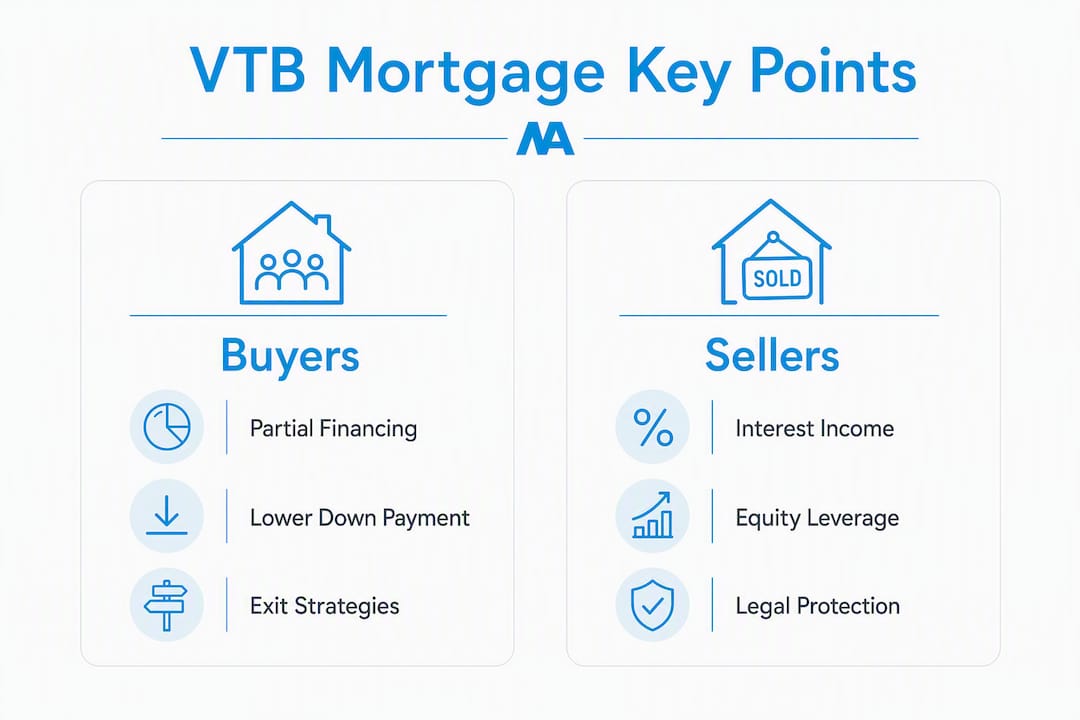
VTB deals most often run short terms of one to five years, with interest rates negotiated between the parties rather than set by a lender's posted rate. The amortization can be set longer (15–25 years) to keep monthly payments manageable, but the outstanding balance comes due at the end of the short term as a balloon payment. That balloon is the most common source of refinancing risk: if the buyer cannot secure new financing at maturity, they may default.
Banking consent and sequencing
Primary lenders must approve subordinate VTB financing before the deal closes. Many banks refuse secondary financing unless the buyer's total loan-to-value ratio remains conservative. Skipping this step is one of the most common deal-breakers. Confirm lender consent in writing before finalising any VTB terms.
Registration: promissory note vs registered charge
A promissory note alone does not protect the seller against other creditors or a subsequent buyer. A properly registered mortgage charge on title does. Always register the VTB as a mortgage charge through a lawyer, not just as a personal loan agreement.
Pro Tip: Secure written lender consent and a mortgage pre-approval that explicitly conditions the deal on the VTB terms before you draft the purchase agreement. Discovering lender refusal at closing is expensive for everyone.
What do the numbers actually look like?
The two examples below illustrate typical VTB payment flows. Both assume a $600,000 purchase price.
| Scenario | Purchase Price | Bank First Mortgage | VTB Amount | VTB Rate | VTB Term | Amortization | Monthly Payment (VTB) | Balloon at Maturity |
|---|---|---|---|---|---|---|---|---|
| Partial VTB (second position) | $600,000 | $450,000 (75%) | $90,000 (15%) | 7.5% | — | 20 years | ~$724 | ~$84,200 |
| Full seller financing | $600,000 | None | $600,000 | 8.0% | — | 25 years | ~$4,628 | ~$570,400 |
Monthly payment figures are approximations based on standard amortization calculations. Use the FCAC mortgage calculator to model your specific scenario.
Scenario 1 — Partial VTB: The buyer carries a $90,000 VTB at 7.5% alongside a $450,000 bank mortgage. Monthly payments on the VTB alone are roughly $724. After three years, approximately $84,200 remains and comes due as a balloon. The buyer must refinance or pay that amount in full.
Scenario 2 — Full seller financing: The seller carries the entire $600,000 at 8.0% over a 25-year amortization with a five-year term. Monthly payments are roughly $4,628. At the five-year mark, the outstanding balance of approximately $570,400 becomes due. This scenario is rare and carries significant risk for both parties if the buyer cannot refinance.
If the VTB rate rises by even one percentage point, monthly payments increase and the balloon grows slightly faster. Conversely, a shorter amortization reduces the balloon but raises monthly payments. Model at least two rate scenarios before agreeing to terms.
Pros, cons, and real risks for sellers and buyers
Benefits
For sellers:
- Attracts more buyers, particularly in a slow market or for hard-to-finance properties.
- The capital gains reserve lets sellers spread a taxable capital gain over up to five years as proceeds arrive, with at least one-fifth reported each year — a meaningful tax planning tool.
- Earns interest income on the outstanding balance, often at a rate above GIC returns.
For buyers:
- Bridges a financing gap without requiring a larger down payment.
- Terms can be more flexible than institutional lending (payment schedules, prepayment rights).
- Useful when conventional lenders decline due to property type or borrower profile.
Risks
For sellers:
- Enforcement is slow and costly. If the buyer defaults, the seller may recover less than the loan amount if property values have fallen, and legal costs erode the recovery further.
- Proceeds are tied up for the VTB term; the seller cannot access that capital freely.
- The seller must manage collections, insurance monitoring, and tax reporting — an administrative burden many underestimate.
- The VTB note can potentially be assigned to a third party; sellers should address assignment rights in the agreement.
For buyers:
- Balloon refinancing risk is real. If rates rise or the buyer's credit deteriorates, refinancing the balloon at maturity may be impossible.
- VTB interest on a personal residence is not tax-deductible unless the property generates rental or business income.
- Priority risk: if the VTB is in second position and the first mortgage lender forecloses, the seller's recovery takes precedence only after the bank is made whole.
A note on insurance: CMHC and most mortgage insurers do not insure mortgages that include secondary vendor financing. This means buyers using a VTB as a second mortgage typically cannot access insured mortgage products for the first mortgage, which usually requires a larger down payment on the bank portion.
Legal steps, registration, and tax checks you cannot skip
Registration and priority
Both parties need independent legal representation, and the mortgage charge must be properly registered against title. Registration rank determines who gets paid first in a default. A VTB in second position means the first mortgage lender is paid out before the seller sees a dollar. Failing to negotiate and confirm priority before closing can leave the seller subordinate to creditors registered later.

Provincial Mortgages Acts govern enforcement timelines. In Ontario, for example, the process involves a formal notice period followed by a redemption window before the seller can proceed with power of sale or foreclosure. Power of sale is generally faster than foreclosure but still requires formal notices and time for the borrower to redeem. Sellers should budget both time and legal costs and not assume that banks' streamlined processes apply to private lenders.
Legal documentation checklist
| Checklist Item | Why It Matters |
|---|---|
| Independent legal counsel for each party | Prevents conflicts of interest; each party's lawyer reviews terms separately |
| Title search before closing | Confirms existing encumbrances and confirms VTB priority position |
| Mortgage charge registered on title | Protects seller's security interest against subsequent creditors |
| Primary lender written consent | Prevents deal collapse at closing; confirms bank accepts the VTB |
| Property insurance naming seller as mortgagee | Protects seller's interest if the property is damaged |
| Clear default remedies in the agreement | Defines what constitutes default and what steps follow |
| Tax and accounting review | Addresses capital gains reserve election and interest income reporting |
Pro Tip: A properly drafted VTB must address priority, enforcement, and clear default remedies — standard purchase agreement templates routinely miss these. Have a real estate lawyer draft or review the VTB terms, not just the purchase and sale agreement.
Tax considerations
VTB interest is taxable to the seller as regular income in the year it is received. Sellers who elect the capital gains reserve can defer a portion of the capital gain, but must report at least one-fifth of the eligible gain each year. The reserve cannot extend beyond five years. Consult an accountant before structuring the VTB to confirm the reserve election is filed correctly and that the interest income is reported on the right schedule.
What to negotiate and a pre-signing checklist
Terms to negotiate
A VTB agreement is more flexible than a bank mortgage, which means more room for both parties to protect themselves — and more room for disputes if terms are vague. Address every one of these before signing:
- Interest rate: Benchmark against current private mortgage rates; a rate that is too low may not compensate the seller for risk.
- Amortization and term: Longer amortization lowers monthly payments but increases the balloon; shorter terms reduce total interest but raise refinancing pressure.
- Payment frequency: Monthly is standard; weekly or bi-weekly accelerated payments reduce the balloon faster.
- Balloon conditions: Define the exact maturity date, the balloon amount calculation method, and what happens if the buyer cannot pay.
- Prepayment rights: Can the buyer pay down the VTB early without penalty? This matters for exit planning.
- Default remedies: Define what constitutes default (missed payments, failure to maintain insurance, breach of primary mortgage terms) and the notice period before the seller can act.
- Assignment clause: Can the seller assign the VTB note to a third party? Buyers should know who they may end up paying.
- Insurance and property taxes: Confirm the buyer maintains adequate insurance and pays property taxes; tax arrears can affect the seller's security.
Questions buyers should ask
- Will the VTB be registered on title as a mortgage charge, or only documented as a promissory note?
- Can the seller assign the mortgage to another party without buyer consent?
- What is the exact balloon amount and maturity date?
- Does the primary lender's approval letter explicitly permit the VTB?
Questions sellers should ask
- What is the buyer's realistic plan to refinance the balloon at maturity?
- Has the buyer provided income verification and a credit report?
- What is the buyer's total debt load, including the first mortgage?
Closing mechanics
Funds flow through each party's lawyer at closing. The VTB amount is typically credited against the purchase price rather than advanced as cash; the buyer's lawyer registers the mortgage charge simultaneously with the transfer of title. Include a contingency clause that voids the VTB if primary lender consent is not obtained by a specified date.
What are the alternatives to a VTB in Canada?
| Alternative | Best When | Key Limitation |
|---|---|---|
| B-lender mortgage | Buyer has bruised credit or non-standard income but can qualify with a B-lender | Higher rates than A-lenders; still requires full underwriting |
| Private mortgage | Property or borrower does not qualify anywhere else; short-term bridge needed | Highest rates; lender fees add cost |
| Rent-to-own | Buyer needs time to build credit or save a larger down payment | Complex contracts; buyer builds little equity during rental period |
| Co-signer or guarantor | Buyer's income is sufficient but credit history is thin | Co-signer takes on full liability; affects their own borrowing capacity |
| Mortgage assumption | Seller has an existing mortgage at a favourable rate the buyer can take over | Lender approval required; not all mortgages are assumable |
The VTB tends to make the most sense when the seller has full equity (or near-full equity) in the property, the buyer has a credible exit plan for the balloon, and the primary lender has confirmed consent. When the buyer simply needs more time to qualify conventionally, a B-lender or a co-signer is often a cleaner path with fewer legal complexities.
On insured mortgages: because CMHC and most insurers exclude secondary vendor financing, buyers who need mortgage insurance (typically those with less than 20% down) generally cannot combine an insured first mortgage with a VTB second. This is a hard structural constraint, not a policy preference.
How a mortgage broker can improve your VTB outcome
Structuring a VTB without broker involvement is possible, but the sequencing risks are significant. Here is where a broker adds concrete value:
- Lender outreach and consent: A broker contacts the primary lender early, confirms whether the VTB is permitted, and obtains written approval that specifies the exact VTB terms the bank will accept.
- Structuring advice: Brokers model different VTB amounts, rates, and terms against the buyer's total debt service ratios to confirm the deal is financeable.
- Exit strategy modelling: Running refinance scenarios for the balloon payment at maturity — across multiple lenders — tells both parties whether the buyer has a realistic path out before they commit.
- Access to lenders: With access to over fifty Canadian lenders, Deneenoel can identify which lenders will accept a deal with a secondary VTB and which will not, saving weeks of back-and-forth.
- Coordinating legal and tax advisers: A broker does not replace a lawyer or accountant, but can help sequence the professionals so nothing falls through the cracks before closing.
- Complex file experience: Self-employed buyers, new-to-Canada buyers, and investment property purchasers often need a VTB precisely because conventional qualification is difficult. These are the files where broker expertise matters most.
Understanding what a mortgage broker does before you enter a VTB negotiation helps you ask the right questions and avoid the most common deal-breakers.
Pro Tip: Deal sequencing is critical: secure primary lender consent early and confirm the buyer's realistic exit plan for any balloon payment before finalising VTB terms. Discovering a lender refusal after the purchase agreement is signed can cost both parties time, money, and the deal itself.
Key takeaways
A vendor take back mortgage works best when the seller has clear equity, the primary lender has confirmed consent in writing, and the buyer has a documented exit plan for the balloon payment.
| Point | Details |
|---|---|
| VTB definition | The seller acts as lender, with the loan registered as a mortgage charge on title. |
| Lender consent is mandatory | Primary lenders must approve subordinate VTB financing; confirm this in writing before signing. |
| Balloon risk requires a plan | Most VTBs run one to five years with a balloon at maturity; buyers need a confirmed refinance path. |
| Tax and legal review are non-negotiable | Sellers must address capital gains reserve and interest income; both parties need independent legal counsel. |
| Deneenoel coordinates the process | Deneenoel provides lender outreach, exit strategy modelling, and access to 50+ lenders for Alberta VTB transactions. |
The deal-breakers most people find out too late
The most common VTB failures I see come down to three things: no written bank consent, a balloon payment with no realistic exit plan, and default remedies that are too vague to enforce.
Sellers often approach a VTB the way they would a handshake loan between friends. They skip the income verification, accept a promissory note instead of a registered charge, and trust that the buyer will refinance when the time comes. VTBs should be underwritten with the same rigour as institutional loans. That means a credit check, proof of income, a realistic debt service calculation, and a registered mortgage charge — every time.
The capital gains reserve is genuinely useful for sellers, but it comes with a trade-off: your sale proceeds are tied up for years, and if the buyer defaults, you are managing an enforcement process rather than reinvesting your equity. That is not a reason to avoid a VTB, but it is a reason to structure it carefully and price the risk honestly.
When a VTB is structured properly — with lender consent confirmed, legal documentation in order, and a credible exit plan for the balloon — it is a reasonable strategic tool. The problem is not the instrument; it is the shortcuts people take when they are eager to close.
Work with Deneenoel on your VTB transaction
Structuring a VTB alongside a conventional mortgage requires more coordination than a standard purchase. Deneenoel works with buyers and sellers across Alberta to confirm primary lender acceptance early, model balloon refinance scenarios across 50+ lenders, and connect clients with the legal and tax professionals needed to close cleanly.

Whether you are a buyer exploring owner financing options or a seller considering a VTB to close a deal, the first step is a straightforward conversation about your numbers and timeline. Deneenoel offers written pre-approvals with rate holds and personalized guidance from application through to closing.
Book a consultation with an Edmonton mortgage broker or a Calgary mortgage broker to confirm whether a VTB fits your transaction and what terms your primary lender will accept.
This article provides general information about vendor take back mortgages in Canada. It is not legal, tax, or financial advice. Confirm current rules and your specific situation with a qualified lawyer, accountant, or mortgage professional.
Useful sources
The following authoritative Canadian sources are worth consulting directly as you work through a VTB transaction.
For legal questions (registration, priority, enforcement, contract terms):
- Insight Law Firm — Vendor Take Back Mortgages: Ontario Buyer & Seller Guide: practical overview of registration, priority, and enforcement options with Ontario-specific procedural detail.
- Falcon Law PC — Understanding Vendor Take Back Mortgages in Ontario: focused on what to include in the purchase and sale agreement, including default remedies and priority clauses.
- Blakes — Navigating Vendor Take Back Mortgages: Five Key Considerations: a law firm perspective on underwriting rigour, sequencing, and strategic use of VTBs.
For tax questions (capital gains reserve, interest income):
- Canada Revenue Agency — Capital Gains Reserve: the CRA's guidance on the capital gains reserve election is the primary source for how sellers report deferred gains. Search "capital gains reserve" directly on the CRA site for the current interpretation bulletin.
For lender policy and general mechanics:
- NerdWallet Canada — What Is a Vendor Take Back Mortgage?: accessible general explainer on how VTBs are registered and how payments flow.
For definitive advice on your specific transaction, retain an independent real estate lawyer for legal matters and a CPA for tax structuring. General online guides, including this one, are a starting point, not a substitute for professional advice tailored to your situation.