
Yes, self-employed Canadians can get a mortgage. The key is documenting your income in a way lenders recognise, and choosing the right lender route for your file. Most applications stall not because of self-employment itself, but because applicants arrive without the right paperwork or apply to the wrong lender type.
Before you do anything else:
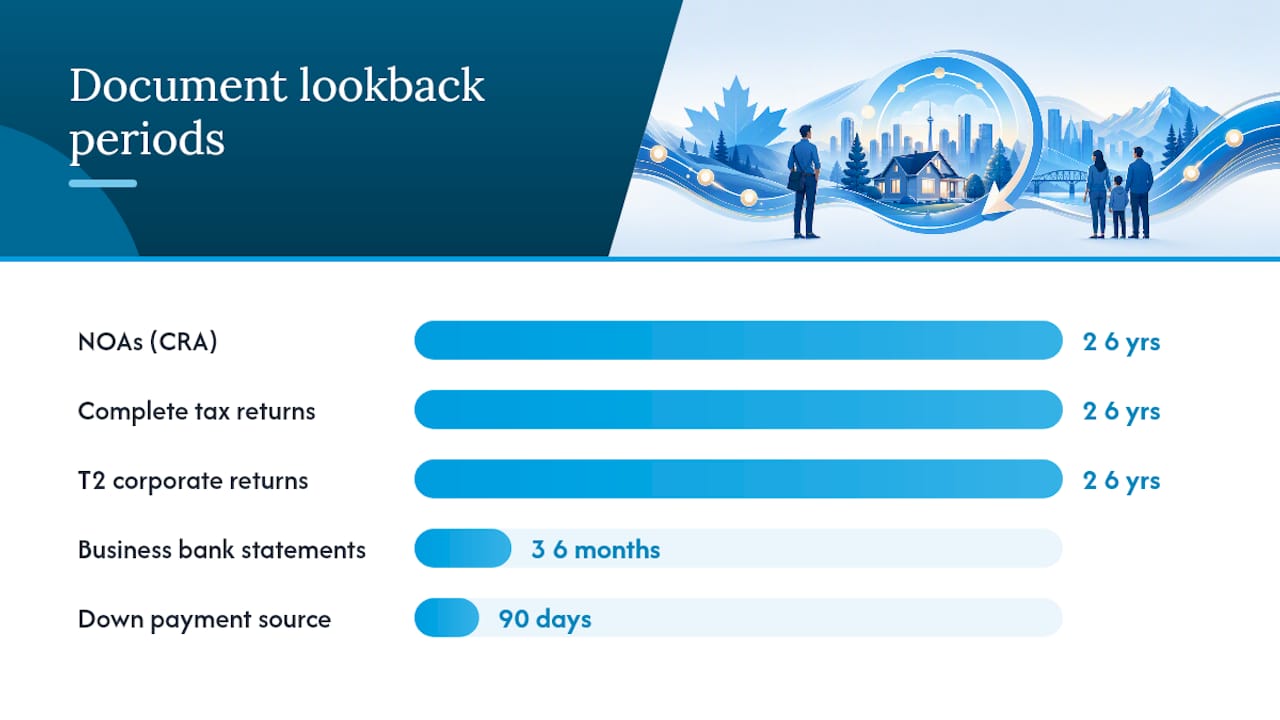
- Gather your last two to three years of Notices of Assessment (NOAs) from the Canada Revenue Agency
- Pull your T1 General with Schedule T2125 (sole proprietors) or your T2 corporate return and accountant-prepared financial statements (incorporated businesses)
- Collect three to six months of personal and business bank statements
- Confirm your business structure (sole proprietor, incorporated, or partnership)
- Gather proof of ongoing contracts or client invoices if your income has grown recently
- Contact a mortgage broker for a written pre-approval with a rate hold before you start house hunting
A written pre-approval locks in a rate while you shop and signals to sellers that your financing is serious. Getting that document in hand is the single most practical first step.
Table of Contents
- What do Canadian lenders check when assessing a self-employed borrower?
- What documents do you need for a self-employed mortgage application?
- How do lenders calculate qualifying income for self-employed borrowers?
- What mortgage routes are available to self-employed Canadians?
- Does CMHC cover self-employed borrowers?
- How do you improve your chances and avoid common mistakes?
- How does a mortgage broker speed up approval for self-employed borrowers?
- Key takeaways
- Why the "just go to your bank" advice fails self-employed borrowers
- Deneenoel helps self-employed Albertans get mortgage-ready
- Useful sources and further reading
What do Canadian lenders check when assessing a self-employed borrower?
Lenders apply the same core underwriting criteria to self-employed borrowers as to salaried ones. The difference is in how they verify the numbers.
Income stability and history carry the most weight. Most lenders want to see at least two years of NOAs showing consistent or growing income. They typically average the two most recent years, which means a spike in one year gets smoothed out. If year one shows $60,000 and year two shows $90,000, many lenders will qualify you on $75,000, not $90,000. Some will use the lower of the two years if income dropped, which is worth knowing before you apply.
Business structure changes what documents you need. Sole proprietors file a T1 with T2125 and their income is reported directly on their personal return. Incorporated borrowers pay themselves a salary or dividends from a corporation, so lenders look at both the T2 corporate return and the personal T1 to understand total available income. Partnerships fall somewhere in between, requiring partnership agreements and allocated income statements. Each structure requires a different document set, and submitting the wrong one wastes time.
Credit score and history matter significantly. Lenders typically pull your personal credit bureau report, and some will also review business credit if you operate through a corporation. A stronger score opens A-lender access and better rates. According to Ratehub, self-employed borrowers with clean credit and solid documentation can access the same rates as salaried applicants. Your credit score is one of the few factors you can improve before applying.
Gross Debt Service (GDS) and Total Debt Service (TDS) ratios cap how much of your income can go toward housing and total debt payments. Outstanding tax arrears are a red flag that can stop an application entirely, so clearing any CRA balance before you apply is non-negotiable.
Pro Tip: Prepare two versions of your file: one for an A-lender (full documentation, two-year average, clean credit) and one for an alternative lender (business bank statements, contracts, accountant letter). Knowing which version you need before you apply saves weeks.
What documents do you need for a self-employed mortgage application?
The document list varies by business structure, but the core set is consistent across lenders. Use this as your preparation checklist.
For all self-employed borrowers:
- Lenders typically request multiple recent years of Notices of Assessment from the Canada Revenue Agency.
- Last two to three years of complete tax returns
- Several months of recent personal and business bank statements are commonly required.
- Proof of down payment source (90-day history)
- Business registration or licence
- Recent GST/HST returns are often requested to verify business tax compliance.
- Signed client contracts or invoices confirming ongoing revenue
| Document | Sole Proprietor | Incorporated | Partnership |
|---|---|---|---|
| T1 General + T2125 | Required | Personal T1 required | Personal T1 required |
| T2 Corporate Return | Not applicable | Required (2–3 years) | Not applicable |
| Accountant financial statements | Helpful | Required | Required |
| Partnership agreement | Not applicable | Not applicable | Required |
| NOAs (2–3 years) | Required | Required | Required |
| GST/HST returns | Required | Required | Required |
| Business bank statements | 3–6 months | 3–6 months | 3–6 months |
According to the RE/MAX blog, lenders place particular weight on bank statements because they reveal actual cash flow, not just reported income. Consistent monthly deposits that align with your stated revenue are a strong signal. Irregular or declining deposits raise questions.
Pro Tip: If you started your business less than two years ago, a letter from your accountant confirming your income and business viability, combined with proof of prior experience in the same industry, can sometimes substitute for a full two-year history. Lenders want to see that your income is predictable, not just that you've been self-employed for a specific length of time.
Missing NOAs are a common delay. Order them directly from CRA My Account well before your broker meeting. Processing can take time if you request paper copies.
How do lenders calculate qualifying income for self-employed borrowers?
This is where many self-employed applicants get a surprise. The income on your mortgage application is rarely the same number as your gross revenue.
Income averaging is the standard method. Lenders take your net income from Line 15000 of your NOA for each of the last two years and average them. If your income fluctuated, the average may be lower than your most recent year. Some lenders will use a three-year average if it produces a higher qualifying number.
Add-backs can increase your qualifying income. Lenders may add back certain non-cash or discretionary expenses that appear on your tax return but do not represent actual cash leaving your pocket. Common add-backs include:
- Capital cost allowance (CCA/depreciation) claimed on business assets
- One-time or non-recurring business expenses
- Business-use-of-home deductions
- Employer health tax or similar payroll deductions on owner compensation
- Retained earnings in a corporation, in some cases
Add-backs are not automatic. Each lender and insurer has its own policy, and an accountant familiar with mortgage applications can prepare a letter explaining which adjustments are reasonable.
T1 vs. T2 income works differently. A sole proprietor's net income flows directly to Line 15000 on their personal return. An incorporated borrower may pay themselves a salary (which appears on their T4 and personal return) plus dividends (which appear on Line 12000 of the personal return). Lenders look at total personal income, but some will also consider retained earnings in the corporation as evidence of financial strength, even if those earnings were not paid out.
Stated-income programs exist for borrowers whose tax returns understate available income, often because of legitimate business deductions. Under these programs, you declare a reasonable income supported by business bank statements and contracts rather than NOAs. Sagen's Business for Self program and Canada Guaranty's Low Doc Advantage both offer insured stated-income options, though they require a strong credit profile and a minimum down payment.
Use the RBC mortgage payment calculator to estimate how different qualifying income figures affect your maximum purchase price and monthly payment before you meet with a lender.
What mortgage routes are available to self-employed Canadians?
Your lender options depend on how well-documented your income is, how long you've been self-employed, and the strength of your credit. There is no single right answer, but the pathways are clear.
A-lenders (major banks and monoline lenders) offer the best rates and terms. They require full documentation: two-plus years of NOAs, clean credit, and GDS/TDS ratios within standard limits. If your file meets these criteria, an A-lender is almost always the right choice. See the best mortgage lenders in Canada for an overview of how lender types compare.
Credit unions sit between A-lenders and B-lenders. Many credit unions use their own underwriting guidelines and can be more flexible with income averaging or business structure. They are worth considering if your income is slightly below A-lender thresholds or if your business is newer.
B-lenders and trust companies accept limited documentation, recent self-employment, or files with minor credit issues. Rates are higher, typically by 0.5%–2% above prime, and terms are often shorter (one to two years). The expectation is that you improve your file and refinance to an A-lender at renewal.
Private lenders are a last resort for borrowers with no documentation, significant credit issues, or tax arrears. Rates are substantially higher and fees can be significant. Short-term bridge financing is the most appropriate use case.
Decision guide:
- Two or more years of NOAs, clean credit, standard GDS/TDS: apply to an A-lender
- Income under-reported on taxes but strong bank statements and contracts: consider an insured stated-income program (Sagen or Canada Guaranty)
- Less than two years self-employed but prior industry experience: credit union or B-lender with a broker's help
- Tax arrears or credit issues: resolve these first, or use a B-lender short-term while you rebuild
Does CMHC cover self-employed borrowers?
Yes. The CMHC Self-Employed program provides mortgage loan insurance for sole proprietors, incorporated borrowers, and partnerships. It covers both traditional documentation files and, in some cases, borrowers with non-traditional income verification.
CMHC's general guidance suggests at least 24 months of self-employment history, though exceptions exist for borrowers with prior experience in the same field or those who have acquired an established business. The program accepts accountant-prepared financial statements and business bank statements as supporting documentation when standard NOAs do not fully reflect income.
CMHC premium bands by loan-to-value (LTV):
CMHC insured mortgages are subject to a maximum property value and amortization limits. For insured purchases, the maximum amortization is 30 years (as of the August 2024 federal rule change for first-time buyers and new construction), and the purchase price must fall within the applicable insured lending limit.
When CMHC coverage is not available or the file does not meet CMHC's criteria, Sagen's Business for Self and Canada Guaranty's Low Doc Advantage are the two alternative insurers. Both allow stated income with a strong credit profile and a minimum down payment, typically 10%. Canada Guaranty's Low Doc Advantage specifically targets borrowers with a solid credit history who cannot fully document income through traditional CRA returns.
Non-permanent residents authorised to work in Canada may also qualify under CMHC's program, subject to additional documentation requirements. See the work permit mortgage guide for details specific to that situation.
How do you improve your chances and avoid common mistakes?
Most self-employed mortgage applications that get declined or delayed share the same handful of problems. Fixing them before you apply is far more effective than trying to explain them to a lender mid-process.
Prioritised action steps:
- Clear any outstanding CRA tax arrears and confirm your NOAs are filed and up to date
- Review your credit report (Equifax and TransUnion) and address any delinquencies or errors
- Separate personal and business bank accounts if you haven't already, and maintain clean, consistent deposits
- Assemble three to six months of bank statements that clearly show business revenue
- Increase your down payment if possible; 20% or more removes the need for mortgage default insurance and opens A-lender access
- File all GST/HST returns on time; missing filings are a red flag for lenders
Common mistakes that delay or kill applications:
- Mixing personal and business transactions in the same account, which makes income verification difficult
- Claiming maximum deductions on your tax return to reduce tax, then expecting lenders to qualify you on gross revenue
- Applying to a major bank directly without a broker when your file has any complexity
- Ignoring seasonal income patterns; if your revenue is seasonal, a 12-month average of bank statements tells a clearer story than a single month
- Missing HST/GST filings, which signal to lenders that your business administration is disorganised
Timeline to expect: assembling a complete self-employed mortgage file typically takes two to six weeks if your tax returns and financial statements are current. Add four to eight weeks if your accountant needs to prepare or amend returns, or if you need to order missing NOAs from CRA.
Statistics Canada data confirms that self-employment income tends to be more variable than employment income, which is precisely why lenders scrutinise the documentation so carefully. Showing consistent or growing income across two to three years is the single strongest thing you can do before applying.
How does a mortgage broker speed up approval for self-employed borrowers?
A broker's value for self-employed borrowers is not just access to more lenders. It is knowing which lender will accept your specific file before you apply, which saves weeks of back-and-forth and protects your credit score from multiple hard inquiries.
Deneenoel works with more than fifty Canadian lenders and specialises in complex files, including self-employed borrowers in Alberta. Here is what that looks like in practice:
- Insurer negotiation: — where a file is borderline for CMHC, exploring whether Sagen or Canada Guaranty offers a better fit
Before your first broker meeting, have your last two NOAs, your most recent tax return, three months of bank statements, and your business registration ready. That is enough to get a preliminary assessment and a rate hold in most cases.
Key takeaways
Self-employed Canadians can qualify for a mortgage by documenting income correctly, choosing the right lender route, and working with a broker who understands how to present a non-traditional file.
| Point | Details |
|---|---|
| Two years of NOAs are the foundation | Most lenders average the last two NOAs to calculate qualifying income; file all returns before applying. |
| Add-backs can increase your qualifying amount | Depreciation and non-cash deductions may be added back to net income, raising the number lenders use. |
| Three insurer options exist | CMHC, Sagen, and Canada Guaranty each cover self-employed borrowers; stated-income programs require strong credit and a minimum down payment, typically around 10%. |
| Credit and clean accounts matter | Separate business and personal accounts, clear CRA arrears, and review your credit report before applying. |
| Deneenoel matches your file to the right lender | With access to over fifty lenders, Deneenoel identifies the best fit for your income type and business structure in Alberta. |
Why the "just go to your bank" advice fails self-employed borrowers
The most common piece of advice self-employed Canadians receive about mortgages is to walk into their bank and apply. It sounds logical. You already have a relationship there. The problem is that major banks apply the most conservative underwriting guidelines in the market, and a self-employed file with any complexity, a newer business, income that dips in one year, or legitimate tax deductions that reduce reported income will often get declined or significantly reduced at a bank before a broker has even looked at it.
What most people do not realise is that the same mortgage, with the same borrower, can qualify at a credit union or a B-lender when it does not qualify at a bank. The income calculation is not universal. Add-back policies differ. Some lenders will accept a letter from your accountant explaining a one-time expense that reduced income in a given year; others will not. A broker who works with fifty lenders knows these distinctions before submitting a single application.
The other underestimated factor is the cost of a declined application. A hard credit inquiry stays on your bureau for two years. Multiple declines in a short period can lower your score and make the next application harder. Submitting to the right lender the first time is not just faster; it protects your credit.
Realistic expectations matter here. A broker cannot manufacture income that does not exist, and they cannot override CRA arrears or a severely damaged credit history. What they can do is find the lender whose guidelines fit your actual situation, prepare your file to present your income in the most accurate and complete way, and tell you honestly if you need six months to strengthen your application before submitting. That honest assessment, delivered early, is often the most valuable thing a broker provides.
Deneenoel helps self-employed Albertans get mortgage-ready
Self-employed borrowers in Alberta face the same income documentation challenges as anywhere in Canada, but the local market moves quickly. Getting a written pre-approval with a rate hold before you start searching is not optional; it is the difference between making a competitive offer and losing a property while your financing is still being sorted out.
Deneenoel provides personalised mortgage brokerage services across Alberta, with access to more than fifty Canadian lenders, including A-lenders, credit unions, B-lenders, and all three mortgage default insurers. For self-employed clients, that means your file gets matched to the lender whose guidelines actually fit your income type and business structure, not just the lender with the most advertising.
To get started, book a consultation with Deneenoel as an Edmonton mortgage broker or a Calgary mortgage broker. Before your first meeting, have your last two NOAs, your most recent tax return, three months of personal and business bank statements, and your business registration ready. That is enough to get a preliminary assessment and a rate hold the same day.
Useful sources and further reading
These primary sources are worth bookmarking as you prepare your application. Rules and premium bands change, and checking directly with the insurer or regulator is always the right move.
- CMHC Self-Employed Mortgage Loan Insurance
- Business for Self (Alt. A) — Sagen
- Low Doc Advantage (Self-Employed) — Canada Guaranty Mortgage Insurance Company
- Self-Employed Mortgage | What are the Requirements? | Ratehub.ca
- Statistics Canada daily release
- Getting a Mortgage When Self Employed — REMAX blog
- RBC mortgage payment calculator