
What "no down payment" usually means in practice is that you fund the minimum required down payment from a source other than your own savings — a borrowed amount, an RRSP withdrawal, a gift, or a structured arrangement with the seller. The distinction matters, because each path carries its own costs, insurer rules, and risks.
Here is what "no down payment" typically refers to in Canada:
- Insured high-LTV mortgage: You borrow the minimum 5% down payment from a personal loan, unsecured line of credit, or a relative's gift, then apply for a CMHC-insured mortgage at 95% loan-to-value (LTV).
- Home Buyers' Plan (HBP): You withdraw from your RRSP (subject to repayment rules) to cover the down payment — a legal and commonly used source.
- Vendor take-back (VTB): The seller lends you part or all of the purchase price, bypassing the need for a traditional down payment.
- Rent-to-own or shared-equity arrangements: You build toward ownership without a lump-sum down payment upfront.
- Private lending: Lenders outside the federally regulated system may accept lower down payments, though at higher rates.
Getting a mortgage pre-approval early is the single most useful step you can take. It tells you exactly which paths are open to you before you start shopping.
Key takeaways
Buying with little or no traditional down payment is possible in Canada through insured high-LTV mortgages, the Home Buyers' Plan, vendor take-backs, and other structured paths, but each carries real costs and eligibility conditions that must be understood before you apply.
| Point | Details |
|---|---|
| Minimum down payment rules | 5% on the first $500,000; 10% on the portion above $500,000; over $1,000,000 is generally uninsured. |
| Insurance premium at 95% LTV | 4.00% for traditional sources; 4.50% for non-traditional sources, added to your mortgage balance. |
| Arm's-length rule | Borrowed down payment funds cannot be tied to the seller or purchase transaction; seller-funded schemes are prohibited by insurers. |
| Top risks to manage | Borrowed down payments increase TDS ratios; thin equity creates refinancing difficulty if property values fall. |
| Deneenoel's role | Deneenoel matches Alberta buyers to the right lender and insurer program, models your debt ratios, and provides written pre-approvals for low- and no-down strategies. |
Table of Contents
- How Canada's minimum down payment rules actually work
- How mortgage loan insurance and LTV bands affect your costs
- What CMHC, Sagen, and Canada Guaranty each allow
- Borrowed down payments and the arm's-length rule
- Legitimate paths to buy with little or no personal down payment
- Which credit products can fund a down payment?
- Costs, pros, and cons of buying with minimal savings
- How to improve your approval odds for a low-down mortgage
- Step-by-step: from assessment to pre-approval to offer
- How a mortgage broker helps with low- or no-down strategies
- Sources
How Canada's minimum down payment rules actually work
Mortgage loan insurance is required any time your down payment is less than 20% of the purchase price. The federal government sets the minimum down payment by purchase price band:
- A minimum percentage on the first tier of the purchase price
- A higher minimum percentage on the portion between lower and upper price thresholds
- Properties above a certain high price point are generally ineligible for insured mortgages and require a larger down payment
For a home priced moderately above the low threshold, the minimum insured down payment reflects applying the lower percentage to the first tier and a higher percentage to the remainder. For homes at the initial tier maximum, the minimum insured down payment corresponds accordingly.
Key figure: Mortgage insurance premiums vary depending on your LTV ratio and whether your down payment comes from a traditional or non-traditional source.
At that level, you are borrowing the maximum the insurer will allow, and you are paying the highest available premium. Lenders require mortgage loan insurance at this LTV because the insurer protects the lender, not you, if you default. Understanding that distinction upfront helps you weigh the real cost of entering the market with minimal savings.
How mortgage loan insurance and LTV bands affect your costs
Mortgage loan insurance premiums are calculated as a percentage of the insured mortgage amount and are typically added to your mortgage balance rather than paid upfront. That means you pay interest on the premium for the full amortization period.
Premium rates by LTV band
The following premium rates apply to CMHC Purchase and comparable programs from Sagen and Canada Guaranty:
On a $475,000 insured mortgage, that difference is $2,375 added to your mortgage balance.
Worked example: 5% vs. 20% down on a $500,000 home
-
Down payment is the minimum required and can be borrowed
-
The insured mortgage corresponds to the remainder of the purchase price
-
A premium applies which is added to the mortgage balance
-
Results in a higher total mortgage balance and higher monthly payments compared to larger down payments
-
Larger down payment means no insurance premium is required
-
Lower mortgage balance results
-
Lower monthly payments than minimal down payment scenario
The monthly payment difference between minimal and larger down payment scenarios is significant. Over 25 years, that gap compounds significantly in total interest paid. The insurance premium alone adds over $21,000 to your mortgage balance on day one.
Premium callout: At 95% LTV with a non-traditional down payment, the CMHC premium is 4.50% of the insured amount. At 80% LTV, it drops to 2.40%. Borrowers who can reach even 10% down cut their premium nearly in half.
What CMHC, Sagen, and Canada Guaranty each allow
Canada has three approved mortgage insurers, and lenders choose which one to use for your file. Each has slightly different program rules, so it is worth asking your lender or broker which insurer they plan to use and why.
CMHC
- Minimum 5% down from flexible sources, including non-traditional (borrowed) funds at the 90.01%–95% LTV band
- CMHC HomeStart lists allowable non-traditional sources and applies a higher premium for those cases
- Non-permanent residents are generally excluded from certain programs
- Maximum amortization of 25 years for insured mortgages (30 years for first-time buyers purchasing new builds, as of recent federal changes)
- Property must be owner-occupied and in Canada
Sagen
- Sagen's Borrowed Down Payment program explicitly permits borrowed or non-traditional down payments at 90.01%–95% LTV
- Repayment of the borrowed funds must be included in the Total Debt Service (TDS) ratio calculation
- Acceptable borrowed sources include personal loans and unsecured lines of credit, provided the source is arm's length from the transaction
- Property value limits apply — check current program caps with your lender
Canada Guaranty
- Offers comparable insured mortgage programs with similar LTV caps and premium structures
- Also accepts non-traditional down payment sources under specific program conditions
- Lender-specific program details vary; your broker can confirm which Canada Guaranty products your lender accesses
Pro Tip: Ask your lender or broker in writing which insurer and program they intend to use for your file before you submit a full application. Program rules differ, and a last-minute insurer switch can change your eligibility or premium.
Borrowed down payments and the arm's-length rule
The arm's-length requirement is one of the most misunderstood rules in Canadian mortgage financing. In insurer terms, "arm's length" means the source of your down payment funds has no direct or indirect connection to the purchase transaction itself.
Why this rule exists: Insurers enforce arm's-length requirements primarily to prevent artificially inflated purchase prices and hidden seller concessions. If a seller secretly provides your down payment, the lender's security is based on a price that does not reflect the property's true market value. OSFI's residential mortgage insurance underwriting guideline frames this as a risk-control measure, not a consumer-protection formality.
Acceptable non-traditional sources
- Personal loans from a financial institution
- Unsecured lines of credit
- Documented gifts from a relative (most lenders require a signed gift letter confirming no repayment is expected)
- RRSP withdrawals under the Home Buyers' Plan
Unacceptable sources
- Seller-funded down payment schemes (the seller provides cash back or inflates the price to cover your down payment)
- Builder incentives structured to offset or replace the down payment
- Any arrangement where the down payment funds flow back to the seller or are tied to the purchase price
Pro Tip: Before you borrow funds for a down payment, get written confirmation from your lender that the source is acceptable under the insurer program they are using. Discovering a problem at the underwriting stage can delay or kill your closing.
Legitimate paths to buy with little or no personal down payment
Several routes exist for buyers who have limited savings. Each has a different risk profile and eligibility threshold.
-
CMHC-insured high-LTV mortgage with borrowed down payment: The most common path. You borrow the minimum 5% from a personal loan or LOC, disclose it fully, and the lender includes the repayment in your TDS calculation. Higher premiums apply, and your debt load increases.
-
Home Buyers' Plan (HBP): The CRA's Home Buyers' Plan lets first-time buyers withdraw from their RRSPs to fund a down payment. Repayment is required over 15 years, and the funds must have been in the RRSP for at least 90 days before withdrawal. Best for buyers who have been contributing to an RRSP but have not yet accumulated separate savings.
-
Vendor take-back (VTB): The seller lends you part of the purchase price, effectively acting as a secondary lender. VTBs can reduce or eliminate the need for a traditional down payment, but they require careful legal structuring. Best for buyers purchasing from a motivated seller in a slower market. Red flag: a VTB that is not disclosed to the primary lender is mortgage fraud.
-
Rent-to-own: You rent the property for a set period, with a portion of rent credited toward a future purchase. Best for buyers who need time to repair credit or accumulate savings. Red flag: poorly drafted agreements that give the seller the right to cancel and keep your credits.
-
Co-ownership or shared-equity: A family member, friend, or equity partner co-signs and contributes to the down payment. Best for buyers with strong income but limited savings. Requires a co-ownership agreement drafted by a lawyer.
-
Employer-assisted programs: Some employers, particularly in public-sector or relocation contexts, offer down payment loans or grants. Eligibility is employer-specific.
-
B-lender or private lender mortgages: Lenders outside the federally regulated system may accept lower down payments or non-standard sources, but rates are materially higher. Best for buyers who cannot qualify through insured channels and have a clear plan to refinance within two to three years.
What to avoid: Seller-funded down payment schemes, undisclosed add-ons that inflate the purchase price, and any arrangement where the source of funds is concealed from the lender or insurer. These are not creative financing — they are fraud.
Which credit products can fund a down payment?
Borrowing your down payment is legal and permitted by insurers under specific conditions, but the product you use affects your debt ratios and approval odds.
| Credit product | Lender/insurer view | Key consideration |
|---|---|---|
| Personal loan | Accepted; repayment included in TDS | Fixed monthly payment increases TDS immediately |
| Unsecured line of credit (LOC) | Accepted; minimum payment included in TDS | Flexible repayment, but full limit counted in some calculations |
| Credit card advance | Generally not accepted by insurers | High cost; signals financial stress to underwriters |
| Borrowing against investments (margin) | Case-by-case; lender discretion | Acceptable if arm's length and documented |
The TDS ratio is the critical constraint. Adding a $25,000 personal loan repayment to your monthly obligations can push you over that threshold, which is why some buyers who borrow their down payment cannot qualify for the mortgage they need.
Pros and cons of each product
- Personal loan: Predictable repayment schedule; easy to document. Downside: the full monthly payment counts against your TDS from day one.
- Unsecured LOC: More flexible repayment. Downside: lenders may count the full available credit limit, not just the drawn amount, when calculating your debt load.
- Investment-backed borrowing: Can work if structured correctly. Requires detailed documentation and lender approval.
Documentation lenders will request
- Loan or LOC statements showing the balance and monthly payment
- Proof that funds were received and deposited (bank statements showing the transfer)
- A signed gift letter if any portion is a gift from a relative
- Bank statements covering 90 days to show the source and movement of funds
- RRSP statements and HBP withdrawal confirmation if applicable
Costs, pros, and cons of buying with minimal savings
Entering the market with a borrowed or minimal down payment is not inherently a bad decision, but the financial trade-offs are real and should be modelled before you commit.
The cost reality
The insurance premium alone adds over $21,000 to the balance, and you pay interest on that amount for 25 years.
Premium callout: The difference between a 4.00% premium (traditional 5% down) and a 4.50% premium (non-traditional 5% down) on a $475,000 insured mortgage is $2,375. That amount is added to your mortgage balance and compounds over your amortization period.
Pros
- Enter the market sooner, before prices rise further
- Begin building equity rather than paying rent with no ownership stake
- The HBP and borrowed-down strategies are fully legal and widely used by first-time buyers across Canada
Cons
- Higher monthly payments from day one due to the larger mortgage balance and insurance premium
- Increased TDS ratio from borrowed down payment repayments, which can limit your borrowing capacity
- Harder to refinance in the first few years if property values decline, since you start with minimal equity
- Potential for negative equity if the market corrects shortly after purchase
The trigger rate risk is also worth understanding if you are considering a variable-rate mortgage at high LTV. A rate increase that triggers a payment adjustment hits harder when your equity cushion is thin.
How to improve your approval odds for a low-down mortgage
A strong file reduces the chance of insurer refusal and can improve the rate your lender offers. Work through this checklist before you apply.
- Check and improve your credit score. Most insured lenders require a minimum score of 680. Review your credit score report for errors and pay down revolving balances before applying.
- Lower your existing debt load. Pay off or reduce credit card balances and any outstanding loans. Every dollar of monthly debt payment reduces the mortgage you can qualify for.
- Document all income sources. Lenders require two years of T4s or Notices of Assessment for salaried employees, and two years of business financials for self-employed applicants. Gaps or inconsistencies in income documentation are a common cause of delays.
- Maintain stable employment. Most lenders want to see at least 90 days at your current employer, or two years of self-employment history. Changing jobs during the application process can reset the clock.
- Accumulate reserves for closing costs. Even if your down payment is borrowed, you need funds for land transfer tax, legal fees, home inspection, and title insurance. Budget 1.5%–4% of the purchase price for closing costs, depending on your province.
- Ask your broker about GDS and TDS limits. The Gross Debt Service (GDS) ratio covers housing costs as a share of income; TDS covers all debt. Insured lenders typically cap GDS at 39% and TDS at 44%. Knowing your ratios before you apply lets you adjust your target purchase price.
- Confirm acceptable down payment sources in advance. Ask your broker which insurer program they plan to use and whether your intended source of funds is explicitly permitted.
Typical timeline
From initial broker consultation to closing, a straightforward insured purchase in Alberta typically takes 30 to 60 days. Complex files with borrowed down payments or non-standard income documentation can take longer. Getting a written pre-approval with a rate hold before you make an offer protects you against rate increases during that window.

Step-by-step: from assessment to pre-approval to offer
Moving from "I want to buy" to "I have an accepted offer" requires a clear sequence. Here is how to approach it.
- Gather your documents. Collect two years of T4s or Notices of Assessment, recent pay stubs, three months of bank statements, LOC or loan statements, and RRSP statements if you plan to use the HBP.
- Check your credit. Pull your own credit report from Equifax or TransUnion before your broker does. Resolve any errors before the formal application.
- Speak with a mortgage broker. A broker with access to multiple lenders can model your GDS/TDS ratios, identify which insurer programs you qualify for, and flag any documentation gaps before they become problems.
- Get a written pre-approval with a rate hold. A written pre-approval locks in a rate for 90 to 120 days and gives you a firm price range to shop within. It is not a guarantee of final approval, but it is the strongest signal you can show a seller.
- Shop with your price range confirmed. Work with a realtor within the purchase price your pre-approval supports. Stretching beyond that range risks a declined final approval.
- Plan for insurance and closing costs. Budget for the mortgage insurance premium (added to your mortgage or paid upfront), land transfer tax, legal fees, and any home inspection costs.
Document checklist
- Government-issued photo ID (two pieces)
- Two years of T4s or Notices of Assessment
- Recent pay stubs (last 30 days)
- Three months of bank statements showing down payment funds
- LOC or personal loan statements if funds are borrowed
- Signed gift letter from a relative if any portion is a gift
- RRSP statements and HBP withdrawal documentation if applicable
- Employment letter confirming position, salary, and start date
For vendor take-back or co-ownership arrangements, have a real estate lawyer review the contract before you sign. These structures carry legal obligations that a standard purchase agreement does not address.
How a mortgage broker helps with low- or no-down strategies
Navigating insurer program rules, debt-ratio calculations, and non-traditional down payment documentation is genuinely complex. A broker who works with these files regularly brings specific advantages that a direct lender relationship does not.
- Lender and insurer access: Brokers with access to fifty or more lenders know which ones accept specific non-traditional down payment sources and which insurer programs those lenders use. That knowledge prevents wasted applications.
- TDS modelling before you apply: A broker can run your numbers across multiple scenarios — different purchase prices, different down payment sources, different amortization periods — so you know your ceiling before you make an offer.
- Documentation preparation: Brokers who handle complex files know exactly what underwriters want to see for borrowed down payments, gift funds, and HBP withdrawals. A complete, well-organized application reduces back-and-forth and speeds approval.
- VTB and co-ownership structuring: If you are considering a vendor take-back or a co-ownership arrangement, a broker can explain how to structure it so it is disclosed correctly and does not trigger an insurer refusal.
- Self-employed and new-to-Canada files: These files require specific income documentation and lender matching. A broker who handles them regularly knows which lenders are most flexible and what documentation substitutes are accepted.
For Alberta buyers, Deneenoel offers a free exploratory consultation and written pre-approval to help you understand exactly which paths are open to you, whether you are in Edmonton, Calgary, or the surrounding areas.
When a broker made a material difference
A self-employed buyer with two years of business history and a borrowed down payment from an unsecured LOC is a file that many direct lenders will decline outright. A broker who knows which lenders accept self-employed income documentation and which insurer programs permit borrowed down payments can match that file to the right lender on the first submission, rather than after two or three declines that damage the buyer's credit profile.
A note on broker perspective
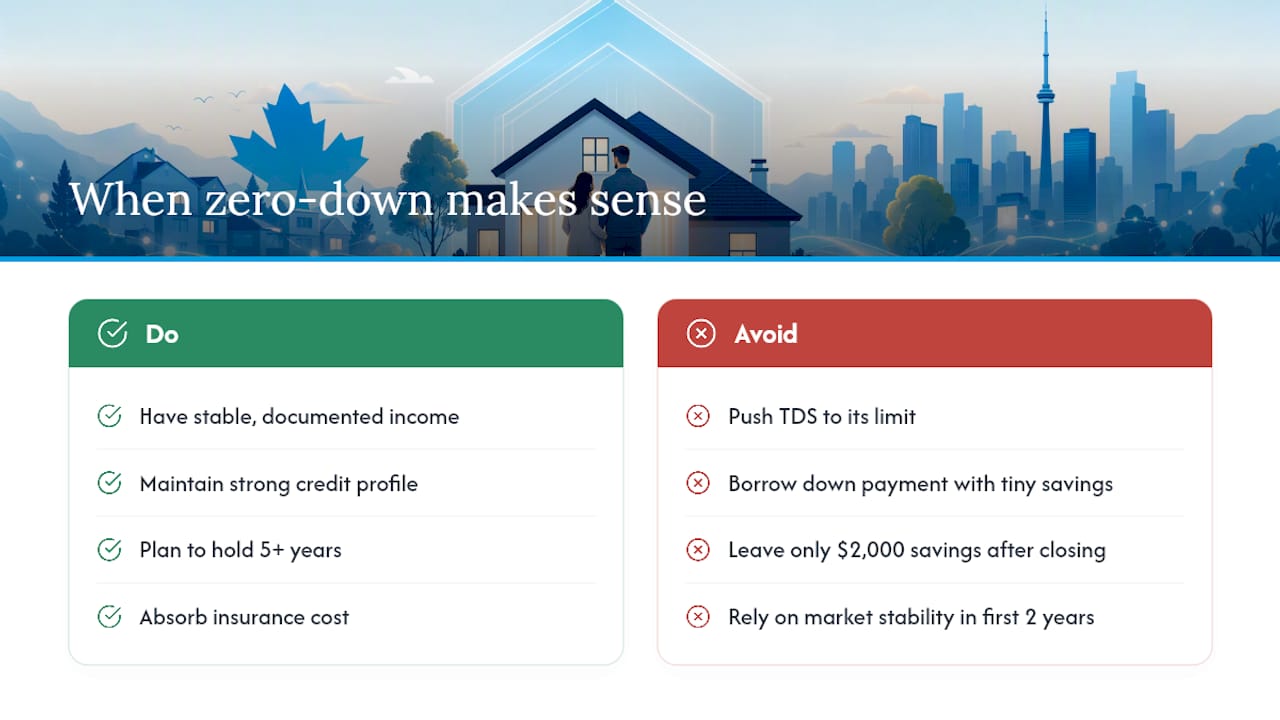
When does zero-down actually make sense?
Pursuing a no-down-payment mortgage is a reasonable decision in specific circumstances and a risky one in others. Here is my honest assessment.
It makes sense when you have stable, documented income, a strong credit profile, and a clear plan to build equity over five or more years. A first-time buyer in Edmonton who has been renting for three years, has a household income that comfortably supports the higher monthly payment, and can absorb the insurance premium without stretching their budget is a good candidate. The alternative is continuing to pay rent with no ownership stake while prices move.
It does not make sense when the borrowed down payment pushes your TDS ratio to its limit, leaving no room for a rate increase, a job change, or an unexpected repair. A buyer who borrows $25,000 for a down payment and has $2,000 in savings after closing is exposed to the first financial disruption that comes along. The market does not owe you stability in the first two years of ownership.
The question is not whether zero-down is possible. It usually is. The question is whether your specific financial position can absorb the costs and risks that come with it.
How Deneenoel can help you move forward
Getting into the market with minimal savings is possible, but the path requires careful structuring. Deneenoel works with buyers across Alberta who are navigating exactly this situation, with access to over fifty Canadian lenders and deep familiarity with CMHC, Sagen, and Canada Guaranty program rules.
Here is what Deneenoel offers for buyers pursuing low- or no-down strategies:
- Written pre-approvals with rate holds so you can shop with confidence
- Insurer-program matching to identify which lender and program fits your down payment source
- TDS and GDS modelling across multiple scenarios before you apply
- Complex file support for self-employed applicants, new-to-Canada buyers, and borrowed-down-payment structures
- Guidance on VTB and co-ownership arrangements, including what to disclose and how
If you are ready to find out what you qualify for, book a consultation with Deneenoel for a free, no-obligation pre-approval. You will leave with a clear picture of your options, your ratios, and your next step.
Sources
Verify current rules and program details directly with these sources before making any financial decision. Program eligibility, premium rates, and property-value limits change periodically.
- Mortgage loan insurance for consumers (CMHC)
- Residential Mortgage Insurance Underwriting Practices and Procedures – Guideline (2019) - Office of the Superintendent of Financial Institutions
- Borrowed Down Payment - Sagen
- Home Buyers' Plan (HBP)
For file-specific interpretation of any of these programs, speak with a licensed mortgage broker before submitting an application. Rules that apply generally may not apply to your specific property type, income structure, or down payment source.
This article is general information, not a substitute for advice from a qualified financial advisor. Consult a qualified financial professional about your own circumstances before acting on anything here.