
The trigger rate is the interest rate at which your fixed mortgage payment covers only interest and no principal. FCAC guidance is direct: contact your lender or mortgage broker as soon as you think you may be near it. Waiting costs you options.
A few things to know right away:
- Who's most at risk: Borrowers with variable-rate mortgages (VRMs) that carry a fixed payment schedule, particularly those who locked in at low rates during 2020–21 with longer amortization periods.
- The key consequence: Once you cross the trigger rate, unpaid interest can be added to your principal, a process called negative amortization, which grows your balance instead of shrinking it.
- The reassurance: Hitting the trigger rate is a signal to act, not a financial emergency. Lenders have options, and so do you.
The Bank of Canada and the Financial Consumer Agency of Canada (FCAC) both publish guidance on this topic. The mechanics are straightforward once you understand them.
Table of Contents
- What the trigger rate actually means for your mortgage
- Trigger rate versus trigger point: two different thresholds
- Which mortgages and borrowers are most at risk?
- How to calculate your personal trigger rate
- What happens when you reach the trigger rate?
- Practical options if you're approaching or have hit the trigger rate
- How Bank of Canada policy flows through to your variable-rate mortgage
- VRM versus ARM: why the product type determines your risk
- When to contact your lender or broker — and what to bring
- Key takeaways
- A broker's perspective on trigger-rate calls
- Deneenoel can help you navigate your trigger rate
- Authoritative Canadian sources for further reading
What the trigger rate actually means for your mortgage
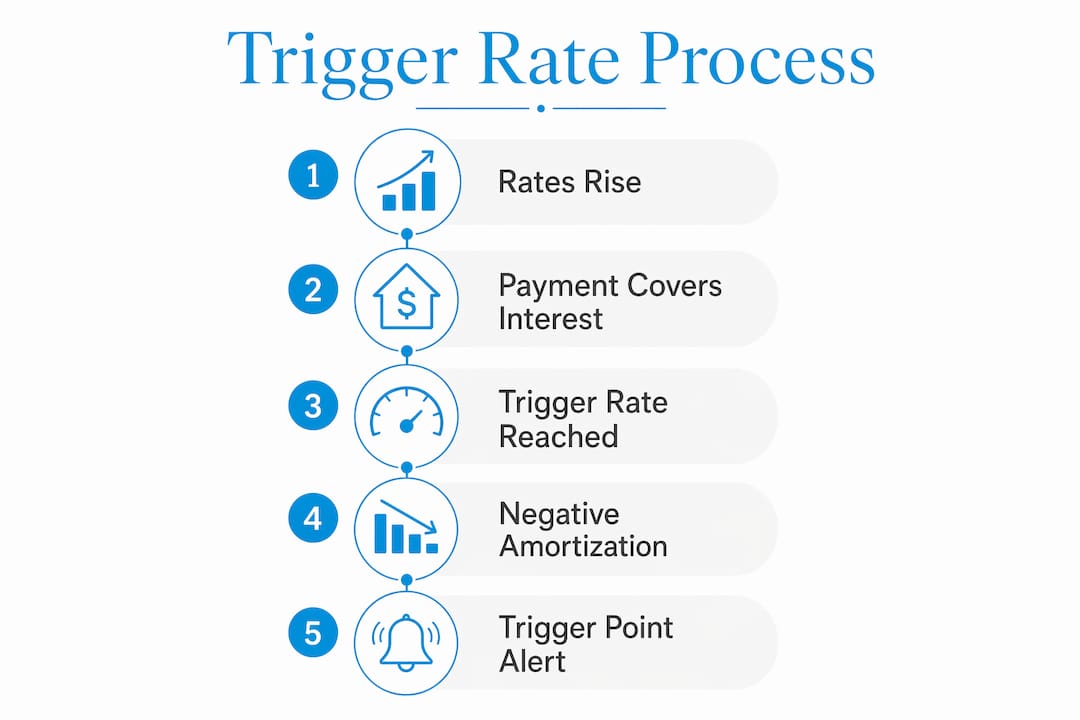
Think of your monthly mortgage payment as a fixed budget with two line items: interest and principal. When interest rates rise, the interest line grows. At some point, it consumes the entire payment, leaving nothing for principal repayment. That exact point is your trigger rate.

Negative amortization is what happens next: the unpaid interest doesn't disappear; it gets added to your outstanding balance. Your mortgage grows even though you're making every payment on time. The compounding effect matters here. Interest in subsequent periods is then calculated on that larger balance, which accelerates future interest costs.
A simple way to picture it: imagine a household budget where your grocery bill keeps rising but your weekly spending limit stays fixed. Eventually, groceries eat the whole budget and nothing goes toward rent. The trigger rate is that tipping point for your mortgage.
Trigger rate versus trigger point: two different thresholds
These two terms are often used interchangeably, but they describe different stages of the same problem.
The trigger rate is the interest rate at which your fixed payment covers only interest. You may cross it without your lender immediately requiring action, depending on their policy.
The trigger point is a separate contractual threshold, typically defined as the moment your outstanding balance rises back to, or above, your original loan amount (or a set percentage of your home's appraised value). That's when lenders are generally required to act.
Here's the typical sequence: rates rise → your payment covers less principal → you reach the trigger rate → unpaid interest begins capitalizing → your balance climbs → you approach the trigger point → your lender contacts you and requires a remedy.
Lenders handle this sequence differently. Some send a courtesy notice when you hit the trigger rate; others allow negative amortization to accumulate until the trigger point is reached. The trigger point is where action becomes mandatory.
Which mortgages and borrowers are most at risk?
Not every variable-rate product carries trigger-rate risk. The distinction matters.
Your mortgage is likely exposed if it has all of the following features:
- A variable interest rate tied to the lender's prime rate
- A fixed payment amount that does not automatically adjust when prime changes
- Contract language referencing a "trigger rate," "negative amortization," or a fixed payment schedule
About three-quarters of variable-rate mortgages in Canada carry fixed payments, which means the majority of VRM holders are in scope.
Borrowers at the highest risk are those who took out long amortization periods at very low rates, particularly during 2020–21. Bank of Canada analysis confirms that a lower origination rate combined with a longer amortization period produces a lower trigger rate, making those mortgages more sensitive to any rate increase.

Adjustable-rate mortgages (ARMs), where the payment amount rises and falls automatically with prime, do not experience trigger rates in the same way. If your payment changes every time the Bank of Canada moves rates, you likely don't have this exposure. If your payment has stayed the same despite rate hikes, you almost certainly do.
How to calculate your personal trigger rate
The most common manual formula used by practitioners is:
(Payment amount × payments per year) ÷ outstanding balance = approximate trigger rate
Step-by-step worked example
- Identify your monthly payment: $2,100
- Multiply by payments per year (monthly = 12): $2,100 × 12 = $25,200
- Divide by your outstanding balance: $25,200 ÷ $420,000 = 0.06
- Convert to a percentage: 0.06 × 100 = 6.00%
In this example, if your variable rate climbs to 6.00%, your entire payment goes to interest. Any rate above that triggers negative amortization.
Manual calculations are approximations. Canadian mortgage contracts use semi-annual compounding rules that can shift the contractual trigger rate by roughly 0.05–0.10% from a simple manual estimate. Payment frequency also affects the numerator: bi-weekly payments produce a slightly different result than monthly. WOWA's trigger-rate calculator is a useful verification tool, but always confirm the exact contractual figure with your lender.
Pro Tip: Your original mortgage contract may already state your trigger rate. Check there first before running the manual formula — and remember that prepayments you've made since origination will have raised it.
What happens when you reach the trigger rate?
The financial consequences follow a predictable pattern once you cross the threshold:
- Your full payment is applied to interest only; no principal is repaid.
- Unpaid interest is added to your outstanding balance (negative amortization begins).
- Your balance grows, which increases the interest calculated in the next period.
- Rising balance erodes your home equity and can complicate renewal negotiations.
- If the balance reaches your trigger point, your lender is required to intervene.
On the lender side, practices vary across Canadian institutions. Some increase your payment automatically; others allow negative amortization for a period and contact you with options; a few will reach out proactively before you formally hit the threshold. None of this is uniform across lenders, which is exactly why knowing your own contract matters.
FCAC recommends that borrowers contact their financial institution as soon as possible when rates are rising and they hold a fixed-payment VRM. Your lender is obligated to explain your options clearly.
Practical options if you're approaching or have hit the trigger rate
Acting early preserves the most choices. Here's a prioritised list of what to consider, roughly in order of ease and impact:
- Contact your broker or lender first. Before doing anything else, get your contractual trigger rate confirmed and understand your lender's specific policies. A broker can model scenarios across multiple lenders simultaneously.
- Increase your regular payment. FCAC identifies this as often the most straightforward remedy. Even a modest increase can restore principal repayment and stop negative amortization. The trade-off: higher monthly cash outflow.
- Make a lump-sum prepayment. A prepayment reduces your outstanding balance, which raises your trigger rate and restores the principal portion of your payment. Most Canadian mortgages allow annual prepayments within set limits (commonly 10–20% of the original principal). Check your contract for the exact allowance.
- Convert to a fixed-rate mortgage. Locking in eliminates trigger-rate exposure entirely. The trade-off: fixed rates are often higher than current variable rates, and you give up potential savings if rates fall. Some lenders allow conversion without penalty; others charge a fee.
- Extend your amortization. Spreading the remaining balance over a longer period lowers the required payment and can restore principal repayment. This is a last resort because it increases total interest paid over the life of the mortgage. You'll need to qualify under current rules.
- Refinance with broker assistance. A full refinance can combine a rate reset, amortization adjustment, and lender change into one transaction. It involves a new approval process and closing costs, but a broker can run a refinance calculation to show whether the numbers make sense for your situation.
Pro Tip: Contact your lender or broker when you estimate you're within roughly 0.25–0.50% of your trigger rate. At that margin, you still have time to choose rather than react.
How Bank of Canada policy flows through to your variable-rate mortgage
The causal chain is short: the Bank of Canada sets its policy rate → Canadian banks adjust their prime rate (typically prime = policy rate + 2.20%) → lender variable rates move in step → the interest portion of your fixed payment grows → less of each payment reaches your principal.
| Variable rate level | Estimated share of fixed-payment VRMs at trigger rate |
|---|---|
| Rates at origination levels (2020–21 lows) | Near zero |
| Rates ~2% above origination | Minority of VRM holders |
| Rates ~4% above origination | Roughly 50% of VRMs with fixed payments |
| Rates ~5%+ above origination | Majority of fixed-payment VRM holders |
Source: Bank of Canada Staff Analytical Note 2022-19. Figures reflect estimated shares at various rate levels, not a specific calendar date.
The rapid rate increases that began in 2022 pushed a large share of fixed-payment VRM holders toward or past their trigger rates in a short period. Rates have since moved, so always check the current Bank of Canada policy rate and your lender's prime rate to assess where you stand today.
VRM versus ARM: why the product type determines your risk
The label "variable-rate mortgage" covers two meaningfully different products in Canada. Knowing which one you have changes everything.
- Fixed-payment VRM: Your payment stays constant regardless of rate moves. As rates rise, more of each payment goes to interest and less to principal. This product carries trigger-rate risk.
- Variable-payment VRM (adjustable-rate): Your payment adjusts automatically when prime changes. More interest means a higher payment, but the principal portion is protected. This product does not carry trigger-rate risk in the same way.
- ARM-style contracts: Similar to variable-payment VRMs; the payment floats with the rate. No fixed-payment threshold to breach.
When reviewing your mortgage contract, look for these phrases: "fixed payment," "variable interest based on prime," "trigger rate," or "negative amortization." If your contract says your payment is fixed and your rate is variable, you have trigger-rate exposure.
If you're unsure, call your lender and ask one direct question: "Does my payment adjust automatically when prime changes?" A yes means you have an adjustable-payment product. A no means you have a fixed-payment VRM and should run the trigger-rate calculation.
When to contact your lender or broker — and what to bring
Being prepared makes the conversation faster and more productive. Gather these before you call:
- Most recent mortgage statement (shows outstanding balance and current rate)
- Your current payment amount and payment frequency
- Remaining amortization period
- Original mortgage contract (if available — it may state your trigger rate directly)
- Any prepayment history (lump sums reduce your balance and raise your trigger rate)
Once you're on the call, ask these questions directly:
- "Have I reached my trigger rate, or how close am I?"
- "Can you calculate my exact contractual trigger rate today?"
- "What are my options, and are there any deadlines I need to know about?"
- "What happens at the trigger point at your institution specifically?"
- "If I increase my payment, by how much would I need to increase it to restore principal repayment?"
A mortgage broker adds a layer of value here that a single lender cannot. A broker can model payment scenarios across more than fifty lenders, compare the cost of converting to fixed versus extending amortization, and negotiate timing with lenders on your behalf. Deneenoel works with clients across Alberta on exactly these conversations, presenting side-by-side scenarios so you can make a clear, informed decision rather than accepting the first option your lender offers.
Pro Tip: Ask your broker to show you the total interest cost over the remaining amortization for each option, not just the monthly payment change. The monthly number can be misleading; the lifetime cost tells the real story.
Key takeaways
The trigger rate is the single most important number a fixed-payment variable-rate mortgage holder needs to know, and calculating it takes less than five minutes with your mortgage statement in hand.
| Point | Details |
|---|---|
| Trigger rate definition | The interest rate at which your fixed payment covers only interest and no principal. |
| Who is at risk | Borrowers with fixed-payment VRMs, especially those who originated at low 2020–21 rates with long amortization periods. |
| Quick self-check | Multiply your payment by payments per year, divide by your outstanding balance; if that percentage is close to your current rate, act now. |
| Immediate next steps | Contact your broker or lender, confirm your contractual trigger rate, and model payment increase or prepayment options before the trigger point is reached. |
| Deneenoel's role | Deneenoel works with Alberta borrowers to model trigger-rate scenarios across more than fifty lenders and identify the most cost-effective path forward. |
A broker's perspective on trigger-rate calls
When a client calls me about their trigger rate, the first thing I do is separate the anxiety from the actual numbers. Most people assume the worst, and most of the time the situation is more manageable than it feels. What I find consistently is that borrowers who call early, before their lender has already initiated a change, have the most options available to them. The ones who wait until they receive a formal notice from their lender are often left with one or two choices rather than five or six.
In Alberta, I've noticed that many borrowers lean toward lump-sum prepayments when they're approaching the trigger rate, particularly those with equity built up during the strong real estate years. That's often a smart move, but it's not always the right one. For some clients, converting to a fixed rate makes more sense, especially if they're within a year of renewal and want certainty. The right answer depends on your balance, your remaining amortization, your cash flow, and what your lender's specific trigger-point policy looks like. That's the conversation worth having before anything else.
Deneenoel can help you navigate your trigger rate
If you hold a variable-rate mortgage with a fixed payment and rates have been moving, a trigger-rate review is worth doing now. Deneenoel offers personalized mortgage guidance across Edmonton, Calgary, and surrounding areas in Alberta, with access to more than fifty Canadian lenders.

A trigger-rate review with Deneenoel covers your current outstanding balance, your estimated and contractual trigger rate, and a side-by-side comparison of your realistic options: payment increase, lump-sum prepayment, conversion to fixed, amortization extension, or refinancing. There's no cost to you for the consultation. Services include pre-approvals, mortgage renewal advice, refinancing, and converting variable-rate mortgages to fixed, all with transparent guidance at every step.
Book a trigger-rate review with an Edmonton mortgage broker at Deneenoel, or reach out through the Calgary office if you're in southern Alberta.
Authoritative Canadian sources for further reading
These sources back the figures and guidance in this article and are worth bookmarking for your own reference:
- Financial Consumer Agency of Canada — Managing your money when interest rates rise: The primary government consumer guide on trigger rates, negative amortization, and your rights as a borrower. Use it to understand lender obligations and FCAC's recommended steps.
- Bank of Canada Staff Analytical Note 2022-19 — Variable-rate mortgages with fixed payments: The most detailed publicly available analysis of trigger-rate prevalence in Canada, including the share of VRMs at trigger rates at various rate levels. Use it to understand the scale of the issue and the BoC's methodology.
- Ratehub.ca — The trigger rate: everything you need to know: A practitioner-level explainer with product comparisons and a calculator. Useful for confirming your manual estimate and comparing fixed versus variable scenarios.
- WOWA.ca — What is the mortgage trigger rate?: Includes a working trigger-rate calculator and a clear breakdown of the formula. Use it to cross-check your manual calculation before calling your lender.
- WealthNorth — Mortgage trigger rate explained: A practitioner note explaining why manual estimates can differ from your contractual trigger rate by 0.05–0.10% due to compounding rules.
Authoritative links are for background research and modelling only. Always confirm your exact contractual trigger rate directly with your lender, as the figure in your contract governs what your lender will act on.
This article is general information for Canadian mortgage borrowers and does not constitute financial or legal advice. Confirm your specific trigger rate and available options with your lender or a licensed mortgage professional.