
In Canada, your down payment determines which mortgage category you fall into. Put down less than 20% on a home priced at $1.5 million or under, and you have a high-ratio mortgage, meaning mortgage default insurance through CMHC, Sagen, or Canada Guaranty is mandatory. The Minimum Qualifying Rate (MQR) framework and the federal Insurable Housing Loan Regulations govern how each category qualifies and what rates you can expect.
Three differences matter most right away:
- Down payment and insurance cost: Under 20% down means you pay a premium of 0.60%–4.50% of the loan amount; at 20% or more, you pay no premium directly.
- Who the insurance protects: Mortgage default insurance protects the lender, not you. You pay the premium, but the lender collects if you default.
- Rate direction: Insured and insurable mortgages typically carry lower headline rates than fully uninsured ones, because lenders face less capital risk on insurer-backed loans.
Key takeaways
| Point | Details |
|---|---|
| Insurance is mandatory under 20% down | Any purchase under $1.5M with less than 20% down requires CMHC, Sagen, or Canada Guaranty default insurance. |
| Premiums range from 0.60% to 4.50% | The exact rate depends on your LTV band; the premium is added to your mortgage or paid at closing. |
| Insurable mortgages carry no borrower premium | At 20% down on an eligible property, lenders may buy portfolio insurance at their cost, often passing rate savings to you. |
| Refinances are always uninsured | Equity takeouts and refinances do not qualify for mortgage default insurance, regardless of LTV. |
| Deneenoel routes files across 50+ lenders | Working with Denée Noel Mortgages means your file is matched to lenders whose portfolio-insurance appetite fits your situation. |
Primary sources and further reading
- CMHC mortgage loan insurance explained: CMHC's 2025 consumer and professional guidance on when insurance is mandatory, who it protects, and how premiums work.
- CMHC purchase premium schedule: The official LTV-band premium table for homeowner purchase loans; use this to calculate your exact premium.
- CMHC mortgage loan insurance cost (consumer guidance): Plain-language explanation of who needs insurance, payment options, and how the premium is applied.
- Canada Gazette SOR/DORS-55 (March 2025): The regulatory amendments documenting the MQR formulation and the December 2024 changes affecting uninsured-to-portfolio-insured switches at renewal.
- Insurable Housing Loan Regulations (Justice Laws): The legislative text setting out insurability criteria, transaction-type rules, and underwriting requirements for mortgage default insurance in Canada.
This article provides general information about Canadian mortgage categories and is not a substitute for professional mortgage or financial advice. Confirm current rules and your specific eligibility with a licensed mortgage broker or your lender before making financing decisions.
Table of Contents
- Insured vs uninsured mortgage: quick comparison
- What an insured (high-ratio) mortgage is in Canada
- What an uninsured (conventional) mortgage is
- The middle ground: how insurable mortgages work
- How mortgage default insurance affects your borrowing cost
- Who qualifies for each category and what changed in 2024–2025
- Pros, cons, and when to choose each option
- How Denée Noel Mortgages helps you navigate the choice
- Ready to find the right mortgage structure for your situation?
- Sources
Insured vs uninsured mortgage: quick comparison
Three practical points stand out from this comparison:
- A 20% down payment does not always guarantee the lowest rate. Some insurable mortgages may be priced close to insured ones, while uninsured mortgages typically carry higher rates.
- Refinancing transactions are generally uninsurable, resulting in higher rates than purchase mortgages at similar loan-to-value ratios.
- There is a maximum purchase price threshold for insured and insurable mortgages; above this threshold, mortgages are uninsured by default.
What an insured (high-ratio) mortgage is in Canada
CMHC mortgage loan insurance is mandatory when your down payment is under 20% and the purchase price is $1.5 million or less. The three approved providers are CMHC, Sagen, and Canada Guaranty. Your lender selects the insurer; you pay the premium.
The premium is calculated as a percentage of your insured loan amount and depends on your loan-to-value (LTV) ratio. Here is the CMHC purchase premium schedule:
You can pay the premium as a lump sum at closing, but most borrowers add it to their mortgage balance. That means you pay interest on the premium over your amortization period, which adds to the total cost. Provincial sales tax applies to the premium in some provinces and must be paid at closing.
A critical point that surprises many buyers: mortgage default insurance protects the lender, not you. If you default, the insurer compensates the lender. You remain liable for any shortfall the insurer then pursues from you.
Pro Tip: Insured mortgages often carry lower interest rates than uninsured ones, even though you pay a premium. This happens because CMHC-backed loans are eligible for the National Housing Act Mortgage-Backed Securities (NHA MBS) program, which lowers lenders' funding costs. That funding advantage is passed on as a lower rate. In many cases, the rate savings over a five-year term partially offset the premium cost, though the net outcome depends on your loan size and amortization.
What an uninsured (conventional) mortgage is
You carry no premium cost, but the lender carries the full credit risk.
Because lenders hold that risk on their own balance sheet, they typically price uninsured mortgages slightly higher than insured or insurable ones. The spread varies by lender and market conditions, but it is a consistent pattern across the Canadian mortgage market.
Uninsured mortgages do offer more flexibility in several areas:
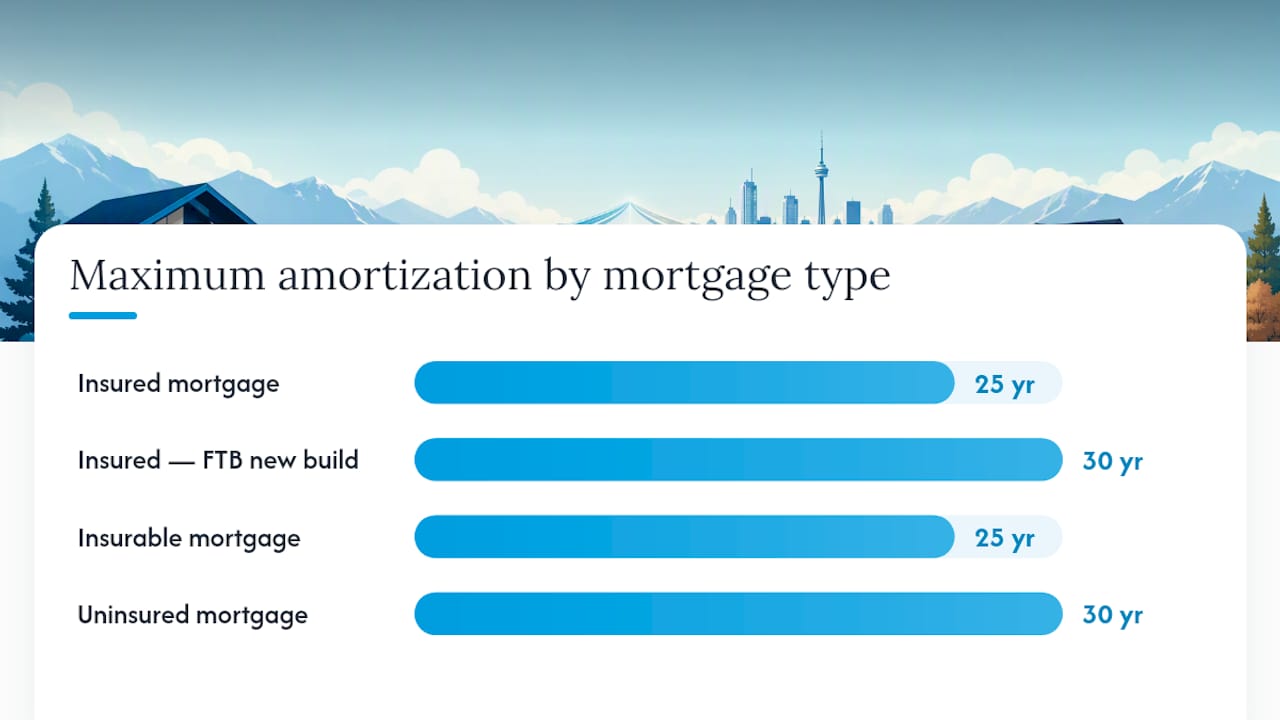
- Amortization: Up to 30 years, compared to 25 years for insured and most insurable files. The longer amortization lowers monthly payments, though total interest paid over the life of the loan increases.
- Purchase price: No cap. Homes priced above $1.5 million can only be financed with an uninsured mortgage.
- Transaction types: Refinancing and equity takeouts are treated as uninsurable transactions, so any refinance is automatically uninsured, regardless of LTV.
Three situations where an uninsured mortgage is the only option or the clear fit:
- Purchasing an investment property (insurers do not cover non-owner-occupied purchases in most cases)
- Refinancing an existing mortgage to access equity
- Buying a home priced above $1.5 million
The middle ground: how insurable mortgages work
Insurable mortgages sit between the two main categories and are often misunderstood. You put down 20% or more, so you pay no insurance premium directly. But your file still meets the eligibility criteria set out in the Insurable Housing Loan Regulations, which means your lender has the option to buy portfolio insurance on the loan at its own cost.
For a mortgage to be insurable, it generally must meet all of the following:
- Purchase price at or below $1.5 million
- Amortization of 25 years or less
- Owner-occupied property (not a rental or investment)
- Purchase transaction (not a refinance or equity takeout)
- Meets insurer underwriting criteria for the borrower's credit and income profile
When a lender portfolio-insures your file, it gains access to lower-cost funding, similar to what it gets on insured mortgages. Lenders often pass a portion of that benefit to borrowers as a rate reduction. The result: insurable borrowers frequently see rates close to insured pricing, without paying a premium.
Pro Tip: Not every lender portfolio-insures every eligible file. A broker with access to multiple lenders can identify which ones will treat your file as insurable and price it accordingly. That routing decision can be worth tens of thousands of dollars over a five-year term on a mid-sized Alberta mortgage.
How mortgage default insurance affects your borrowing cost
The premium is the most visible cost, but the rate difference between categories matters just as much. Here is the CMHC premium schedule again for reference, since it drives the example below:

Illustrative example (figures are approximate and for comparison only):
Assume a $500,000 purchase price in Alberta, a 5-year fixed rate, and a 25-year amortization.
- Insured (10% down, $450,000 loan): CMHC premium at 3.10% = $13,950 added to the mortgage. Insured rate: 4.49%. Monthly payment: approximately $2,490. Total interest over 25 years: approximately $297,000.
- Insurable (20% down, $400,000 loan): No premium. Insurable rate: 4.54%. Monthly payment: approximately $2,200. Total interest over 25 years: approximately $260,000.
- Uninsured (20% down, $400,000 loan, 30-year amortization): No premium. Uninsured rate: 4.74%. Monthly payment: approximately $2,060. Total interest over 30 years: approximately $341,000.
The uninsured 30-year option lowers monthly payments but substantially increases total interest paid. The insured scenario costs more in total, but it gets you into the market with less cash upfront.
Pro Tip: Always run both the premium-plus-interest total and the monthly payment comparison side by side. A lower monthly payment from a 30-year uninsured mortgage can look attractive, but the total interest cost over that longer amortization often exceeds what you would have paid with a 25-year insured mortgage, even including the premium.
Who qualifies for each category and what changed in 2024–2025
Qualification rules differ by category, and recent regulatory changes have shifted some boundaries.
Insured mortgage qualification:
- Down payment under 20%, purchase price at or below $1.5 million
- Maximum amortization: 25 years (30 years for first-time buyers purchasing a new build, per the 2024 federal update)
- Owner-occupied purchase only
- Stress-tested at the MQR: the greater of your contract rate plus 2% or the 5.25% floor, per the Canada Gazette amendments
Insurable mortgage qualification:
- 20% or more down, purchase price at or below $1.5 million
- Amortization of 25 years or less
- Owner-occupied purchase transaction
- Meets insurer underwriting criteria
Uninsured mortgage qualification:
- 20% or more down, no purchase-price cap
- Amortization up to 30 years
- Includes refinances, equity takeouts, investment properties, and purchases above $1.5 million
- Stress-tested at the MQR for most lenders
Key December 2024 regulatory change: The 2024 Fall Economic Statement introduced amendments removing the MQR stress-test requirement for certain uninsured borrowers who switch lenders at renewal and move to a lender that purchases portfolio insurance on the file. This expands renewal options for some conventional borrowers and increases lender competition at renewal.
Regulatory callout: The MQR is set at the greater of the borrower's contract rate plus 2% or a 5.25% floor. For a borrower qualifying at a 4.74% contract rate, the qualifying rate is 6.74%. This stress test reduces the maximum mortgage amount a borrower can qualify for compared to qualifying at the contract rate alone, and it applies across insured, insurable, and most uninsured files.
Debt service ratios also apply across all categories. Your credit score affects which lenders will approve your file and at what rate, independent of the insurance category.
Pros, cons, and when to choose each option
Insured mortgage
- Pros: Lower down payment required, lowest headline rates, access to NHA MBS-backed lender funding, insurance can transfer at sale or renewal in some cases
- Cons: Premium adds to loan balance, amortization capped at 25 years (with limited exceptions), purchase-price cap of $1.5 million, insurance protects lender not borrower
Insurable mortgage
- Pros: No premium paid by borrower, rates often close to insured pricing, 25-year amortization
- Cons: Still subject to $1.5 million cap and 25-year amortization limit, not available for refinances or investment properties, rate benefit depends on lender's portfolio-insurance appetite
Uninsured mortgage
- Pros: No purchase-price cap, 30-year amortization available, works for refinances and investment properties, more lender underwriting flexibility
- Cons: Higher rates than insured or insurable, lender carries full credit risk and prices accordingly, no premium-transfer benefit at renewal
Decision checklist — run through these steps with your numbers:
- Check your down payment as a percentage of the purchase price. Under 20%? You are in insured territory.
- Check the purchase price. Above $1.5 million? You are uninsured by default.
- Confirm your amortization preference. Need more than 25 years? Only uninsured allows it (with most lenders).
- Identify your transaction type. Refinancing or buying an investment property? Uninsured is the category.
- If you are at exactly 20% down on an eligible property, ask your broker whether the file qualifies as insurable and which lenders will portfolio-insure it.
- Run the premium-plus-interest total cost comparison against the insurable and uninsured scenarios before deciding.
Pro Tip: Insured mortgages can be easier to switch at renewal. Because the insurance follows the loan, some lenders will accept a transfer without requiring a new stress test, which increases your negotiating power and lender options at renewal time. For mortgage renewal strategy, this portability is worth factoring into your initial decision.
How Denée Noel Mortgages helps you navigate the choice
Choosing between insured, insurable, and uninsured is not just a math problem. It depends on which lenders will portfolio-insure your file, how their rates compare on that specific day, and whether your amortization or transaction type limits your options. That is where working with a broker makes a concrete difference.
Denée Noel Mortgages provides:
- Lender matching across 50+ Canadian lenders: Not every lender offers insurable pricing on every eligible file. Access to a wide lender network means your file gets routed to the lender whose portfolio-insurance appetite and rate structure best fit your situation.
- Insurable-file routing: Identifying whether your 20%-down purchase qualifies as insurable, and which lender will treat it that way, can shift your rate meaningfully.
- Premium vs. rate modelling: Side-by-side cost comparisons across insured, insurable, and uninsured scenarios so you can see the total-cost picture, not just the monthly payment.
- Written pre-approvals with rate holds: Lock in a rate while you shop, with a mortgage pre-approval that reflects your actual category and lender options.
- Refinancing and renewal strategy: Since refinances are uninsurable, getting the right lender and rate structure matters more, not less. Denée's team handles complex files including self-employed borrowers and new-to-Canada clients.
The next step is straightforward: bring your purchase price, down payment amount, and amortization preference to a broker consultation. You will leave knowing your category, your rate range, and your total cost estimate. Learn more about what a mortgage broker does before your first conversation.
A note from Denée on what I see most often
Sometimes they are. I have seen two clients with identical down payments, purchase prices, and credit profiles end up with meaningfully different rates simply because one was routed through a lender with active portfolio-insurance arrangements and the other was not.
A few things worth keeping in mind before you decide:
- The category your mortgage falls into is not always obvious from the lender's rate sheet.
- Refinancing changes the category entirely, regardless of your equity position.
- Total cost over the full amortization tells a different story than the monthly payment alone.
Ready to find the right mortgage structure for your situation?
Sorting out whether your purchase qualifies as insured, insurable, or uninsured is exactly the kind of question a broker answers before you ever submit an application. Denée Noel Mortgages works with buyers across Alberta, from first-time purchases in Edmonton to investment properties in Calgary, with access to more than 50 lenders and the ability to model your costs across all three mortgage categories.

Book a no-obligation consultation with an Edmonton mortgage broker or reach out through Denée Noel Mortgages to get your numbers in front of a broker who knows Alberta's market and the lenders most likely to work in your favour.
Sources
- CMHC mortgage loan insurance explained
- CMHC Purchase | CMHC
- Canada Gazette (SOR/DORS-55) — amendments affecting mortgage insurance and MQR
- Insurable Housing Loan Regulations (Justice Laws Website)
- CMHC — mortgage loan insurance cost (consumer guidance)