
A mortgage gift letter is a lender-required, one-page declaration confirming that the funds provided for your down payment are a genuine gift with no expectation of repayment and no lien on the property. Without one, lenders may treat the money as a loan and add it to your debt obligations, which can derail your approval entirely. Here is what you need to do right away:
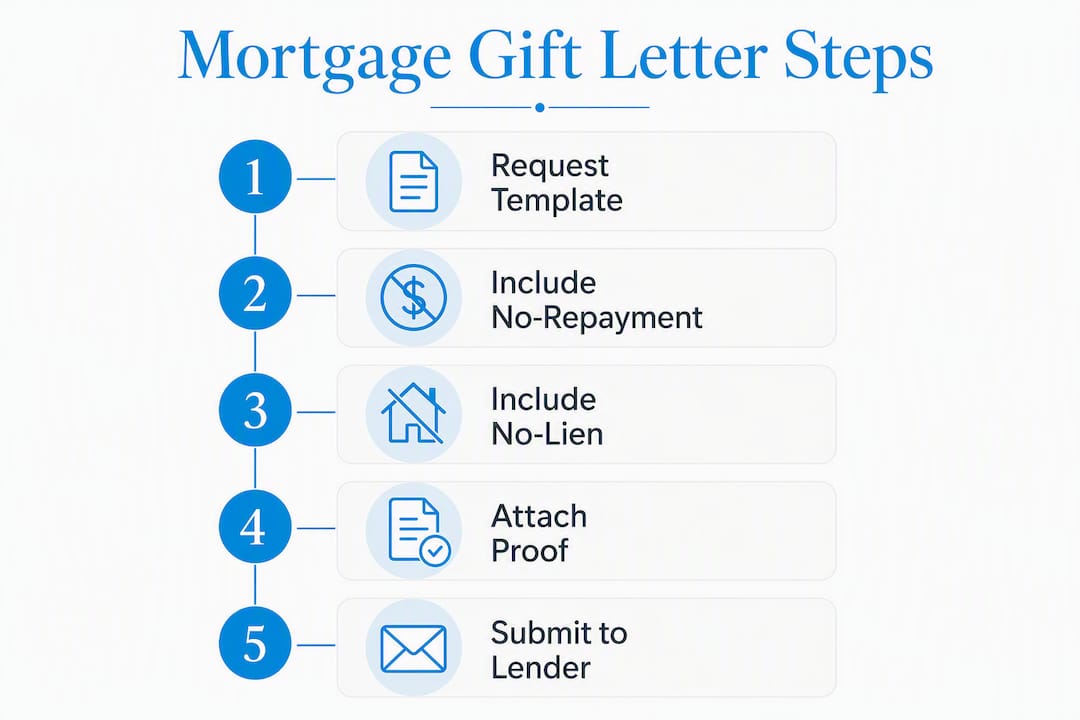
- Ask your lender or mortgage broker for their preferred gift-letter template before drafting anything yourself.
- Arrange proof of transfer: a wire receipt, e-transfer confirmation, or cheque image showing the donor's name, the amount, and the date.
- Collect donor evidence of funds: typically 90 days of the donor's bank statements showing the money was theirs to give.
These three items, the signed gift letter, the transfer receipt, and the donor's bank statements, are what underwriters look for first. Get them in order early and you avoid the most common cause of last-minute closing delays.
Table of Contents
- What is a mortgage gift letter and how does it differ from a loan?
- Who can give a mortgage gift in Canada?
- What must a gift letter say?
- How lenders verify gifted funds and what seasoning means
- Tax and legal implications for donors and recipients in Canada
- Where to get a gift letter and a ready-to-use sample template
- Step-by-step checklist and timeline for a gifted down payment
- Common red flags and mistakes that cause lender rejections
- How a mortgage broker can simplify gift-letter paperwork
- Key takeaways
- Why careful gift documentation matters more than most buyers realise
- Ready to get your gift-letter package right the first time?
- Useful Canadian sources for gift-letter guidance
What is a mortgage gift letter and how does it differ from a loan?
A gift letter is a short, signed document that confirms one thing clearly: the money transferred to you is a gift, not a loan. It carries no repayment schedule, no interest, and creates no financial obligation between you and the donor. That distinction matters to lenders because it tells them your debt-to-income ratio is not being understated.

A loan from a family member, even an informal one, is a liability. Lenders are required to count it against your borrowing capacity. A co-signer is different again: a gift giver has no legal responsibility for your mortgage payments, while a co-signer shares both the legal liability and the credit consequences of the mortgage. Accepting a gift keeps your parents or relatives off title and off the hook for your debt.
Lenders insist on precise language in the letter because vague wording leaves room for interpretation. Phrases like "we expect to be repaid when you can" or "we'd like a share of the equity" turn a gift into a hidden liability. The letter eliminates that ambiguity in writing.
Pro Tip: Ask your lender for their gift-letter template before the donor signs anything. Using the lender's own wording is the single fastest way to prevent a request for a revised letter from underwriting.
Who can give a mortgage gift in Canada?
Most lenders accept gifts from immediate family members: parents, grandparents, siblings, legal guardians, and spouses. Beyond that circle, rules vary considerably from one lender to the next.
| Donor type | Typically accepted? | Extra documentation likely? |
|---|---|---|
| Parents or step-parents | Yes, by nearly all lenders | Standard gift letter + bank statements |
| Grandparents | Yes, by most lenders | Standard gift letter + bank statements |
| Siblings | Yes, by most lenders | Standard gift letter + bank statements |
| Legal guardian | Yes, by most lenders | May require proof of guardianship |
| Spouse or common-law partner | Yes, universally | Standard gift letter |
| Extended family (aunts, uncles, cousins) | Varies by lender | Often requires extra identity verification |
| Friends or unrelated third parties | Rarely accepted | Usually declined or requires full explanation |
For insured mortgages, the rules tighten further. Mortgage insurers including CMHC, Sagen, and Canada Guaranty set the standards lenders must follow, and those standards typically restrict acceptable donors to immediate family. If your mortgage requires default insurance (a down payment below 20%), confirm the donor qualifies under the insurer's guidelines, not just the lender's.
Non-immediate-family donors will almost always trigger a request for additional identity verification: a copy of government-issued ID, a letter explaining the relationship, and sometimes a statutory declaration. Plan for that paperwork in advance rather than scrambling for it during underwriting.
What must a gift letter say?
Every lender has slightly different preferences, but the mandatory fields are consistent across Canada. A properly completed gift letter for a mortgage down payment must include all of the following:
- Donor's full legal name, address, and contact information
- Recipient's full legal name (the borrower)
- Relationship between donor and recipient (e.g., "mother and daughter")
- Exact dollar amount of the gift in Canadian dollars
- Date the gift was or will be transferred
- Explicit no-repayment statement: a clear declaration that the funds are a gift and no repayment is required or expected
- No-lien/no-charge statement: confirmation that the donor will not hold any interest in, or charge against, the property
- Donor's signature (and in some cases, the recipient's signature)
- Witness or notary line if the lender requires it
Optional fields some lenders request include the source of the donor's funds (savings, RRSP withdrawal, sale of an asset) and a statement confirming the transfer has already occurred.
For the two most critical clauses, lender-friendly language looks like this:
No-repayment clause: "This gift is provided without any expectation of repayment, now or in the future, and no repayment arrangement of any kind exists between the donor and the recipient."
No-lien clause: "The donor will not hold, register, or seek any interest, charge, or lien against the property being purchased."
Copy these phrases closely. Underwriters flag vague alternatives.
How lenders verify gifted funds and what seasoning means
Signing the letter is only half the work. Lenders verify that the money actually moved and that it came from a legitimate source. Typical proof includes donor bank statements, recipient deposit records, wire receipts, and e-transfer confirmations showing the donor's name, the amount, and the date of transfer. Screenshots of online banking transfers are generally accepted when they display all three details clearly.
Seasoning refers to how long gifted funds must sit in your account before a lender will count them as part of your down payment. Some lenders require funds to be in the borrower's Canadian account 30–90 days before closing; international transfers often face stricter requirements tied to anti-money-laundering checks. The earlier the funds arrive, the fewer questions underwriters ask.
For bank statements lenders accept, most want to see 90 days of history from the donor's account to confirm the funds were genuinely available and not borrowed. A practical timeline: if your target closing date is 90 days out, transfer the gift now. For a 30-day closing, the funds should already be in your account. International gifts need even more lead time.
Tax and legal implications for donors and recipients in Canada
The tax picture is straightforward. Canada does not impose a gift tax on private monetary gifts; donors and recipients generally face no immediate income-tax consequences from a gifted down payment. The Canada Revenue Agency does not treat a cash gift between family members as taxable income for the recipient, and the donor does not claim a deduction. Where tax rules can apply is in property transfers (if the gift involves real estate rather than cash) or capital gains situations, so confirm with an accountant if the gift is anything other than a straightforward cash transfer.
The legal picture is more nuanced.
- A gift letter is written for the lender, not for a court. Courts look to substance: if the parties privately intended a loan or an equity share, a signed gift letter does not automatically override that intent in a family dispute or estate claim.
- If there is any ambiguity about whether the money is truly a gift, get a lawyer to draft a separate private agreement confirming the intent. This protects both parties if circumstances change.
- Signing a gift letter while maintaining a private repayment arrangement is mortgage fraud. Both the donor and the recipient can face serious legal consequences. The lender relies on the letter to assess risk; a side-deal that contradicts it misrepresents a material fact in the mortgage application.
Pro Tip: If the transfer is large or the family relationship is complicated, a brief consultation with a real estate lawyer costs far less than resolving a dispute later. Get the intent documented properly from the start.
Where to get a gift letter and a ready-to-use sample template
Using your lender's own template is strongly preferred because it contains the exact wording their underwriters expect. Ask your mortgage broker or lender for it before the donor signs anything. If no template is available, the sample below covers every field a Canadian lender typically requires.
Sample mortgage gift letter (fillable)
Date: __________
To: [Lender Name]
I/We, [Donor Full Name(s)], of [Donor Address], confirm that I/we have gifted the sum of $[Amount] CAD to [Recipient Full Name], my/our [Relationship, e.g., daughter], to be applied toward the purchase of the property located at [Property Address].
This gift is provided without any expectation of repayment, now or in the future, and no repayment arrangement of any kind exists between the donor and the recipient. The donor will not hold, register, or seek any interest, charge, or lien against the property being purchased.
The funds were transferred on [Date] from [Donor Bank Name, Account ending in XXXX] to [Recipient Bank Name].
Donor Signature: __________ Date: __________
Recipient Signature: __________ Date: __________
Witness/Notary (if required): __________
| Field | What to enter |
|---|---|
| Donor full name(s) | Legal name(s) as on government ID |
| Recipient full name | Borrower's legal name as on mortgage application |
| Relationship | Specific family relationship (e.g., "father and son") |
| Amount | Exact dollar figure in CAD |
| Property address | Full civic address of the property being purchased |
| Transfer date | Date funds left the donor's account |
| Donor bank | Name of institution and last four digits of account |
Once signed, attach the transfer receipt and the donor's bank statements. If your lender requires notarisation, have the donor sign in front of a notary public or commissioner of oaths before submitting.
Step-by-step checklist and timeline for a gifted down payment
Follow these steps in order to keep your file clean and your closing on schedule.
- Confirm the gift with your donor early. Discuss the amount, timing, and the documentation they will need to provide before any money moves.
- Contact your lender or mortgage broker to request the gift-letter template and confirm which donor relationships are acceptable for your mortgage type.
- Transfer the funds as early as possible. For conservative lenders, 90 days before your anticipated application date is ideal. Most A-lenders are satisfied with 30 days. Some lenders will accept funds deposited as close as 15 days before closing, but that is the minimum and leaves no buffer.
- Collect the donor's bank statements covering at least 90 days, showing the funds were available and the transfer went out.
- Save your deposit confirmation: the e-transfer notification, wire receipt, or cheque image showing the donor's name, amount, and date.
- Complete and sign the gift letter using the lender's template. Have the donor sign it. Arrange notarisation if required.
- Submit the full package to your broker or lender: gift letter, transfer receipt, donor bank statements, and your own bank statement showing the deposit.
- Confirm acceptance with your underwriter before your mortgage pre-approval expires or your closing date arrives.
Pro Tip: Coordinate the gift transfer with your pre-approval timeline. A large, unexplained deposit appearing in your account after your pre-approval was issued will prompt questions from underwriting. Move the funds before or during the pre-approval process so the paper trail is already in place.
Common red flags and mistakes that cause lender rejections
Most gift-related problems are avoidable. The issues below are the ones that most commonly stall approvals or trigger rescinded offers.
The single most common red flag is ambiguous repayment language. Phrases like "we'll sort it out later" or "pay us back when you can" in any written communication, including text messages, can be enough for an underwriter to reclassify the gift as a loan.
Undocumented transfers are the second most frequent problem. If the money moved months ago and neither party kept records, reconstructing the paper trail is difficult and sometimes impossible. Always document transfers at the time they happen.
Other mistakes to avoid:
- Using funds from a friend or unrelated third party without confirming lender acceptance first. Most lenders will not count these funds regardless of how the letter is worded.
- Failing to collect the donor's proof of funds. Your deposit record alone is not enough; lenders want to see where the money came from on the donor's side.
- Backdating the gift letter or the transfer date. This is document fraud. Date everything accurately.
- Assuming the gift letter alone is sufficient. The letter is one piece of a package; without the transfer receipt and donor statements, it carries little weight with underwriters.
If a lender raises a concern after submission, respond quickly with additional documentation rather than waiting. Delays in responding to underwriter requests are one of the most common reasons closings get pushed back.
How a mortgage broker can simplify gift-letter paperwork
Working with a mortgage broker reduces the friction at every stage of the gift documentation process. Here is where that support makes a practical difference:
- Template sourcing: a broker with access to multiple lenders can pull the correct gift-letter template for your specific lender immediately, rather than leaving you to search for it.
- Wording review: before you submit, the broker checks the letter for language that could trigger an underwriter's concern, such as vague repayment clauses or missing fields.
- Proof-of-funds checklist: the broker tells you exactly which documents to collect from the donor and in what format, so you are not going back and forth with the lender.
- Transfer timing advice: based on your closing date and the lender's seasoning requirements, the broker advises when the funds need to move to avoid a last-minute problem.
- Underwriting liaison: if the lender requests additional documentation, the broker manages that communication directly, which is faster than the borrower navigating it alone.
Deneenoel works with more than fifty Canadian lenders across Alberta, which means the gift-letter requirements, acceptable donor lists, and seasoning windows for each lender are already known. That lender-specific knowledge prevents the most common documentation errors before they reach underwriting. For buyers with complex files, such as self-employed borrowers or new-to-Canada clients, having a broker who knows which lenders are most flexible on gift documentation can be the difference between a smooth approval and a prolonged back-and-forth. Understanding your mortgage approval in Alberta is much clearer when someone who knows the local underwriting environment is in your corner.
Key takeaways
A mortgage gift letter is the lender's proof that your down payment funds are a genuine gift with no repayment obligation, and getting the documentation right from the start is the fastest path to a clean approval.
| Point | Details |
|---|---|
| Use the lender's template | Request the lender's own gift-letter template through your broker to avoid wording errors. |
| Season funds early | Transfer gifted funds 30–90 days before closing; international transfers need even more lead time. |
| Collect donor proof of funds | Donor bank statements covering at least 90 days are required alongside the signed letter. |
| No private repayment deals | Any side-agreement to repay the gift contradicts the letter and can constitute mortgage fraud. |
| Deneenoel simplifies the process | With access to numerous Alberta lenders, Deneenoel reviews gift-letter wording and proof-of-funds packages to prevent approval delays. |
Why careful gift documentation matters more than most buyers realise
Most buyers treat the gift letter as a formality, something to sign quickly and file away. After working through many gifted down payment files across Alberta, what I see consistently is that the problems never come from bad intentions. They come from incomplete documentation assembled in a hurry.
The gap between a smooth closing and a stressful one almost always comes down to whether the paper trail was built proactively or reactively. When a buyer calls me two weeks before closing to say the gift funds arrived six months ago and there are no records, the options narrow fast. Lenders are not being difficult when they ask for 90 days of donor statements and a transfer receipt. They are following insurer guidelines that exist precisely because undocumented funds are a genuine risk to the integrity of the mortgage system.
What I tell every client: treat the gift documentation the same way you treat your purchase contract. Get it right, get it early, and keep copies of everything. The gift letter itself is straightforward. The discipline around it is what protects you at closing.
Ready to get your gift-letter package right the first time?
Gifted down payments are one of the most common ways Alberta buyers reach their down payment target, and the paperwork does not need to be stressful. Deneenoel offers a free document review for buyers using gifted funds: bring your gift letter draft and your proof-of-funds documents, and the file gets checked against the specific requirements of the lender you are working with before anything is submitted.

With access to more than fifty Canadian lenders, Deneenoel can match your file to the lender whose gift documentation requirements fit your situation, whether you are a first-time buyer in Edmonton, a move-up buyer in Calgary, or anywhere across Alberta. No guessing about seasoning windows or donor eligibility rules. You get a clear checklist, a reviewed letter, and a broker who follows up with underwriting so you are not waiting for answers.
Book a free consultation with an Edmonton mortgage broker at Deneenoel, or reach out through deneenoel.com to get your gifted down payment file in order today.
Useful Canadian sources for gift-letter guidance
These are the authoritative references to consult alongside this guide. For large or unusual gifts, always confirm current rules with your lender and consider speaking with a real estate lawyer.
- CMHC Mortgage Loan Insurance for Consumers: covers insured mortgage requirements including down payment rules and acceptable sources of funds under CMHC's guidelines.
- CRA — Gifts and Income Tax (P113): the Canada Revenue Agency's official publication on how gifts are treated for income-tax purposes; confirms there is no gift tax on private monetary gifts in Canada.
- Merovitz Potechin — Gift Letters for a Mortgage Down Payment in Canada: a Canadian law firm's practical overview of gift-letter requirements and when legal documentation is advisable.
This article provides general information about mortgage gift letters in Canada and is not legal or financial advice. Confirm current lender requirements, insurer guidelines, and tax rules with your lender, mortgage broker, or a qualified professional before proceeding.