
A blend and extend mortgage combines your existing interest rate with a lender's current rate into a single weighted average, then restarts your term from scratch so you can lower your payments or access equity without triggering a prepayment penalty. For most Canadian homeowners mid-term, it is worth running the numbers before your next renewal. The quickest next step is to use the FCAC mortgage calculator to model your scenario, then ask your lender or a broker for a written quote. The Financial Consumer Agency of Canada requires lenders to disclose how they calculate the blended rate, so you have the right to see the formula before you sign anything.
Key takeaways
A blend-and-extend mortgage avoids prepayment penalties but always produces a rate above today's best available rate, so running a total-cost comparison against breaking is the only way to know which path saves more money.
| Point | Details |
|---|---|
| Lender discretion | Blending is not guaranteed; FCAC confirms lenders are not required to offer it. |
| Always verify the formula | Ask for the blended-rate calculation in writing and confirm which new rate was applied. |
| Blend-and-extend locks your term | A new full term starts; consider your moving plans and rate outlook before committing. |
| Compare total cost, not just rate | Include the IRD or three-month penalty in the break-and-refinance scenario before deciding. |
| Deneenoel provides free comparisons | Alberta homeowners can get written blend-vs-break comparisons across many lenders at no upfront cost. |
Table of Contents
- What is a blended mortgage, and what are the two main types?
- How is a blended mortgage rate calculated?
- How to use a blend-and-extend calculator effectively
- What are the real pros and cons of blend-and-extend?
- What does a blend-and-extend actually cost?
- Do all lenders offer blend-and-extend in Canada?
- How to request a blend-and-extend: a step-by-step checklist
- How a mortgage broker helps with blend-and-extend decisions
- When I recommend blend-and-extend in practice
- Deneenoel can run your blend-and-extend numbers for free
- Sources
What is a blended mortgage, and what are the two main types?
A blended mortgage keeps your current mortgage intact while folding in a new rate. You do not break the contract, so no prepayment penalty applies. The resulting rate sits somewhere between your old rate and today's market rate, weighted by how much of each is in the mix.
Two distinct variants exist, and choosing the wrong one can cost you months of interest:
- Blend-to-term: Your maturity date stays the same. The blended rate applies only for the time remaining on your original term. This suits homeowners who want a modest rate reduction without extending their commitment.
- Blend-and-extend: Your term resets to a full new period, typically five years. The lender blends the old rate across that longer horizon, which usually produces a lower blended rate than blend-to-term because the new rate carries more weight over the extended period.
Ratehub explains that blend-to-term is more common when only a short time remains on the original term, while blend-and-extend tends to be offered when a homeowner also wants to borrow additional funds or lock in for a fresh full term. Lenders often prefer blend-and-extend because it secures the borrower's business for another full cycle.
When to pick which option:
| Goal | Better choice |
|---|---|
| Reduce rate, keep original maturity | Blend-to-term |
| Lower rate and restart for a full new term | Blend-and-extend |
| Access equity or top-up funds mid-term | Blend-and-extend |
| Moving within two years | Neither — consider porting first |
How is a blended mortgage rate calculated?
The math is straightforward once you have four numbers: your outstanding balance, your current rate, the months remaining on your term, and the new rate and term length the lender is offering.
The month-weighted formula
Most Canadian lenders use a time-weighted approach rather than a simple average. The FCAC's example method works as follows:
- Multiply your current rate by the months remaining on your existing term.
- Multiply the new rate by the months in the new term extension (the months being added).
- Add the two results together.
- Divide by the total number of months in the new blended term.
Worked example with realistic Canadian numbers
- Blend-and-extend total term is the sum of months remaining plus the new full term length.
- Weighted numerator: (5.50 × 24) + (4.25 × 60) = 132 + 255 = 387
- Blended rate: 387 ÷ 84 = 4.607%
That gap illustrates why the time-weighted method matters: the more months at the new rate, the lower the blended result.
Pro Tip: Ask your lender to send you the exact formula and the inputs they used in writing before you agree to anything. If their blended rate is higher than your own calculation, the difference likely comes from which "new rate" they applied — posted versus negotiated.
How to use a blend-and-extend calculator effectively
A calculator gives you a reliable starting point, but only if you feed it the right numbers. The FCAC mortgage calculator can model payment and interest scenarios to help you verify a lender's quote.
Inputs to gather before you start:
- Outstanding principal balance (from your most recent mortgage statement, not the original amount)
- Your current contracted interest rate
- Exact months remaining on your current term
- The new rate your lender is actually offering for the blend (not the advertised posted rate)
- Any top-up amount you want to borrow, if applicable
- The new term length in months
Three scenarios worth running side by side:
- Blend-to-term at the lender's offered rate
- Blend-and-extend at the same rate
- Breaking the mortgage and refinancing at the best available rate, after subtracting the prepayment penalty
Common mistakes that skew results:
- Using the lender's advertised rate instead of the rate they will actually apply to your blend. WealthNorth notes that big banks' blend offers can be several basis points above what a monoline or negotiated rate would be, so always confirm which rate the lender used.
- Forgetting that any top-up funds are typically priced at the current full rate, not the blended rate, which raises your effective cost.
- Comparing monthly payments only, rather than total interest paid over the full term.
Pro Tip: Run the break-and-refinance scenario with the actual penalty included. Smaller gaps usually favour blending.
What are the real pros and cons of blend-and-extend?
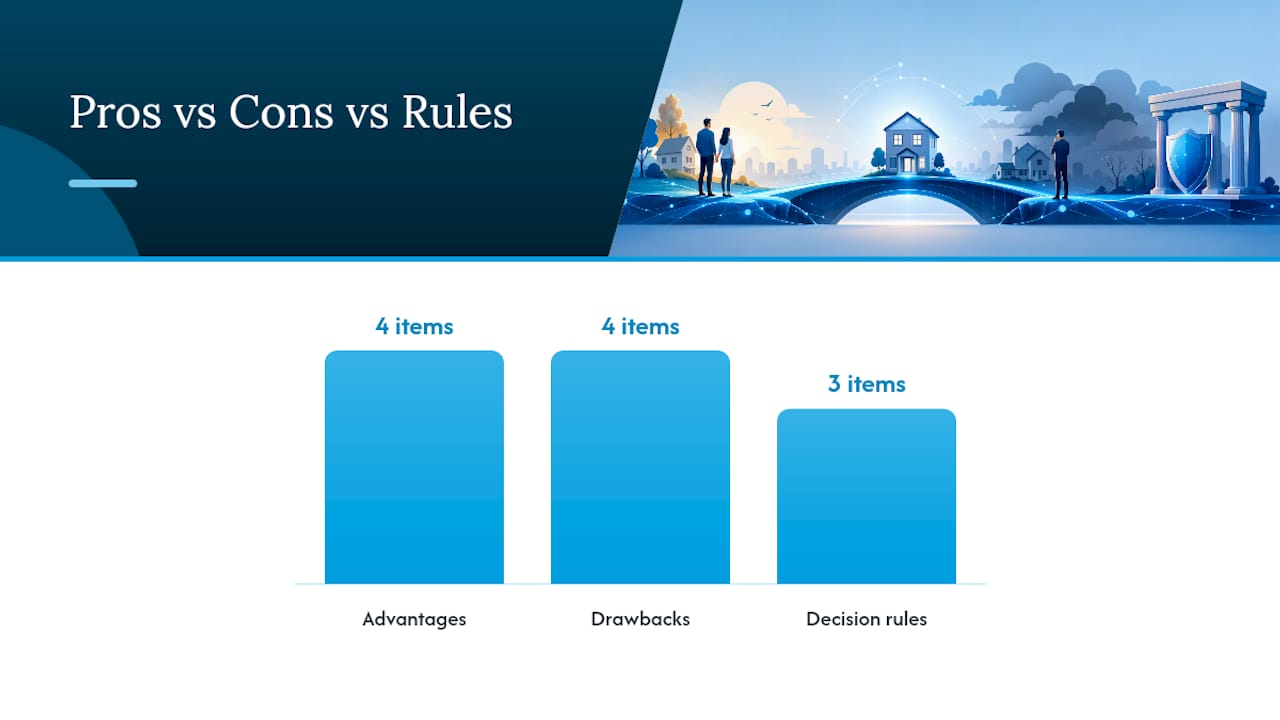
NerdWallet's explainer and Forbes Advisor's summary both confirm that blending avoids the prepayment penalty but trades away flexibility. Here is the practical breakdown.
Advantages:
- No prepayment penalty, which can run into thousands of dollars on a fixed-rate mortgage
- Immediate rate reduction without waiting for renewal
- Access to equity through a top-up without a full refinance
- Simpler process than breaking and reapplying with a new lender
Drawbacks:
- You are locked into a new full term, which limits your ability to switch lenders or renegotiate if rates fall further
- Portability rules become more complex after a blend-and-extend; some lenders restrict porting on a blended product
- The blended rate is always higher than today's best available rate, so you are not getting the lowest possible rate
- If rates drop significantly after you blend, you may regret the extended commitment
Quick decision rules:
- More than 18 months remaining on your term and rates have dropped by 0.75% or more: run the blend-and-extend numbers.
- Planning to sell or move within two years: blending is likely not worth the extended term commitment.
- Need to borrow additional funds without a full refinance: blend-and-extend with a top-up is often the most practical path.
Pro Tip: Before deciding, check your mortgage renewal options in full. Blend-and-extend is one tool among several, and the right choice depends on your timeline, rate outlook, and whether you need extra funds.
What does a blend-and-extend actually cost?
The headline benefit is no prepayment penalty, but there are still costs to account for.
Prepayment penalties: IRD vs three months' interest
If you were to break your mortgage instead of blending, you would face one of two penalties. For variable-rate mortgages, lenders typically charge three months' interest. For fixed-rate mortgages, the penalty is the greater of three months' interest or the interest rate differential (IRD). The IRD is calculated as the difference between your contracted rate and the lender's current rate for a term closest to your remaining term, multiplied by your outstanding balance and the months remaining. On a mortgage with a few years left and a rate gap of over one percent, the IRD penalty can be substantial, potentially reaching many thousands of dollars.
Blending sidesteps this entirely, which is the core financial argument for the option.
Administrative and appraisal fees
A blend-and-extend typically involves a mortgage amendment fee, which varies by lender but commonly falls in the range of a few hundred dollars. If you are adding a top-up, an appraisal may be required, adding further cost. Always ask for a full fee disclosure before proceeding.

Total-cost comparison: blend-and-extend vs breaking to refinance
WealthNorth's worked example illustrates how these two paths compare when you include the penalty.
| Path | Effective rate | Penalty cost | Net advantage |
|---|---|---|---|
| Blend-and-extend | 4.607% | $0 | No upfront cost |
| Break and refinance at 4.25% | 4.25% | ~$10,000+ IRD | Lower rate, higher upfront cost |
Whether breaking wins depends entirely on how long you keep the mortgage after refinancing. If you stay for the full new term, the lower rate may recover the penalty cost. If you sell or renew early, blending is almost always the better financial outcome.
Tax implications
The act of blending a mortgage does not create a taxable event in Canada. If you use a top-up to fund investment or income-producing renovations, the interest on that portion may be deductible under CRA rules. For investment-linked borrowing strategies, the Smith Manoeuvre is worth reviewing with a tax professional.
This article provides general information, not tax or legal advice. Confirm your specific situation with a qualified professional or the Canada Revenue Agency.
Do all lenders offer blend-and-extend in Canada?
No. The FCAC is clear that lenders are not required to offer a blend-and-extend option. It is a discretionary product, and availability varies significantly across lender types.
The major chartered banks (RBC, TD, BMO, Scotiabank, CIBC) generally offer some form of blending, though the terms and the "new rate" they apply differ. Credit unions often offer blending as well, sometimes with more flexibility on term lengths. Monoline lenders vary widely; some offer it only with a top-up or only on specific products.
WealthNorth's analysis points out that the new rate a bank applies to the blend may be their posted rate rather than a negotiated rate, which can make the blended result less favourable than it first appears. A broker can sometimes access a better new-rate component than a borrower calling the branch directly.
Common eligibility conditions to confirm with your lender:
- The blend must stay on the same product type (e.g., fixed-to-fixed)
- Top-up funds may be required to qualify for blend-and-extend at some lenders
- You must remain with the same lender; blending does not allow a lender switch
- Some lenders restrict blending on insured mortgages or high-ratio files
Pro Tip: Ask your lender three specific questions: (1) Do you offer blend-and-extend on my product? (2) What new rate will you apply, and is it negotiable? (3) Can you provide the blended-rate calculation in writing before I commit?
How to request a blend-and-extend: a step-by-step checklist
Steps to follow
- Gather your documents. Pull your most recent mortgage statement (outstanding balance, rate, maturity date), a recent property assessment or appraisal if you plan to top up, and proof of income if the lender requires requalification.
- Run your own blended-rate calculation. Use the FCAC formula from the "How is a blended mortgage rate calculated?" section above to get a baseline number before you call.
- Contact your lender and request a written quote. Ask specifically for the blended rate, the formula used, the new term, and all associated fees in writing.
- Request the new-rate component separately. Ask which rate they applied as the "new rate" and whether it is negotiable.
- Model the break-and-refinance alternative. Ask your lender for the prepayment penalty amount in writing, then compare total interest cost over the new term for both paths.
- Compare across lenders if possible. A broker can pull quotes from multiple lenders simultaneously, which is especially useful if your current lender's blend offer is not competitive.
- Submit the application. Once you have chosen the best path, provide any required documentation and confirm the amendment or new mortgage agreement details before signing.
Questions to ask your lender or broker:
- What is the exact blended rate, and how was it calculated?
- Is the new-rate component the posted rate or a discounted rate?
- What fees apply (amendment fee, appraisal, legal)?
- Does blending affect my portability rights if I move?
- What is the prepayment penalty if I were to break instead?
Typical timeline: Most blend-and-extend amendments complete within two to four weeks, faster if no appraisal is required. Have your documents ready before you call to avoid delays.
How a mortgage broker helps with blend-and-extend decisions
A licensed mortgage broker brings three things to a blend-and-extend decision that a direct lender call cannot: independent math verification, access to multiple lender quotes, and negotiating leverage on the new-rate component.
What a broker does for you:
- Reproduces the lender's blended-rate calculation independently to confirm accuracy
- Requests written quotes from multiple lenders, including your current one, so you have a genuine comparison
- Models the total cost of blending versus breaking and refinancing, including all fees and penalties
- Identifies whether the lender's "new rate" is posted or negotiated, and pushes for a better rate where possible
- Flags eligibility issues (product type, insured mortgage restrictions) before you invest time in an application
Deneenoel serves Alberta homeowners in Edmonton, Calgary, and surrounding areas with access to more than fifty Canadian lenders. Services include written pre-approvals with rate holds, refinancing support, and mid-term restructuring guidance. For complex files, including self-employed borrowers or homeowners with multiple properties, having a broker run the numbers across lenders often surfaces options that a single lender conversation would not.
For straightforward files where your current lender's offer looks reasonable, a broker can still confirm whether the math holds and whether a better new-rate component is available elsewhere. The advisory service costs you nothing upfront. Structured mortgage advice from an independent adviser follows a similar principle in other markets: the value is in the comparison, not just the transaction.
If you want written comparisons before committing, reaching out to a broker before you call your lender is the more efficient sequence.
When I recommend blend-and-extend in practice
Blend-and-extend is not the right answer for every mid-term homeowner, and I want to be direct about that.
Two situations illustrate the contrast well.
The caution I always add: if you believe rates will fall another full percentage point in the next 12 months, blending now locks you out of capturing that drop. A blend-and-extend is a commitment, not just a rate adjustment.
Deneenoel can run your blend-and-extend numbers for free
Deciding between blending and breaking is a total-cost question, not just a rate comparison. Deneenoel provides Alberta homeowners with a written cost comparison that includes the blended rate, the break-and-refinance alternative with the actual penalty, and a clear timeline, all at no charge.

With access to more than fifty Canadian lenders across Edmonton, Calgary, and surrounding Alberta communities, Deneenoel can request written blend quotes from your current lender and compare them against what other lenders would offer on a fresh mortgage after the penalty. You get a side-by-side picture, not just one lender's version of the math. There is no upfront fee for the advisory service; Deneenoel is paid by the lender only when a mortgage is successfully placed.
To get started, contact Deneenoel with your current mortgage statement and a note about what you are trying to accomplish. A written comparison is typically ready within a few business days.
Sources
- Canada
- Ratehub
- How a Blend-and-Extend Mortgage Can Save You Money — NerdWallet
- How A Blended Mortgage Works — Forbes Advisor
- Blended Mortgage Rate Canada: How Blend-Rate Mortgages Work (2026) | WealthNorth
This article is general information, not a substitute for advice from a qualified financial advisor. Consult a qualified financial professional about your own circumstances before acting on anything here.