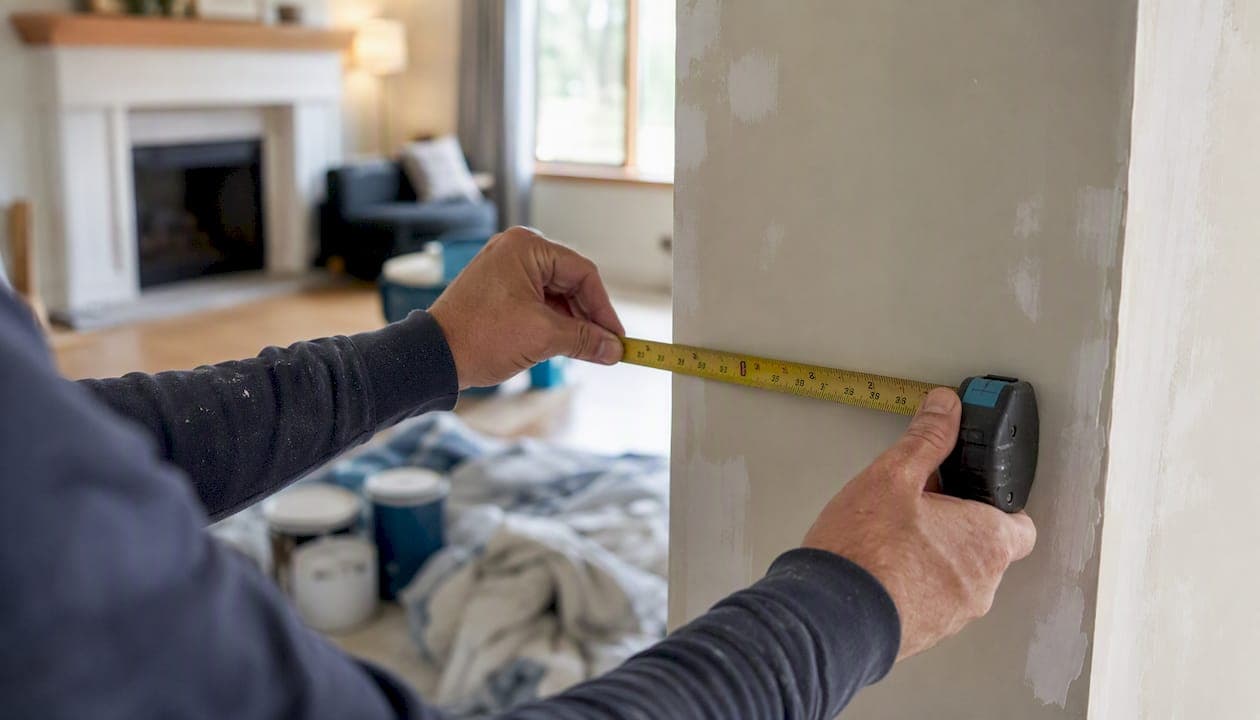
A purchase plus improvements mortgage lets you roll approved renovation costs into the mortgage you use to buy the home, all financed at your regular mortgage rate instead of a higher-interest personal loan or credit card. You buy the house, add the price of the upgrades to your loan amount, and pay it off over your normal amortization.
Here's the mechanic in short form:
- Holdback and release: the renovation portion sits in a holdback (usually held by your lawyer or lender, and gets released once you prove the work is done, typically through paid invoices, photos, or an inspection.
- Completion window: most lenders expect the renovations finished within 90 to 120 days of closing.
- Programs to check: the three insurer programs that matter in Canada are CMHC Improvement, Sagen's Purchase Plus Improvements Program, and Canada Guaranty's Purchase Advantage Plus. Get contractor quotes first, then talk to a broker about pre-approval that already accounts for your renovation scope.
Key Takeaways
Purchase plus improvements mortgages work because they let Canadian homebuyers finance renovations at mortgage rates instead of higher-cost personal loans, provided the appraised improvement value supports the loan.
| Point | Details |
|---|---|
| Lending value rule | Your loan is based on the lesser of as-improved value or as-is value plus documented improvement costs. |
| Holdback ties up cash | Renovation funds sit in trust until you prove completion, so budget for temporary cash flow. |
| Insurer choice matters | CMHC, Sagen, and Canada Guaranty each set different LTV, advance, and premium rules. |
| Budget with contingency | Get three contractor quotes and add 15–20% contingency to avoid the most common funding shortfall. |
| Work with a broker | Denée Noel Mortgages matches your renovation scope to the right lender and insurer across many Alberta options. |
Table of Contents
- How purchase plus improvements financing actually works
- Which Canadian programs support purchase plus improvements?
- Eligibility, LTV, and how much down payment you'll need
- Documents, timelines, and how the money actually gets released
- What premiums and interest carrying costs do to your total price
- Which renovations qualify, and which ones don't
- How to apply, step by step
- Broker tips: pitfalls to avoid on your renovation file
- When a purchase plus improvements mortgage makes sense
- Get renovation financing arranged the right way
- Sources
How purchase plus improvements financing actually works
Lenders order two appraisals on the property: an "as-is" value based on current condition, and an "as-improved" value based on what the home will be worth once your renovations are complete. Your borrowing power comes from the gap between those two numbers, not from your contractor's invoice alone.
The lending value insurers use is the lesser of the as-improved value or the as-is value plus your documented cost of improvements. That detail trips people up constantly. If your appraiser thinks your $40,000 kitchen only adds $25,000 in value, the lender lends against $25,000, not $40,000.
- Your down payment gets calculated on that same lending value, not on the sticker price of the reno.
- Interest generally starts accruing on the full mortgage amount, including the holdback, from the day you close, according to Sagen's program details.
- Funds sit in trust until you provide proof of completion, meaning you or your contractor need to carry costs temporarily.
Quick numbers to remember: the completion clock usually runs 90 to 120 days, and the holdback funds are not sitting in your bank account at closing. You'll need either savings, a flexible contractor payment schedule, or short-term financing to bridge that gap.
This is the part of purchase plus improvements mortgages that catches first-time buyers off guard. You're approved, you've closed, but the renovation cash isn't liquid until an inspector or your lender signs off on the work.
Which Canadian programs support purchase plus improvements?
Three insurers dominate this space, and the one your lender uses affects your down payment, your premium, and how your draws get released. CMHC Improvement can insure financing up to 95% of the as-improved value for one and two-unit owner-occupied properties, and up to 90% for three and four-unit properties. Canada Guaranty's Purchase Advantage Plus mirrors the 95% LTV ceiling for one and two-unit properties, with its own premium bands and draw structure.
| Dimension | CMHC Improvement | Sagen | Canada Guaranty |
|---|---|---|---|
| Max insured LTV | 95% (1–2 units), 90% (3–4 units) | Up to 95% for many purchases | 95% (1–2 units) |
| Advance type | Single or multiple, insurer-managed options available | Single or multiple advances | Single or progress advances |
Ask your broker which insurer the lender is planning to use before you get attached to a number. Insurer rules shift the down payment math, the premium you pay, and whether your draws get released once or in stages.
Eligibility, LTV, and how much down payment you'll need
Purchase plus improvements mortgages generally cover one to four-unit owner-occupied properties, though the loan-to-value ceiling shifts with unit count. One and two-unit homes can qualify for up to 95% financing on the as-improved value under CMHC's rules, while three and four-unit properties top out around 90%.
- On a $500,000 as-improved value at 95% LTV, you're looking at roughly $25,000 down, subject to your specific lender's calculation.
- Some insurer guidance caps the as-improved property value for homeowner loans below a certain high threshold, so higher-value purchases may need a different structure.
- Standard amortization tops out at 25 years for insured mortgages; longer amortizations exist through other programs but rarely apply here.
The numbers only tell half the story. You still need to pass GDS/TDS ratio thresholds, show acceptable credit, and document your income the same as any other insured mortgage application. A strong credit score matters just as much here as it would on a conventional purchase.
Documents, timelines, and how the money actually gets released
Lenders and insurers want proof before they release a dollar of your holdback. Expect to gather professional written quotes from licensed contractors, a clear scope of work, permits if your municipality requires them for the job, and either paid invoices or before-and-after photos once the work wraps up.
- Written contractor quotes, submitted before final approval
- A defined scope of work tied to the appraised improvement value
- Paid invoices, receipts, or photographic proof for the final draw
- Permits where the renovation requires municipal sign-off
Most lenders build the file around a 90 to 120 day completion window, and they won't release holdback funds until someone verifies the work happened. That verification can come from an appraiser revisiting the property, an inspector's report, or in some cases just documented photos and invoices.
Draws can go two ways: some lenders manage progress draws directly, releasing funds in stages as work is completed, while insurer-managed options can allow up to four validated advances at no extra cost. Get at least three contractor quotes upfront, and confirm early whether your lender or the insurer will be the one signing off on each draw.
What premiums and interest carrying costs do to your total price
Mortgage loan insurance premiums get calculated on your total loan amount, purchase price plus improvement costs combined, and the rate climbs as your loan-to-value ratio rises.
- Premiums are typically a one-time charge, often added directly to your mortgage balance rather than paid upfront.
- Because premiums scale with LTV, pushing your down payment even a few percentage points higher can shrink the one-time cost meaningfully.
- Interest usually starts accruing on the entire mortgage, holdback included, from your closing date, per Sagen's program terms.
Here's the trade-off buyers underestimate: you're paying interest on renovation money you haven't drawn yet. For a short, 90-day renovation, that carrying cost is usually modest. Rolling costs into your mortgage is still generally cheaper than a personal loan or credit card, since you're borrowing at mortgage rates rather than double-digit consumer rates, according to WealthNorth's breakdown of the product. Ask your broker for a blended monthly cost comparison against a HELOC or personal loan before you commit either way.
Which renovations qualify, and which ones don't
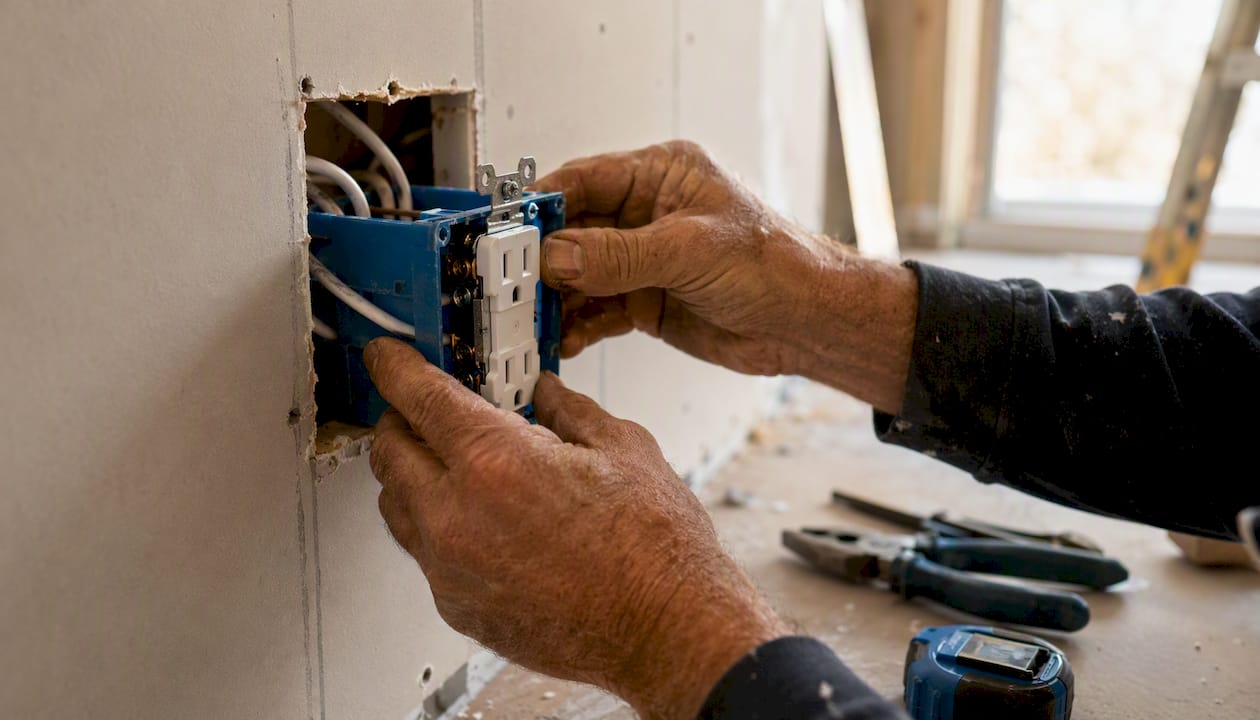
Lenders and appraisers favour permanent, value-adding work. Kitchen and bathroom modernizations, roof replacement, new windows, HVAC upgrades, and electrical or structural repairs all fit comfortably within a purchase plus improvements mortgage because they show up in the as-improved appraisal.
- Usually eligible: kitchens, bathrooms, roofing, windows, HVAC, electrical panels, foundation or structural repairs.
- Usually excluded: furniture, appliances not built into the structure, cosmetic staging items, and anything completed before closing.
Pro Tip: Prioritize mechanical and structural upgrades over cosmetic ones. An appraiser will credit a new furnace or roof far more reliably than fresh paint or landscaping, and that credited value is what actually increases your borrowing power.
How to apply, step by step
- Get contractor quotes and a written scope of work before you finalize your offer.
- Apply for mortgage pre-approval that already includes your renovation plan.
- Your lender orders two appraisals: as-is and as-improved.
- Close on the home with the holdback arrangement in place.
- Complete the renovation within the required window and gather your proof.
- Submit invoices or photos for final inspection and holdback release.
While you work through those steps, prepare these in parallel:
- Proof of income and employment
- Credit documentation and any explanation letters
- Contractor licences and proof of insurance
- Municipal permits, where applicable
A broker's job here is matching the lender and insurer combination to your specific file, making sure the conditional commitment includes the renovation scope, and keeping the appraisal and lender communication moving so you don't lose your closing date. Getting a proper mortgage pre-approval early gives you room to negotiate with confidence once you're in a bidding situation.
Broker tips: pitfalls to avoid on your renovation file
Underbudgeting is the single most common mistake we see. Get at least three licensed, insured contractor quotes, then add a 15 to 20% contingency on top of whatever number they give you, since CMHC's own guidance points to cost overruns as the top reason files stall.
Interest accrues on your full mortgage, holdback included, starting the day you close. A three-month renovation still costs you three months of interest on money sitting untouched in trust.
Pro Tip: Negotiate your contractor's payment schedule before you sign anything. Ask upfront who covers inspection fees if your draw requires multiple site visits, since that cost sometimes gets passed to the borrower without warning.
When a purchase plus improvements mortgage makes sense
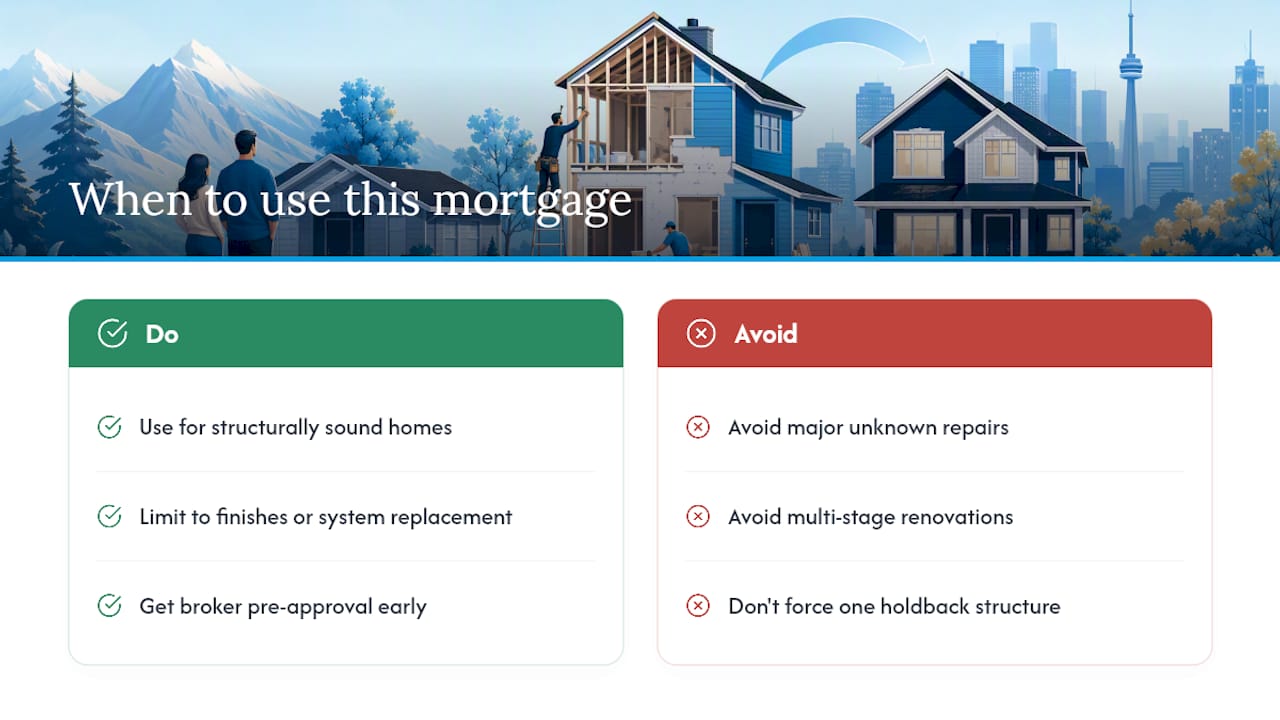
I recommend this product most often to buyers purchasing a structurally sound home that just needs updated finishes or a mechanical system replaced. It works cleanly for that scenario.
If you're staring down major unknown repairs or a multi-stage renovation with an uncertain scope, a staged financing alternative may serve you better than trying to force it into one holdback structure. Talk to a broker about pre-approval early so you can lock in your strategy before you're negotiating on a property you love.
Get renovation financing arranged the right way
Every insurer plays by slightly different rules on down payment, draw structure, and premium bands, and picking the wrong lender for your file can cost you weeks or thousands of dollars. Denée Noel Mortgages arranges purchase plus improvements financing across more than fifty Canadian lenders, matching your renovation scope to whichever insurer, CMHC, Sagen, or Canada Guaranty, actually fits your property and your numbers.

Our services on a file like this include pre-approvals built around your renovation scope, lender matching across differing insurer rules, and help wording the conditional commitment so your draw process doesn't stall mid-renovation. Denée serves homebuyers across Alberta, including Edmonton and Calgary, and can shop your file across the lender network to find the insurer combination that suits your project.
Book a consult and bring your contractor quotes along with a draft scope of work. That single step lets us start matching your file to the right lender before you're deep into negotiations on a property.
Sources
This article is general information, not a substitute for advice from a qualified financial advisor. Consult a qualified financial professional about your own circumstances before acting on anything here.