
Choose a credit union if lower fees, competitive savings rates, and member ownership matter most to you. Choose a bank if you need nationwide branch access, a wider product range, or advanced digital services. The deposit insurance rules differ significantly between the two, and that gap matters most when you hold large balances.
- Best if you choose a credit union: You want lower monthly fees, better GIC or savings rates, relationship-based service, and you live in a province where deposits are fully guaranteed (Alberta, British Columbia, Saskatchewan, or Manitoba).
- Best if you choose a bank: You travel frequently, move between provinces, need specialty lending or wealth management products, or want a single institution with a mature mobile app and coast-to-coast ATMs.
The deposit insurance difference is the most overlooked factor in this decision. Bank deposits are covered by the Canada Deposit Insurance Corporation (CDIC) up to $100,000 per eligible category. Credit union deposits are covered by provincial insurers, and four provinces guarantee them in full with no dollar cap. Full details are in the deposit insurance section below.
Table of Contents
- How credit unions and banks compare at a glance
- What makes a bank different from a credit union
- What products and services do both offer?
- Fees, interest rates, and what to actually compare
- Deposit protection and regulation in Canada
- Branches, ATMs, and digital banking access
- How to choose between a bank and a credit union
- What this means for your mortgage
- Key takeaways
- A note on navigating this choice as a mortgage broker
- Working with Deneenoel on your Alberta mortgage
- Useful sources to verify your institution's coverage
How credit unions and banks compare at a glance
| Dimension | Bank | Credit Union |
|---|---|---|
| Ownership & governance | Shareholder-owned, for-profit | Member-owned cooperative, one-member-one-vote |
| Product range | Broad: wealth management, specialty lending, varied credit cards | Core products strong; large credit unions approach bank breadth |
| Monthly fees | Often higher; premium tiers common | Often lower; some accounts are free |
| Savings/GIC rates | Competitive at Big Six; varies widely | Frequently higher than bank posted rates |
| Loan/mortgage rates | Scale-driven; bundled discounts available | Relationship-based; flexible underwriting |
| Deposit insurance | CDIC: up to $100,000 per eligible category | Provincial insurer; four provinces offer unlimited coverage |
| Branch/ATM access | National and international networks | Regional; many share ATM networks (e.g., THE EXCHANGE) |
| Digital banking | Typically more advanced apps and features | Improving; large credit unions now competitive |
| Customer service | Varies by institution size | Consistently high; community-focused |
| Membership required | No | Yes; common bond or share purchase required |
Three practical differences stand out for most Canadians:
- Deposit insurance limits can favour credit union members in Alberta, BC, Saskatchewan, and Manitoba, where provincial guarantees are unlimited.
- Banks generally have a broader branch and ATM network, which can be advantageous if you move provinces or travel frequently.
- Credit unions often offer more competitive savings rates, though smaller ones might provide fewer wealth management options.
What makes a bank different from a credit union
Banks are for-profit corporations owned by shareholders. A board elected by those shareholders governs the institution, and profits flow back to investors as dividends. OSFI (the Office of the Superintendent of Financial Institutions) is the primary federal regulator for banks in Canada, setting prudential standards and overseeing compliance.
Credit unions are member-owned cooperatives, governed on a one-member-one-vote basis regardless of how much money a member holds. Most credit unions are provincially regulated and chartered, though a small number hold federal charters. Desjardins, operating as caisses populaires in Québec and parts of Ontario, is the largest and most recognizable example in Canada. Joining typically requires meeting a common bond (geography, employer, or community) and purchasing a small membership share.
The profit motive is what drives most downstream differences. Because credit unions return surplus earnings to members through patronage refunds, better rates, or community investments rather than to outside shareholders, they have structural room to offer lower fees and higher deposit rates. That is not a marketing claim; it is a function of cooperative accounting.
What products and services do both offer?
Both banks and credit unions provide the core products most Canadians need day to day:
- Chequing and savings accounts
- GICs and term deposits
- Mortgages and home equity lines of credit
- Personal and auto loans
- Credit cards
- Registered accounts (RRSP, TFSA, RRIF, RESP)
Where they diverge is in depth and specialisation. Banks, particularly the Big Six, typically offer a wider variety of credit cards, more sophisticated wealth management platforms, and specialty lending products such as business banking, trade finance, and complex investment vehicles. Credit unions often compete strongly on savings and GIC rates and on relationship-based mortgage underwriting, particularly for borrowers whose files are not straightforward.
Large credit unions and networks, including Desjardins and major regional credit unions, can match many bank services. Smaller credit unions may lack dedicated investment advisors or full-service brokerage accounts. If you rely on a specific wealth management product, confirm availability before switching.
Pro Tip: Check whether your credit union offers a full RRSP or RESP investment platform, not just a savings deposit account under that registered label. The distinction affects your long-term investment options significantly.
Fees, interest rates, and what to actually compare
Credit unions generally charge lower monthly account fees and post better savings and GIC rates than the posted rates at major banks. Banks offset this with more fee tiers, premium packages that waive fees at higher balances, and bundled discounts when you hold multiple products.
Loan and mortgage pricing is where the comparison gets nuanced. A bank may offer a rate discount if you bundle your chequing account, credit card, and mortgage together. A credit union may offer more flexible underwriting terms or a slightly better rate for a loyal member. Neither is universally cheaper; the gap depends on your specific file, the institution, and the current rate environment.
The practical items to compare when you are shopping:
- Monthly account fee and the minimum balance needed to waive it
- Out-of-network ATM fees
- GIC yield for your preferred term (compare the same term length)
- Mortgage interest rate and whether it is fixed or variable
- Prepayment privileges (how much extra you can pay annually without penalty)
- Penalty calculation method (interest rate differential vs. three months' interest)
Understanding personal finance terms like GIC, patronage refund, and prepayment privilege makes this comparison much faster.
Deposit protection and regulation in Canada
This is the section most comparison articles get wrong, so read it carefully.
Bank deposits at CDIC member institutions are automatically insured up to $100,000 per eligible deposit category. Common categories include deposits in your own name, joint deposits, RRSP deposits, TFSA deposits, and RRIF deposits, each covered separately up to $100,000. OSFI regulates the banks themselves; CDIC insures the deposits.
Credit union deposits are covered by provincial insurers, not CDIC. Coverage limits vary by province, and four provinces provide unlimited protection with no dollar cap: Alberta, British Columbia, Saskatchewan, and Manitoba.
| Insurer | Institutions covered | Coverage limit |
|---|---|---|
| CDIC | Federally regulated banks | $100,000 per eligible category |
| Credit Union Deposit Guarantee Corporation (Alberta) | Alberta credit unions | Unlimited (100% of all deposits) |
| Credit Union Deposit Insurance Corporation of BC | BC credit unions | Unlimited |
| Saskatchewan Credit Union Deposit Guarantee Corporation | SK credit unions | Unlimited |
| Manitoba Credit Union Deposit Guarantee Corporation | MB credit unions | Unlimited |
| Financial Services Regulatory Authority of Ontario (FSRA) | Ontario credit unions | $100,000 per eligible deposit category |
Four provinces — Alberta, British Columbia, Saskatchewan, and Manitoba — guarantee 100% of credit union deposits with no dollar cap. In Alberta, the Credit Union Deposit Guarantee Corporation provides this protection by statute, covering all deposits including accrued interest.
For most Canadians with balances under $100,000, the practical safety difference between a bank and a credit union is minimal. The gap opens for larger balances. An Albertan holding $400,000 in a credit union has full statutory protection; the same balance at a bank requires careful splitting across CDIC categories to achieve equivalent coverage.
Registered accounts (RRSP, TFSA, RRIF) are each separate CDIC categories at banks, which helps. At credit unions, check with your provincial insurer for how registered accounts are treated, as rules differ.
Branches, ATMs, and digital banking access
Banks hold a clear advantage on physical reach. The Big Six operate thousands of branches and ATMs across Canada and internationally, which matters if you move provinces, travel for work, or need in-person service in multiple cities.

Credit unions are regional by nature. Most operate within a single province, though many participate in shared ATM networks such as THE EXCHANGE Network, which gives members fee-free access to a large number of ATMs across Canada. For everyday local banking, this is often sufficient.
Digital banking is where the gap has narrowed most. Larger credit unions and credit union networks now offer competitive mobile apps, e-transfers, and online account management. Smaller credit unions are improving through technology partnerships. That said, the largest banks still invest more in app development, and their platforms tend to have more features, particularly for investment accounts and real-time notifications.
Newcomers to Canada often open a bank account first for the nationwide access and newcomer packages that waive fees for the first year. A credit union can be a strong secondary option once you are settled, particularly for better savings rates and community-oriented service.
How to choose between a bank and a credit union
Work through this checklist in order. The first answer that strongly favours one option is usually the right signal.
- Assess your branch and ATM needs — If you travel interprovincially or internationally, a bank's network is harder to replace. If you bank locally, a credit union's shared ATM access is usually adequate.
- Consider newcomer status — If you are new to Canada, ask both institution types about newcomer packages, credit-building options, and whether a credit history from your home country is considered.
Having accounts at both a bank and a credit union is a practical strategy for many Canadians. Keep your everyday chequing at the institution with the best ATM access, and hold GICs or savings at the institution offering the better rate.
Pro Tip: When you visit a branch or call in, ask these specific questions: "What is your deposit insurer and what are the coverage limits?" "Do you charge a fee for out-of-network ATMs?" "What are your mortgage prepayment privileges?" "Do you have a newcomer package?" Written answers are better than verbal ones.
What this means for your mortgage
Credit unions often compete strongly on mortgage pricing, particularly for members with an established relationship or for borrowers whose files fall outside standard bank criteria. Self-employed Canadians, new-to-Canada buyers, and those with non-traditional income sources sometimes find credit union underwriting more flexible.
Banks can offer bundled discounts when you hold multiple products, and their scale means they can move quickly on rate promotions. The practical items to compare on any mortgage offer:
- Interest rate (fixed vs. variable, and the term length)
- Prepayment privileges: how much you can pay down annually without penalty
- Portability: whether you can take the mortgage to a new property if you move
- Penalty calculation method if you break the mortgage early
- Lender appetite for your specific file (self-employed, new-to-Canada, investment property)
The rate difference between a bank and a credit union on a mortgage is often small. What matters more is the total cost of the mortgage over the term, including penalties, restrictions, and whether the lender will approve your file at all.
Pro Tip: A mortgage broker compares offers from both banks and credit unions simultaneously, which is faster and more thorough than applying to each separately. For complex files or when you want to be certain you are not leaving money on the table, a broker's access to 50+ Canadian lenders is a genuine advantage.
Key takeaways
Credit unions generally offer lower fees and better savings rates; banks offer broader access and deeper product ranges. The deposit insurance rules in Canada make province of residence a critical variable for anyone holding large balances.
| Point | Details |
|---|---|
| Match institution to priorities | Credit unions suit lower fees and local service; banks suit nationwide access and product breadth. |
| Deposit insurance varies by province | Alberta, BC, Saskatchewan, and Manitoba guarantee 100% of credit union deposits; CDIC covers bank deposits up to $100,000 per category. |
| Large balances need careful planning | Holding over $100,000 at a bank requires splitting across CDIC categories; provincial credit union guarantees may simplify this in four provinces. |
| Mortgages need a full comparison | Rate, prepayment terms, portability, and lender flexibility matter more than the headline rate alone. |
| Deneenoel compares both | Working with Deneenoel gives Alberta homebuyers access to mortgage offers from banks and credit unions across 50+ lenders in one place. |
A note on navigating this choice as a mortgage broker
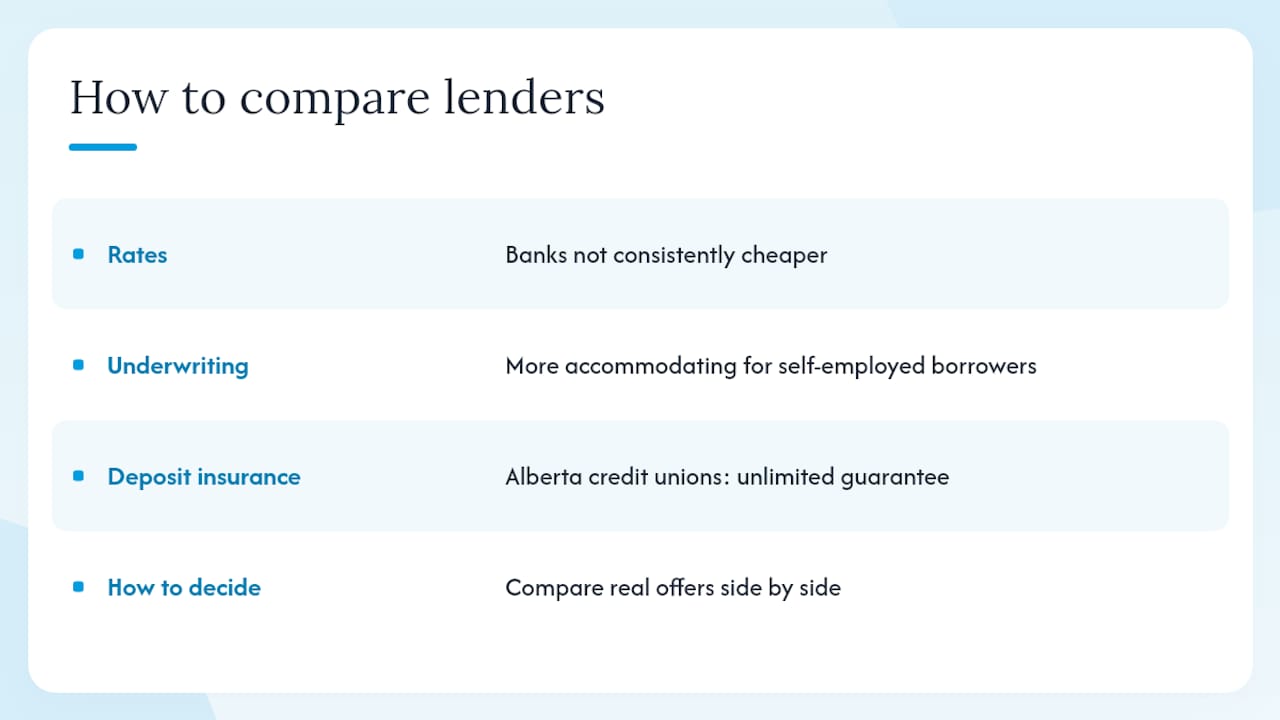
The credit union vs. bank question comes up in almost every mortgage conversation I have with Alberta clients. Most people assume banks automatically offer better mortgage rates because of their size, but that is not consistently true. Credit unions often price competitively for members, and their underwriting can be more accommodating for self-employed borrowers or those with non-standard income.
What I find more useful than the institution type is the specific offer in front of you: the rate, the prepayment terms, the penalty structure, and whether the lender will actually approve your file. A client who qualifies easily at a bank may get a better rate at a credit union, or vice versa. The only way to know is to compare real offers side by side.
The deposit insurance piece is genuinely underappreciated. Alberta's unlimited guarantee for credit union deposits is a statutory protection that many clients do not know exists. For someone holding a large down payment in savings while waiting to close on a home, that distinction is worth understanding.
My role is to do that comparison work for you, across both institution types and across lenders you may not have considered. The goal is always the right mortgage for your situation, not the most convenient one.
Working with Deneenoel on your Alberta mortgage
Whether you are buying your first home, refinancing an existing mortgage, or financing an investment property, the bank vs. credit union question is just one part of a larger picture. Deneenoel gives Alberta homebuyers access to mortgage offers from more than fifty Canadian lenders, including banks, credit unions, and monoline lenders, all compared in one place with no fee to you.

Denée Noel Mortgages provides written pre-approvals with rate holds, handles complex files for self-employed and new-to-Canada clients, and walks you through prepayment terms, portability, and penalty structures so you know exactly what you are signing. The service is free to clients; lenders pay the commission on a successfully funded mortgage.
Ready to see what your best mortgage offer actually looks like? Book a free consultation with Denée today and get a written pre-approval that gives you real negotiating power.
Useful sources to verify your institution's coverage
Before you commit to any institution, confirm the deposit insurance details directly. Here is where to check:
- Choosing a financial institution
- Deposit insurance
- CDIC vs provincial deposit insurance in Canada
- FAQ – Credit Union Deposit Guarantee Corporation
- Banks — OSFI
- Banks vs. credit unions in Canada: what's the difference? | Ratehub.ca
- Credit Unions vs. Banks in Canada: What Newcomers Should | WelcomeAide
- Credit Unions vs. Banks (2023): What You Need to Know | KOHO
This article provides general information about Canadian financial institutions and deposit insurance. It is not financial or legal advice. Confirm current coverage rules and eligibility with your institution or the relevant insurer before making decisions based on your specific balance or account structure.