
A home appraisal for mortgage financing is a licensed professional's independent estimate of your property's current market value — and it directly determines the loan-to-value ratio your lender will accept. In Alberta, whether you need one depends primarily on your down payment size, your lender type, and the nature of the transaction.
Here is the short version:
- Insured mortgage (under 20% down): Mortgage default insurers like CMHC typically assess value internally. A formal appraisal is rarely required of you, and if one is ordered, the insurer covers the cost.
- Conventional mortgage (20% or more down): The lender carries the risk directly, so most will require a full appraisal. You pay, usually as part of your closing costs.
- Private sale or refinancing: A full on-site appraisal is almost always required, regardless of your down payment, because there is no open-market listing to validate the price.
OSFI's Guideline B-20 requires federally regulated lenders to use a risk-based approach to property valuation and to combine multiple valuation tools rather than relying on any single method. That framework is what drives most appraisal decisions your lender makes. A mortgage broker who knows Alberta's lender landscape can tell you upfront whether your file will trigger a full appraisal or whether an automated valuation will suffice.
Table of Contents
- When does your lender actually require an appraisal?
- Who orders the appraisal, who pays, and who owns the report?
- What types of appraisals do Alberta lenders use?
- What appraisers inspect and what lenders flag
- What does an appraisal cost in Alberta, and how long does it take?
- What to do when the appraisal comes in low
- Special cases: condos, acreage, new builds, and income properties
- How to prepare your property and mortgage file before the appraiser arrives
- Key takeaways
- A mortgage broker's perspective on appraisals in Alberta
- Deneenoel's appraisal and mortgage support across Alberta
- Useful sources and authorities for further reading
When does your lender actually require an appraisal?
The 80% loan-to-value threshold is the clearest dividing line. Below it, your mortgage is insured and the insurer manages valuation risk. Above it, the lender holds the exposure and wants independent confirmation of value.
Common triggers for a required appraisal in Alberta:
- Conventional mortgage with 20%–34.99% down payment
- Private sale (no MLS listing or real estate agent involved)
- Refinancing, particularly cash-out refinancing or debt consolidation where you are accessing equity
- Investment property financing or second mortgage applications
- Unique or non-standard properties (acreage, mixed-use zoning, rural locations)
- Large loan amounts where the lender's internal risk threshold is exceeded
- HELOC applications where the lender needs to confirm remaining equity
Appraisal threshold: Once your mortgage exceeds 80% loan-to-value, mortgage default insurance is required. Below that threshold, lenders carry the risk themselves and typically require an independent appraisal to confirm collateral value.
With a large down payment, some lenders may waive the appraisal entirely if the property is in a stable, well-documented neighbourhood with recent comparable sales. It is still the lender's call, not a guarantee.
Pro Tip: Ask your broker to confirm the specific lender's appraisal policy before you remove your financing condition. Policies vary between banks, credit unions, and monoline lenders — and knowing this early prevents last-minute surprises.

Who orders the appraisal, who pays, and who owns the report?
The ordering flow is straightforward but often misunderstood by first-time buyers.
Who orders it:
- For most conventional mortgages, the lender orders the appraisal through an approved appraiser panel or instructs the broker to arrange one.
- For private sales or refinances, the lender may ask you to arrange a third-party appraisal from an AIC-designated appraiser.
- You should never order your own appraisal and present it to a lender expecting acceptance — the lender must be the client of record for the report to be valid for their purposes.
Who pays:
- The borrower typically pays, either directly to the appraiser or as part of closing costs.
- If you have an insured mortgage and the insurer orders a valuation, they cover the cost.
- Some lenders offer appraisal fee waivers during promotional periods, but these are not standard.
Who owns the report:
Appraisal reports belong to the lender, not the borrower, even though you paid for it. The report is a risk management document prepared for the lender's credit decision. You will typically receive the appraised value and any major flags, but not the full document unless the lender releases it to you.
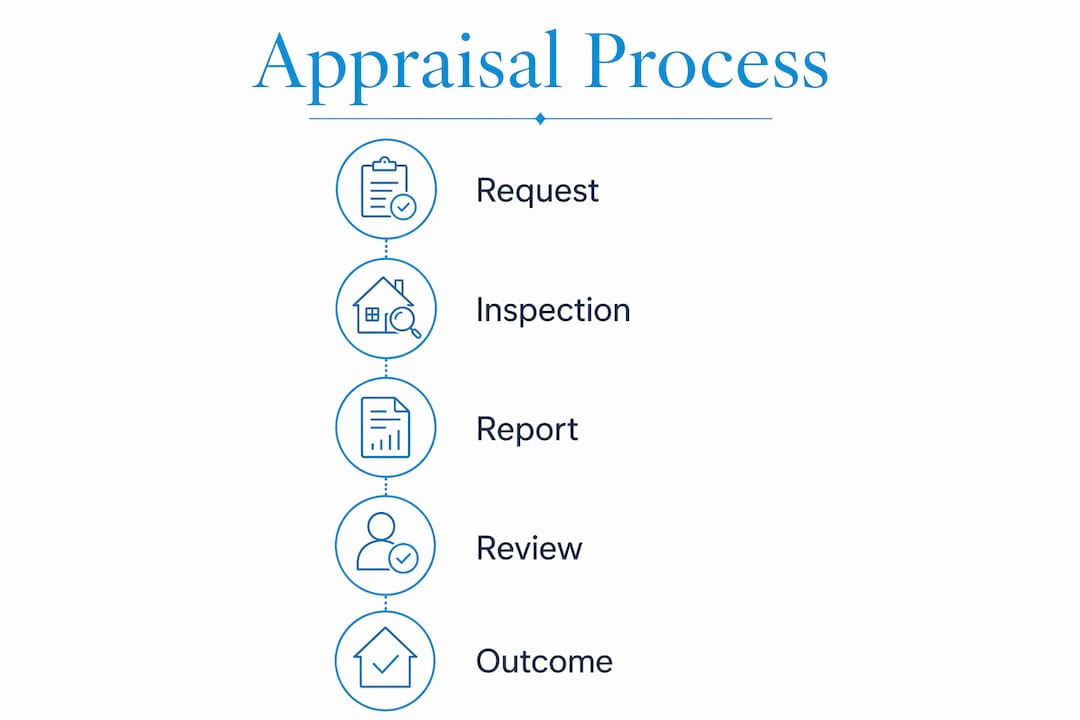
The typical flow from order to delivery:
- Lender or broker places the appraisal order with an approved appraiser.
- Appraiser contacts the listing agent or homeowner to book access.
- On-site inspection takes place (usually 30–60 minutes for a standard home).
- Appraiser researches comparable sales and prepares the report.
- Report is submitted directly to the lender; you receive the value confirmation.
What types of appraisals do Alberta lenders use?
Not every mortgage file requires the same level of valuation. Lenders choose the method based on the transaction's risk profile, the property type, and what OSFI's Guideline B-20 considers appropriate for the exposure involved.
Appraisal types:
- Full on-site appraisal: Interior and exterior inspection with comprehensive research. Required for most conventional mortgages, private sales, refinancing, and complex properties.
- Drive-by (exterior) appraisal: Exterior-only scope. Acceptable for lower-risk files where recent interior data exists and the lender accepts a limited-scope report.
- Desktop / AVM (Automated Valuation Model): No site visit; value estimated from comparable sales data. Faster and cheaper, but only accepted for straightforward properties in active markets.
Per the Appraisal Institute of Canada, drive-by and desktop reports are only appropriate for first mortgages where the property is not under construction, recent MLS or inspection data is available (generally within three years), and the lender accepts a limited-scope report with a $50,000 liability cap.
Valuation methods appraisers use:
| Method | Best suited for | How it works |
|---|---|---|
| Sales comparison approach | Residential homes | Compares subject property to recent, similar sales with adjustments for differences |
| Income approach | Rental / investment properties | Capitalises net rental income to estimate value |
| Cost approach | New builds, unique structures | Estimates land value plus depreciated replacement cost of improvements |
Which lender types accept which methods:
- Banks and monoline lenders: Generally require full on-site appraisals for conventional files; may accept AVMs for low-risk insured files.
- Credit unions: Similar to banks, though some provincial credit unions have more flexibility on desktop valuations for existing members.
- Private lenders: Almost always require a full on-site appraisal, regardless of down payment, because they cannot rely on insurer backing.
What appraisers inspect and what lenders flag
A standard appraisal compares at least three recent, similar sales and documents the property's condition, size, lot, rooms, and finishes. Here is what the appraiser physically reviews:
Interior checklist:
- Total living area (measured, not taken from MLS)
- Number and size of bedrooms and bathrooms
- Kitchen quality and condition (appliances, cabinetry, countertops)
- Basement: finished or unfinished, legal suite or storage
- Heating system type and age
- Visible structural concerns (cracks, water damage, settling)
Exterior checklist:
- Roof condition and estimated remaining life
- Windows, siding, and foundation
- Lot size, grading, and drainage
- Garage (attached, detached, or none)
- Access and driveway condition
Red flags that trigger underwriter scrutiny:
- Unpermitted suites or additions not reflected in the legal description
- Living area figures that differ from MLS or tax records
- Excessive dollar adjustments between the subject and comparables
- Comparables pulled from outside the immediate market area without clear justification
- Missing or poor-quality interior photographs
Lenders and insurers apply extra scrutiny to unique structures, acreage, and mixed-use zoning. Inadequate photographic evidence or illogical comparable selection often triggers secondary audits and delays.
Pro Tip: Gather renovation receipts, building permits, and any upgrade documentation before the appraiser arrives. You cannot influence the value, but you can ensure the appraiser has accurate information — and that prevents avoidable downward adjustments.
What does an appraisal cost in Alberta, and how long does it take?
Appraisal costs in Alberta generally vary depending on the property type and complexity, with prices typically ranging within a moderate cost spectrum. Rural acreage, unique builds, or properties requiring significant travel time will cost more and take longer.
Factors that affect cost and timeline:
- Property type and complexity (standard home vs. acreage vs. income property)
- Location (urban Calgary or Edmonton vs. rural or remote communities)
- Tenant occupancy (coordinating access with tenants adds scheduling time)
- Appraiser availability in the local market
Standard timelines:
- Urban residential property: report typically delivered within 3–5 business days of the inspection.
- Rural or acreage property: allow 5–10 business days, sometimes longer in remote areas.
- Rush orders: most appraisers offer expedited service for an additional fee, though availability varies.
If the lender orders a re-inspection (for example, after required repairs are completed), budget an additional fee and timeline. A second appraisal from a different appraiser, sometimes requested after a low-value result, will also carry its own full cost.
What to do when the appraisal comes in low
A low appraisal changes your loan-to-value calculation and can directly affect your mortgage approval. It is not automatically a deal-breaker, but you need to move quickly because most purchase agreements have tight financing deadlines.
Step-by-step response:
- Review the report carefully. Ask your lender for the value confirmation and any flagged concerns. Look for factual errors: wrong square footage, missing rooms, or comparables that do not reflect your neighbourhood.
- Provide missed information. If the appraiser missed a recent renovation or used a comparable that sold under distressed conditions, document it and pass it to your broker.
- Request a Reconsideration of Value (ROV). Your lender can submit an ROV to the appraiser with new comparables or corrected facts. A successful ROV requires evidence that materially changes the market logic — it is not a complaint process and is not guaranteed.
- Negotiate the purchase price. If the seller's price exceeds the appraised value, you have grounds to renegotiate. The gap between appraised value and purchase price comes out of your pocket.
- Increase your down payment. Covering the shortfall yourself keeps the deal alive if you have the funds available.
- Seek an alternate lender. Different lenders use different appraiser panels. A second opinion from a different lender's appraiser sometimes produces a different result, though this is not guaranteed and adds time.
- Walk away. If your purchase agreement includes a financing condition, a low appraisal that prevents mortgage approval can be grounds to exit without penalty.
| Option | Speed | Cost to you | Likelihood of success |
|---|---|---|---|
| Negotiate purchase price | Moderate | None (if seller agrees) | Depends on seller motivation |
| Pay the gap | Fast | Full shortfall amount | Certain if funds available |
| Reconsideration of Value | Slow (5–10 days) | Usually none | Low to moderate; evidence-dependent |
| Alternate lender / second appraisal | Slow | Second appraisal fee | Moderate; no guarantee of higher value |
| Walk away (financing condition) | Fast | None | N/A |
Special cases: condos, acreage, new builds, and income properties
Condos
Appraisers and insurers look beyond the unit itself. Reserve fund health, recent special assessments, condo corporation rules, and the ratio of owner-occupied to rental units all factor into the lender's risk assessment. A condo with a depleted reserve fund or pending major repairs can receive a lower appraised value or face insurer restrictions.
Acreage and rural properties
Access roads, well and septic systems, and zoning classification all require documentation. Properties on private roads or with shared access agreements need clear title evidence. CMHC and insured mortgage appraisal expectations flag rural and mixed-use properties as higher scrutiny files, particularly when comparable sales are scarce.
New builds and pre-construction
OSFI expects valuations to reflect current market value at mortgage origination, not at the time a purchase agreement was signed. Pre-construction buyers face timing risk: if market values shift between signing and completion, the appraisal at closing may not support the original purchase price. Blanket appraisals prepared before construction is complete carry prudential risk under OSFI's framework.
Income properties
Lenders use the income approach alongside the sales comparison approach for rental properties. You will need current lease agreements, rental income history, and vacancy rate data for the area. How the lender models rental income affects the appraised value and, in turn, the loan amount they will approve. Solid documentation here directly protects your borrowing capacity.
Pro Tip: For income properties, have your lease agreements, rent rolls, and any property management agreements ready before the appraisal is ordered. Gaps in rental documentation are one of the most common causes of underwriting delays on investment files.
How to prepare your property and mortgage file before the appraiser arrives
Preparation does not influence the appraiser's opinion of value — and it should not. Professional appraisers are legally required to remain independent and cannot be pressured to reach a target number. What preparation does is ensure the appraiser has accurate, complete information so the report reflects the property fairly.
Pre-visit checklist:
- Confirm the legal description matches the MLS listing and title documents.
- Provide clear access to all areas, including the basement, attic hatch, and garage.
- Tidy key rooms — not for aesthetics, but so the appraiser can photograph and measure accurately.
- Compile receipts and permits for any renovations or additions completed in the last five years.
- Note any upgrades not visible at a glance (new furnace, updated electrical panel, new roof).
- For rental properties, have signed lease agreements and a current rent roll available.
- If the property has a suite, confirm it is permitted and provide the permit documentation.
Broker role in the process:
A broker coordinates the appraisal order, ensures the appraiser has the correct property details and access instructions, and communicates any time-sensitive lender deadlines. What a broker cannot do is suggest a target value or share the purchase price in a way intended to anchor the appraiser's conclusion. Keeping communication in the lender's channel preserves the independence the process depends on.

One common preventable delay: an undisclosed unpermitted basement suite discovered during the appraisal inspection triggers an additional review, sometimes requiring a municipal permit or a revised scope of work before the lender will proceed.
For a broader look at how appraisals fit into the appraisal role in home loans, the procedural steps are broadly similar across North American mortgage markets, though Canadian regulatory requirements differ.
Key takeaways
Alberta buyers and homeowners who understand the appraisal process before they need one avoid the most common delays and surprises in mortgage financing.
| Point | Details |
|---|---|
| Appraisal triggers | Conventional mortgages (20%+ down), private sales, and refinancing almost always require a full on-site appraisal. |
| LTV and insurance impact | Appraised value sets your loan-to-value ratio, which determines whether mortgage default insurance applies and how much you can borrow. |
| Report ownership | You pay for the appraisal but the lender owns the report; request the value confirmation in writing from your lender. |
| Low appraisal options | A Reconsideration of Value, price negotiation, or alternate lender are your main paths forward — act quickly within your financing condition window. |
| Work with Deneenoel early | Deneenoel coordinates appraisal ordering, lender matching, and ROV support across Alberta, with access to over fifty Canadian lenders. |
A mortgage broker's perspective on appraisals in Alberta
Appraisal issues come up more often than most buyers expect, and the ones that derail deals almost always trace back to something that could have been caught earlier. The most common scenario I see is a buyer who assumed the purchase price would be supported, only to find the appraiser's comparables told a different story. That gap is not always the appraiser's error. Sometimes the market moved faster than the comparables reflect. Sometimes the property has features that are genuinely hard to value in a thin market.
What I tell clients is this: the appraisal is the lender's tool, not yours. The report belongs to them, the appraiser answers to them, and the value conclusion is what the lender will lend against — not what you agreed to pay. Understanding that distinction early changes how you approach your financing condition and your negotiating position.
The broker's role in this process is coordination and preparation, not influence. I can make sure the appraiser has accurate property details, that the lender's deadline is met, and that if a value comes in low, we move through the ROV or alternate lender options quickly. What I cannot do is tell an appraiser what number to hit — and any broker who suggests otherwise is not someone you want managing your file.
Alberta's market has enough regional variation, from Edmonton's established neighbourhoods to rural acreage in the Peace Country, that lender and appraiser familiarity with local conditions genuinely matters. Working with a broker who has active files across the province means you get lender matching that accounts for those differences, not a one-size approach.
Deneenoel's appraisal and mortgage support across Alberta
Navigating an appraisal requirement is straightforward when you have the right lender matched to your file from the start. Deneenoel works with over fifty Canadian lenders across Edmonton, Calgary, and surrounding Alberta communities, which means the lender selected for your file already fits your property type, down payment, and financing goals before the appraisal is ever ordered.

Whether you are buying your first home, refinancing to access equity, or financing an investment property, Deneenoel coordinates the full appraisal process: ordering, documentation preparation, lender communication, and ROV support if a value comes in short. The advisory service is free to you — Deneenoel is paid by the lender upon successful placement. If you are in Edmonton, the Edmonton mortgage broker page outlines exactly how the process works for your area. Calgary buyers can connect through the Calgary mortgage broker page. Ready to get started? Reach out to Deneenoel directly at deneenoel.com to book a no-obligation conversation before your next purchase or refinance.
Useful sources and authorities for further reading
- OSFI Guideline B-20: The federal framework governing how regulated lenders must approach property valuation, collateral management, and appraisal tool selection.
- OSFI's view on blanket appraisals and appraisal timing: Specific OSFI guidance on pre-construction and blanket appraisal risks, including recency requirements at mortgage origination.
- CMHC: Your Home Value: CMHC's resource for mortgage professionals on how home value is assessed in the context of insured mortgage decisions.
- Appraisal Institute of Canada — For Mortgage Professionals: Explains AIC-designated appraiser qualifications, report types (full, drive-by, desktop), and the Canadian Uniform Standards of Professional Appraisal Practice (CUSPAP).
- How appraisals affect mortgage approvals: Practical breakdown of how appraised value influences LTV, borrowing limits, and what borrowers can do when a value comes in low.
- What lenders look for in an appraisal report: Covers underwriter expectations around comparable support, adjustment logic, and common red flags that trigger secondary review.
- Deneenoel Alberta mortgage resources: Broker-written guides and direct advisory support for Alberta homebuyers and homeowners navigating appraisals, pre-approvals, and lender selection.
This article provides general information about the mortgage appraisal process in Alberta and is not professional mortgage, legal, or financial advice. Confirm current lender and insurer requirements with a licensed mortgage professional or the relevant regulatory body for your specific situation.