
The most effective combination of programs for a first time home buyer in Alberta right now is the First Home Savings Account (FHSA) paired with the Home Buyers' Plan (HBP), the new First-Time Home Buyers' GST/HST rebate, and the Home Buyers' Amount. Together, these four federal tools can meaningfully reduce the after-tax cash you need at closing. Alberta also helps by charging no provincial land transfer tax, which already puts you ahead of buyers in Ontario or British Columbia.
Here is what every Alberta first-time buyer should know immediately:
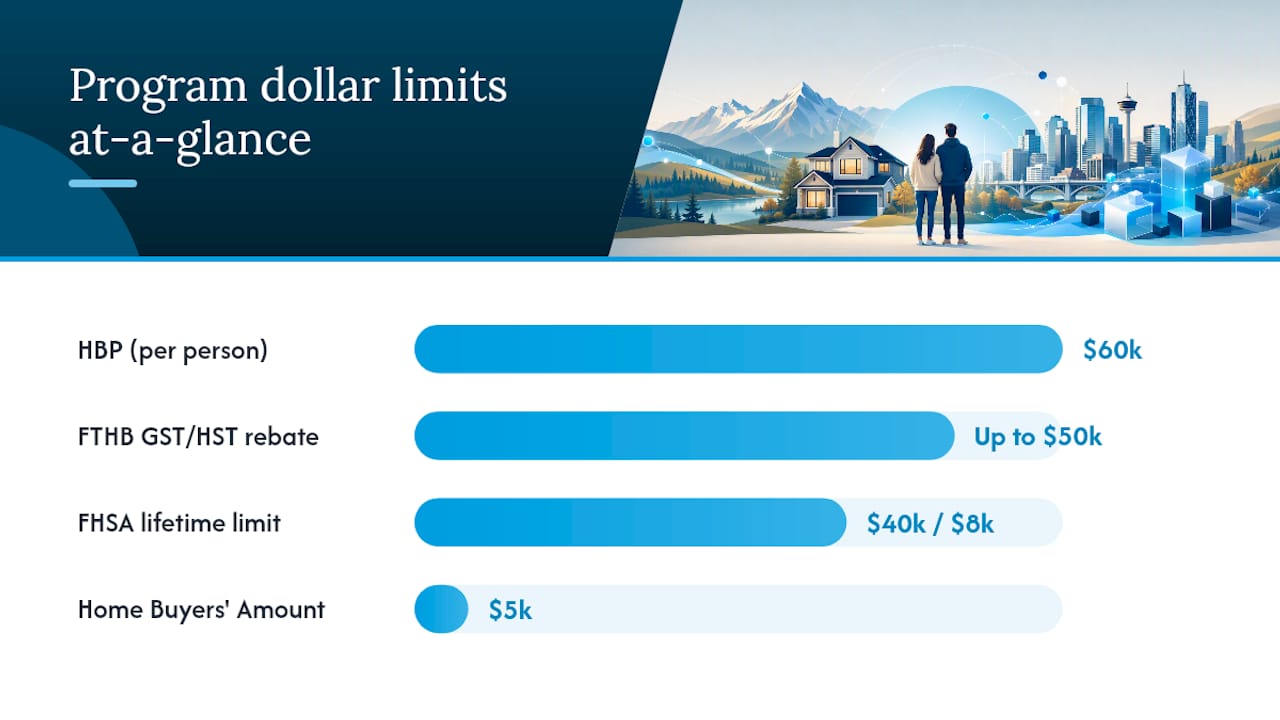
- FHSA: $8,000 participation room in the year you open the account; $40,000 lifetime contribution limit; contributions are tax-deductible and qualifying withdrawals are tax-free.
- Home Buyers' Plan (HBP): withdraw up to $60,000 per person ($120,000 for a qualifying couple) from your RRSP, tax-free, with repayment generally spread over 15 years.
- FTHB GST/HST rebate: a 100% rebate of the GST or federal portion of HST on a newly built or substantially renovated home valued up to $1 million; eligible buyers can receive up to $50,000.
- Home Buyers' Amount: claim a set non-refundable tax credit on your return resulting in tax relief depending on your tax situation.
Your single most important next step: open an FHSA today if you have not already, then book a mortgage pre-approval so you know your budget before you start shopping.
Key takeaways
Alberta first-time buyers who combine the FHSA, HBP, and the new FTHB GST/HST rebate can access more tax-advantaged purchasing power than at any previous point in Canadian history.
| Point | Details |
|---|---|
| Open your FHSA now | The $8,000 annual room only starts accumulating once the account is open; delay costs you real deduction room. |
| Stack FHSA and HBP | A couple can access up to $80,000 from FHSAs plus $120,000 via HBP — independent limits, same purchase. |
| New build? Claim the FTHB rebate | The FTHB GST/HST rebate covers 100% of GST on homes up to $1 million; apply within two years of ownership. |
| Alberta has no land transfer tax | Closing costs are materially lower than in Ontario or B.C. — budget for legal fees and title registration instead. |
| Deneenoel for mortgage guidance | Deneenoel connects Alberta first-time buyers with over fifty lenders and provides written pre-approvals with rate holds. |
Table of Contents
- Which first-time buyer programs apply in Alberta right now?
- Federal programs every Alberta first-time buyer should use
- Alberta and municipal programs: what is open, limited, or closed
- What to budget for: down payments, insurance, and closing costs in Alberta
- Who qualifies as a first-time home buyer under CRA rules?
- How to use FHSA and HBP together for the same home
- Your 8-step checklist from saving to closing in Alberta
- When should you call a mortgage broker, lawyer, or accountant?
- First-time buyer programmes beyond Calgary and Edmonton
- A note from Denée
- Ready to take the next step toward your first Alberta home?
- Sources
Which first-time buyer programs apply in Alberta right now?
Stat to know: The FTHB GST/HST rebate can return up to $50,000 to eligible buyers of newly built homes valued up to $1 million. For a buyer purchasing a $600,000 new build in Calgary, that is a substantial reduction in the effective purchase cost.
The CMHC First-Time Home Buyer Incentive is closed. Do not build your plan around it. The federal savings and tax tools listed above are where your energy belongs.
Federal programs every Alberta first-time buyer should use
First Home Savings Account (FHSA)
The FHSA is the most powerful savings tool introduced for Canadian first-time buyers in decades. Your first-year participation room is $8,000, contributions are generally deductible against your income (reducing your tax bill now), and qualifying withdrawals for a first home are completely tax-free. The lifetime contribution limit is $40,000.
One detail that catches people off guard: unused participation room carries forward only one year at a time. If you open your FHSA in 2026 and contribute nothing, you carry $8,000 forward to 2027, but you do not accumulate unlimited room indefinitely. Open the account as early as possible, even if you contribute a small amount, to start the clock. You will also need to file Schedule 15 with your tax return to track contributions and participation room. Transfers from an RRSP to an FHSA are permitted but are not deductible.
Home Buyers' Plan (HBP)
The HBP lets you withdraw up to $60,000 from your RRSP tax-free to buy or build a qualifying first home. A couple buying together can access up to $120,000 combined. Repayment is generally spread over 15 years, starting the second year after the year of withdrawal.
The critical rule: the funds must have been in your RRSP for at least 90 days before you withdraw them. Depositing money and pulling it out the next week does not qualify. You also need to complete Form T1036 for each RRSP withdrawal under the HBP. Missing that form can trigger withholding tax on the withdrawal, turning a tax-free withdrawal into a taxable one.
You can use both the FHSA and the HBP for the same home purchase. That combination is covered in detail below.
Home Buyers' Amount (HBTC)
The Home Buyers' Amount is a $5,000 claim on line 31270 of your federal tax return for the year you buy. It produces a non-refundable tax credit worth up to roughly $750 in federal tax relief, depending on your personal tax situation. It is not a large amount, but it costs you nothing to claim and requires no application beyond your annual return.
GST/HST new housing rebate and the FTHB GST/HST rebate
Two separate rebates apply to new construction, and understanding how they interact matters.
The GST/HST new housing rebate has existed for years and provides a partial rebate of GST or the federal portion of HST on new homes. It phases out as the purchase price rises above $350,000 and disappears entirely at $450,000 for the federal portion.
The FTHB GST/HST rebate, introduced through Bill C-4 (royal assent March 13, 2026), is a top-up that provides a 100% rebate of the GST or federal part of HST on eligible newly constructed or substantially renovated single-unit homes or condos valued up to $1 million. It applies to purchase agreements entered on or after March 20, 2025, with construction and occupancy deadlines extending to 2031 and beyond for owner-built homes. The CRA is now accepting applications, and eligible buyers can receive up to $50,000. Apply within two years of taking ownership.
| Program | Limit | Deductible? | Tax-free withdrawal? | Apply via |
|---|---|---|---|---|
| FHSA | $40,000 lifetime / $8,000/year | Yes | Yes | Financial institution + Schedule 15 |
| HBP | $60,000 per person | No | Yes (if rules met) | Form T1036 |
| Home Buyers' Amount | $5,000 claim | No | N/A — tax credit | Line 31270, T1 return |
| FTHB GST/HST rebate | Up to $50,000 | No | N/A — rebate | CRA / builder at closing |
Pro Tip: Complete Form T1036 before you visit your financial institution to make an HBP withdrawal. Arriving without it can delay the withdrawal or cause the institution to apply withholding tax. Keep a copy for your records and your accountant.
Alberta and municipal programs: what is open, limited, or closed
Alberta buyers benefit from a specific structural advantage: the province charges no provincial land transfer tax. In Ontario, a buyer purchasing a $600,000 home pays roughly $8,475 in provincial land transfer tax (plus a municipal tax in Toronto). In Alberta, that line item is $0. You pay modest land title registration fees instead, typically a few hundred dollars based on the property value and mortgage amount.
Here is the current status of local programs:
- Attainable Homes Calgary: Active but operates with a waitlist. The programme offers below-market pricing on select homes in Calgary through a shared-equity model. Eligibility is income-based and tied to household size. Check Attainyourhome directly for current availability and application windows, as inventory is limited.
- First Place (Edmonton): Active but limited. This City of Edmonton programme has offered deferred down payment assistance on select lots and homes. Availability depends on current inventory. Contact the City of Edmonton's housing office or check the city website for open application periods.
- Other Alberta municipalities: Programmes in smaller cities such as Red Deer, Lethbridge, and Grande Prairie are not consistently available. Some municipalities have offered affordable housing initiatives through local housing authorities, but these change frequently. Contact your municipality's housing or planning department directly to ask what is currently open.
A clear note: municipal programme pages are not always updated promptly when inventory closes or waitlists fill. Calling the programme office directly is more reliable than relying on a website last updated months ago.
What to budget for: down payments, insurance, and closing costs in Alberta
Down payment minimums and mortgage default insurance
The minimum down payment in Canada depends on the purchase price:
- Under $500,000: 5% of the purchase price.
- $500,000 to $999,999: 5% on the first $500,000 plus 10% on the remainder.
- $1,000,000 and above: 20% minimum; mortgage default insurance does not apply.
Typical closing costs in Alberta
Alberta buyers generally face lower closing costs than buyers in most other provinces, largely because of the absence of a provincial land transfer tax. Budget for the following:
- Land title registration fees: Calculated on a sliding scale based on property value and mortgage amount. For a $500,000 home with a $450,000 mortgage, total registration fees are typically in the range of a few hundred dollars each for the title transfer and mortgage registration.
- Legal fees: A real estate lawyer in Alberta typically charges $1,000–$1,800 for a standard purchase, plus disbursements (title searches, registration costs, couriers).
- Home inspection: $400–$600 for a standard single-family home.
- Property tax adjustment: At closing, you may owe the seller a prorated share of property taxes already paid for the year.
- Title insurance: Usually $200–$400 and strongly recommended.
- Moving costs and immediate repairs: Variable; budget at least $1,500–$3,000.
Pro Tip: Ask your lawyer for a closing cost estimate in writing before you remove conditions on an offer. Surprises at closing are avoidable. A good real estate lawyer will give you a detailed statement of adjustments several days before possession.
Who qualifies as a first-time home buyer under CRA rules?
The CRA definition is more forgiving than many buyers expect, and it includes a useful lookback provision.
CRA definition: You are considered a first-time home buyer if you have not owned a qualifying home that you occupied as your principal place of residence at any time during the current calendar year or the preceding four calendar years. This is the four-year lookback rule. If you owned a home but sold it more than four years ago, you may qualify again.
A qualifying home includes single-family houses, semi-detached houses, townhouses, mobile homes, condominium units, and apartments in a duplex, triplex, or fourplex. A share in a co-operative housing corporation that entitles you to possess a housing unit also qualifies.
Common edge cases:
- Co-ownership: If you and a partner are buying together and only one of you has owned a home in the past four years, only the first-time buyer partner can claim the Home Buyers' Amount and use the HBP. The FHSA has its own eligibility rules, so each person must qualify independently.
- Previous ownership: Sold your home in 2021 or earlier? You likely qualify again as a first-time buyer in 2026.
- Buying for a related person with a disability: Special rules under the HBP allow you to withdraw RRSP funds to buy a qualifying home for a related person with a disability, even if you do not meet the first-time buyer definition yourself. Confirm eligibility with the CRA or a tax advisor.
To open an FHSA, you must be a Canadian resident, at least 18 years old (or the age of majority in your province), and a first-time home buyer as defined above. You must also have a Social Insurance Number.
How to use FHSA and HBP together for the same home
You can use both the FHSA and the HBP for the same home purchase. Here is the sequence that avoids the most common mistakes:
- Open your FHSA as early as possible. The account must be open for the participation room clock to start. Even a $500 contribution in year one is better than waiting.
- Contribute to your FHSA annually. Contributions are deductible. Claim the deduction in the year that produces the highest marginal tax benefit, which may not always be the year you contribute. You can carry forward unused deductions.
- Build your RRSP separately. Contributions to your RRSP are also deductible. Do not transfer RRSP funds into your FHSA expecting a deduction — RRSP-to-FHSA transfers are permitted but not deductible.
- Observe the 90-day RRSP holding rule. Any RRSP funds you plan to withdraw under the HBP must have been in the account for at least 90 days before withdrawal. Plan contributions well in advance of your purchase timeline.
- Complete Form T1036 for each HBP withdrawal. Submit this form to your financial institution before the withdrawal is processed. One form per withdrawal, per institution.
- Make your qualifying FHSA withdrawal. When you are ready to buy, complete the required FHSA withdrawal forms with your financial institution. The withdrawal must be for a qualifying first home and you must have a written agreement to buy or build.
- File Schedule 15 with your tax return. This form tracks your FHSA contributions, withdrawals, and participation room. Missing it can create discrepancies with the CRA.
- Claim the Home Buyers' Amount on line 31270 of your T1 return for the year of purchase.
The interaction between FHSA lifetime limits and HBP withdrawals is straightforward: they are separate pools. Your $40,000 FHSA lifetime limit and your $60,000 HBP withdrawal limit are independent of each other. A couple can access up to $80,000 combined from FHSAs plus $120,000 from RRSPs under the HBP, for a potential combined total of $200,000 in tax-advantaged funds toward a down payment.
Pro Tip: Model whether claiming your FHSA deduction this year or deferring it to a higher-income year produces a larger net tax benefit. If you expect a significant income increase next year, deferring the deduction can be worth more. A mortgage broker or tax advisor can run this scenario in under 30 minutes.
Your 8-step checklist from saving to closing in Alberta
- 12+ months out: open your FHSA and review your RRSP. Start contributions immediately. Check whether your RRSP funds have been held long enough to satisfy the 90-day HBP rule by the time you plan to buy.
- 9–12 months out: get a mortgage pre-approval. A written pre-approval with a rate hold protects you against rate increases while you shop. Rate holds typically last 90–120 days. Bring two years of T4s or NOAs, recent pay stubs, bank statements, and a list of debts.
- 6–9 months out: set your savings target. Calculate your minimum down payment, estimated closing costs (legal fees, inspection, title insurance, adjustments), and a moving buffer. Automate contributions to your FHSA.
- 3–6 months out: engage a real estate agent. Choose an agent who works regularly with first-time buyers in your target area. Ask how many transactions they completed in the past 12 months, what their average days-on-market looks like, and how they handle multiple-offer situations.
- Active search: make an offer with conditions. Always include a home inspection condition and a financing condition. Waiving these to compete in a hot market is a significant risk for a first-time buyer.
- Conditions removed: contact your real estate lawyer immediately. Your lawyer reviews the purchase contract, conducts a title search, and prepares the transfer documents. In Alberta, a real estate lawyer is required at closing. Engage one before you remove conditions, not after.
- 2–3 weeks before closing: confirm your mortgage and FHSA/HBP withdrawals. Ensure your lender has all required documents. Process your FHSA and HBP withdrawals with your financial institution. Confirm the closing cost estimate with your lawyer.
- Closing day: sign, pay, and receive keys. Your lawyer will walk you through the statement of adjustments, collect the balance of funds, and register the title. You will receive your keys once the funds are confirmed.
Documents to bring when you meet your broker or lawyer:
- Government-issued photo ID
- Two years of Notice of Assessments (NOAs) or T4s
- Three months of bank statements
- Recent pay stubs (last 30 days)
- FHSA and RRSP account statements
- Signed purchase agreement (for the lawyer)
When should you call a mortgage broker, lawyer, or accountant?
Three triggers to call a mortgage broker
Contact a mortgage broker before you start actively shopping, not after you find a home you love. Specifically:
- Pre-approval stage: A broker accesses rates from over fifty lenders simultaneously, which a single bank cannot do. The rate hold protects you while you search.
- Complex income situations: Self-employed buyers, new-to-Canada buyers, and those with variable or commission income often face additional lender scrutiny. A broker who handles these files regularly knows which lenders are most flexible. Your credit score also plays a significant role in which products and rates you qualify for.
- Rate and term selection: Fixed vs. variable, 25-year vs. 30-year amortization, open vs. closed — these decisions have long-term cost implications. A broker can model the scenarios for your specific situation.
When you need a real estate lawyer
In Alberta, a real estate lawyer is not optional at closing. They handle title transfer, mortgage registration, and the statement of adjustments. You need legal help earlier than closing in a few situations: if the title has a caveat or encumbrance, if you are purchasing a new condo assignment, or if there are unusual conditions in the purchase contract.

Questions to ask each professional
Ask your mortgage broker:
- Which lenders are most competitive for my income type and down payment?
- What is the penalty structure if I need to break this mortgage early?
- How does my credit score affect the rates available to me?
- Can I use both my FHSA and HBP funds as part of my down payment?
Ask your real estate lawyer:
- Are there any caveats or encumbrances on this title?
- What does my statement of adjustments include?
- When do I need to have funds ready, and in what form?
Ask your accountant:
- Should I claim my FHSA deduction this year or defer it?
- How does the HBP repayment schedule affect my annual tax filing?
- Am I eligible for the FTHB GST/HST rebate on this purchase?
First-time buyer programmes beyond Calgary and Edmonton
Outside Alberta's two major cities, formal first-time buyer programmes are less common but not entirely absent. The picture varies significantly by municipality.
Red Deer has periodically offered affordable housing initiatives through the Red Deer Housing Authority, which manages subsidised rental and ownership units. These are not consistently open to new applicants, but the authority is the right contact point for current availability.
Lethbridge has worked with Habitat for Humanity Southern Alberta on affordable homeownership for qualifying low-to-moderate income families. Habitat's model requires a significant sweat-equity contribution from buyers and has income eligibility thresholds. This is not a conventional purchase programme, but it is a real pathway for buyers who meet the criteria.
Grande Prairie and Fort McMurray do not currently have active municipal first-time buyer programmes, but both cities have seen affordable housing strategies discussed at the council level. Buyers in these markets benefit from the same federal tools (FHSA, HBP, Home Buyers' Amount, FTHB GST/HST rebate) as buyers anywhere in Canada, and the absence of a provincial land transfer tax applies province-wide.
The most reliable approach for buyers outside Calgary and Edmonton is to contact the local municipality's housing or planning department and ask two direct questions: Does the city have any active first-time buyer or affordable housing programmes? Is there a waitlist, and how do I get on it? Programmes in smaller municipalities are often under-publicised and under-subscribed relative to demand.
A note from Denée
Working with first-time buyers in Alberta is genuinely one of the most rewarding parts of this work. The federal tools available right now — particularly the FHSA and the new FTHB GST/HST rebate — are more powerful than anything that existed when I started in this industry, and most buyers I speak with are not fully aware of how to use them together.
My role is to sit down with you, understand your income, your savings, and your timeline, and then match you with the right lender from a pool of over fifty Canadian lenders. I provide written pre-approvals with rate holds so you can shop with confidence. For self-employed buyers or those who are new to Canada, I handle the additional complexity that standard bank applications often cannot accommodate. If you have questions about your credit history and how it affects your options, I can walk you through that too.
I would welcome the chance to talk through your specific situation. [Years of experience, certifications, and client testimonials to be added by client.]
Ready to take the next step toward your first Alberta home?
Buying your first home in Alberta is genuinely more achievable than many buyers realise, especially when you know which tools to use and in what order. The FHSA, HBP, and new FTHB GST/HST rebate can put tens of thousands of dollars back in your pocket — but only if the paperwork and timing are handled correctly.

Deneenoel offers first-time buyers in Alberta something a single bank cannot: access to over fifty Canadian lenders, independent advice, and a written pre-approval with a rate hold so you can shop without worrying about rates moving against you. Whether you are in Edmonton, Calgary, or anywhere else in the province, the process starts with a straightforward conversation about your numbers.
If you are in the Edmonton area, book a consultation with Denée to get your pre-approval started. Calgary buyers can connect through the Calgary mortgage broker page. Wherever you are in Alberta, reach out through Deneenoel and let's get your file moving.
This article is general information, not a substitute for advice from a qualified financial advisor. Consult a qualified financial professional about your own circumstances before acting on anything here.
Sources
Bookmark these pages and apply directly through them:
- Canada
For the FTHB GST/HST rebate specifically, coordinate with your builder at closing if you are purchasing a new construction home. For a resale purchase, this rebate does not apply. The statutory application window is typically within two years of taking ownership.