
Yes, you can refinance to buy out your spouse and keep the home — but whether it works depends on two things: whether you qualify on a single income under the mortgage stress test, and whether the required loan amount stays within lender and insurer limits. Here is what that means in practice:
- A standard refinance allows you to borrow up to the typical limit of appraised value (loan-to-value, or LTV). If the buyout amount fits within that limit, no mortgage default insurance is required.
- The CMHC Spousal Buyout Program pushes that ceiling higher, but requires mortgage default insurance through CMHC, Sagen, or Canada Guaranty. This is often the option that makes a buyout possible when a standard refinance falls short.
- The stress test applies either way. You must qualify at the greater of your contract rate plus 2% or the regulatory floor, on your income alone.
Two steps to take right now:
- Secure a legally binding separation agreement that specifies the exact buyout amount and how the funds will be used.
- Contact a mortgage broker for a pre-qualification to confirm whether your single income can carry the new mortgage.
If you cannot qualify on your own, a sale or one of the alternatives covered later in this guide may be the more realistic path.
Table of Contents
- What is a spousal buyout mortgage?
- How does a spousal buyout work in Alberta?
- Who can qualify and what documents do you need?
- How do you calculate the buyout amount?
- Step-by-step: how to refinance and fund the buyout
- What costs should you budget for?
- What if you can't qualify to refinance on your own?
- How can a mortgage broker help with a spousal buyout in Alberta?
- Key takeaways
- What Alberta brokers see go wrong — and how to avoid it
- Deneenoel is ready to help with your Alberta spousal buyout
- Useful sources and references
What is a spousal buyout mortgage?
A spousal buyout mortgage is a refinance or purchase-structured loan that lets one spouse pay the other their share of the home's equity and take over sole ownership. In plain terms: you borrow against the home to pay your ex their portion, the joint mortgage is discharged, and a new mortgage in your name alone is registered on title.
A quick illustration: if your home is worth $600,000 and you owe $300,000, there is $300,000 in equity. Under a typical 50/50 split, your spouse's share is $150,000. You would need to refinance for $450,000 to cover both the existing mortgage and that payout.
Lenders treat this as a new mortgage application, not a simple name change. That means full income verification, a fresh appraisal, and, when the loan exceeds 80% of the home's value, mortgage default insurance. The insured version is sometimes called a "purchase-structured" buyout because insurers classify it similarly to a purchase transaction, rather than a standard refinance.
How does a spousal buyout work in Alberta?
The equity calculation and Alberta's Family Property Act
The starting point is always an independent appraisal. From the appraised value, you subtract the outstanding mortgage balance (and any home equity line of credit) to arrive at the available equity. Under Alberta's Family Property Act, the increase in the home's value during the relationship is presumptively divided equally between spouses or adult interdependent partners. Section 7(4) of the Act gives the court the power to distribute property, and equal division is the default unless a court order or written agreement says otherwise.

One important nuance: it is the increase in value during the relationship that gets divided, not necessarily the total equity. If one spouse owned the home before the relationship, the pre-relationship value may be excluded from division. The Family Property Act also specifies valuation dates and exemptions for gifts and inheritances, so the 50/50 split is a presumption, not a guarantee in every case.
The CMHC, Sagen, and Canada Guaranty insured programs
When the required refinance amount exceeds 80% of the appraised value, mortgage default insurance is mandatory. The CMHC Spousal Buyout Program structures the transaction as a purchase rather than a standard refinance and allows borrowing up to 95% of the appraised value. Sagen and Canada Guaranty offer comparable insured options, though with slightly different rules around permitted fund uses. Sagen, for instance, may allow funds to cover matrimonial debts and prepayment penalties if the separation agreement specifies this, while CMHC restricts funds strictly to buying out the spouse's share.
That 15-percentage-point difference between 80% and 95% LTV is frequently what makes a buyout feasible at all. Without insured financing, many single-income buyouts simply cannot be structured within a standard refinance.
Legal title and the stress test
A divorce judgment alone does not remove your spouse from the mortgage. Only a refinance or a lender-approved assumption switches the mortgage into one person's name. Until that happens, the lender can pursue both original borrowers for the debt, regardless of what the separation agreement says.
The mortgage stress test requires you to qualify at the greater of your contract rate plus 2% or the regulatory floor. Qualifying on a single income is the most common practical barrier—not the LTV limit. Documented spousal or child support payments can be used as qualifying income, but lenders require a formal court order or signed agreement showing the payments are ongoing.
Alberta-specific: dower rights and adult interdependent partners
Married spouses in Alberta are protected by the Dower Act, which prevents a sole-titled owner from selling or mortgaging the family home without the other spouse's written consent. Adult interdependent partners (AIPs) are not covered by the Dower Act and must rely on the Family Property Act to protect their interest, often by registering a caveat on title. Both situations affect how the separation agreement must be worded and what consent documents the lender will require at closing.
| Insurer | Max LTV | Permitted fund uses | Key requirement |
|---|---|---|---|
| CMHC | 95% | Buyout of spouse's share only | Finalized separation agreement |
| Sagen | 95% | Buyout plus matrimonial debts/penalties (if specified) | Separation agreement with explicit fund-use language |
| Canada Guaranty | 95% | Buyout of spouse's share | Separation agreement; principal residence required |
Who can qualify and what documents do you need?
Eligibility checklist
- Both spouses are currently on title (or the departing spouse has a registered interest)
- The property is your principal residence
- A finalized separation agreement or court order specifies the buyout amount and permitted use of funds
- You can qualify for the new mortgage on your income alone under the stress test
- The home's appraised value falls within insurer limits (for insured financing)
- The property is in Canada and the transaction is arm's-length
Documents to prepare
- Signed separation agreement or minutes of settlement (with explicit buyout amount and fund-use language)
- Independent professional appraisal confirming current market value
- Current mortgage statement(s) and any HELOC balance
- Full income documentation: recent pay stubs, T4s, and the last two years' Notices of Assessment
- Proof of spousal or child support income (court order or signed agreement plus deposit records)
- Government-issued photo ID for both parties
- Title documents and any existing title insurance policy
Pro Tip: Both parties should obtain independent legal advice before signing the separation agreement. Lenders and insurers look closely at the agreement's wording — vague language about fund use can delay or derail approval. A family lawyer who understands mortgage requirements can draft the clause correctly the first time.
The mortgage approval process in Alberta requires the same documentation as any new mortgage application, plus the separation agreement. Getting these documents organized before you approach a lender saves weeks.
How do you calculate the buyout amount?
The formula
Appraised value − outstanding mortgage(s) − allowable adjustments = available equity
Divide the available equity by the agreed split (usually 50/50) to find the departing spouse's payout. The refinance amount equals the existing mortgage balance plus that payout.
Worked example
Say your home appraises at a typical value and you have an outstanding mortgage balance.
- Available equity is calculated as appraised value minus outstanding mortgage balance.
- Departing spouse's share is typically half of the available equity.
- Required refinance amount equals the existing mortgage plus the departing spouse’s share.
- Loan-to-value ratio is the refinance amount divided by the appraised value.
If the LTV falls below the standard refinance limit, no mortgage default insurance is required, and the transaction proceeds as a conventional refinance. If it exceeds the limit, mortgage default insurance is required.
That exceeds 80%, so mortgage default insurance is required. The insurance premium is calculated on the insured loan amount and is typically added to the mortgage balance rather than paid upfront. At 83.3% LTV, the applicable CMHC premium rate applies to the full $500,000, increasing the total mortgage slightly. The resulting loan must still fall within the 95% LTV ceiling ($570,000 on a $600,000 home).
Closing costs such as legal fees, appraisal, and title registration are separate expenses generally paid out of pocket rather than added to the mortgage.
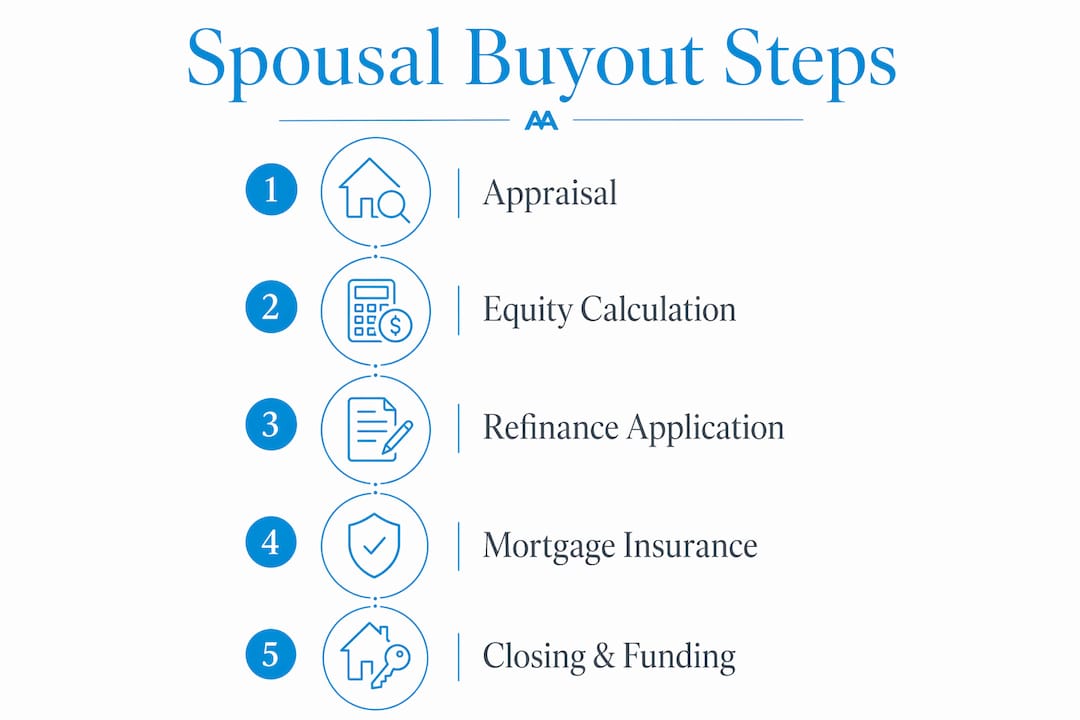
Step-by-step: how to refinance and fund the buyout
-
Finalize the separation agreement. Work with a family lawyer to draft a separation agreement that names the buyout amount, specifies that funds are for the spouse's equity share, and addresses any matrimonial debts. This document is the foundation every lender and insurer requires.
-
Get a mortgage pre-qualification. Contact a mortgage broker before ordering an appraisal. A mortgage pre-approval confirms whether your single income can carry the new mortgage under the stress test and identifies which lenders and insurer programs fit your file. Typical timeline: a few days to one week.
-
Order an independent appraisal. Lenders require a professional appraisal to confirm the fair market value used for the LTV calculation and insurer eligibility. Your broker can recommend an approved appraiser. Typical timeline: one to two weeks.
-
Submit the full lender and insurer application. Your broker packages your income documents, separation agreement, appraisal, and mortgage statements and submits to the lender. If the LTV exceeds 80%, the lender forwards the file to CMHC, Sagen, or Canada Guaranty for insurer approval. Typical timeline: one to three weeks for lender and insurer review.
-
Receive mortgage commitment and instruct your lawyer. Once approved, the lender issues a commitment letter. You instruct a real estate or closing lawyer to handle the title transfer, discharge of the joint mortgage, and registration of the new mortgage.
-
Close the transaction. On closing day, the lawyer discharges the existing joint mortgage, registers the new mortgage in your name, transfers title, and releases the buyout funds to your departing spouse. Typical timeline: one to two weeks for legal preparation and closing.
Total realistic timeframe: six to twelve weeks from separation agreement to closing, depending on how quickly paperwork is assembled and whether any negotiation is still ongoing. Files with complex income situations or contested valuations can take longer.
What costs should you budget for?
Beyond the headline loan amount, a spousal buyout refinance in Alberta carries several additional costs. Transaction costs commonly vary depending on the home's value and specific circumstances, including whether mortgage default insurance applies and prepayment penalties are triggered.

| Cost item | Typical range (Alberta) | Notes |
|---|---|---|
| Independent appraisal | $300–$600 | Required by lender; ordered early in the process |
| Legal fees (family lawyer) | — | Separation agreement drafting and independent legal advice |
| Legal fees (real estate/closing lawyer) | — | Title transfer, mortgage discharge, new mortgage registration |
| Mortgage default insurance premium | Varies by LTV | Added to mortgage balance; applies when LTV exceeds 80% |
| Prepayment penalty | Varies | Applies on fixed-rate mortgages broken before maturity; can be several thousand dollars |
| Title registration | $300–$500 | Land Titles Office fee in Alberta |
Prepayment penalties deserve particular attention. If you are mid-term on a fixed-rate mortgage, breaking it to refinance can trigger an interest rate differential (IRD) penalty that adds meaningfully to the total cost. Timing the refinance to coincide with your renewal date eliminates this cost entirely. Your broker can model both scenarios so you can make an informed decision.
The mortgage default insurance premium is calculated as a percentage of the insured loan amount and is almost always added to the mortgage balance rather than paid at closing. This increases your total borrowing slightly but avoids a large upfront cash requirement.
What if you can't qualify to refinance on your own?
Single-income qualification under the stress test is the most common reason a buyout refinance falls through. If that is your situation, you have several realistic options:
- Sell the property and split the proceeds. The cleanest resolution when neither party can qualify alone. Both spouses are removed from the mortgage, proceeds are divided per the agreement, and each can move forward independently.
- Add a co-signer. A parent or close family member with strong income can co-sign the new mortgage to help you qualify. The co-signer takes on legal liability for the debt, which is a significant commitment for them to consider carefully.
- Extend the amortization. Stretching to a 30-year amortization reduces monthly payments and can improve your debt service ratios enough to qualify. The trade-off is higher lifetime interest costs.
- Mortgage assumption. In some cases, the departing spouse can be removed from the mortgage through a lender-approved assumption, avoiding a full refinance. Not all lenders permit this, and the remaining spouse still needs to qualify.
- Private or bridging financing. Short-term private financing can bridge a gap while you improve your income or credit position. Costs are higher than conventional lending, and this works best as a temporary measure with a clear exit plan.
- Vendor take-back arrangement. The departing spouse effectively acts as a secondary lender, deferring part of their payout. This requires significant trust and clear legal documentation, and is generally a last resort.
If refinance qualification is genuinely out of reach, a sale is often the fastest and lowest-risk resolution. It removes both parties from the mortgage cleanly and avoids prolonged financial entanglement. A B lender mortgage may also be worth exploring if your credit or income profile does not meet major bank standards but is otherwise solid.
How can a mortgage broker help with a spousal buyout in Alberta?
Working with a mortgage broker changes the process in practical ways. Rather than approaching a single bank and accepting whatever they offer, a broker shops your file across more than fifty Canadian lenders simultaneously — including major banks, credit unions, and monoline lenders that do not deal directly with the public. That breadth matters when your file is complex: a single-income application with support income, a mid-term penalty calculation, or an insured buyout at high LTV often requires a lender with specific appetite for that file type.
Deneenoel provides pre-qualifications specifically structured for spousal buyouts, running your income through the stress test before you commit to an appraisal or legal fees. This early check tells you whether the buyout is feasible, what loan amount you can support, and whether an insured program through CMHC, Sagen, or Canada Guaranty is the right route. It also identifies whether extending the amortization or documenting support income differently would improve your qualifying position.
The coordination piece is where broker involvement makes the biggest practical difference. A spousal buyout involves a family lawyer, a closing lawyer, an appraiser, and a lender, all working toward the same closing date. Deneenoel works alongside your legal team to make sure the separation agreement wording satisfies insurer requirements, the appraisal is ordered at the right time, and the lender's conditions are met before the closing lawyer is instructed. When these parties are not aligned, closings get delayed and costs increase.
For post-divorce financial planning beyond the mortgage itself, resources like post-divorce financial planning can help you think through the broader picture once the buyout is complete.
Key takeaways
A spousal buyout mortgage in Alberta is feasible when you can qualify on a single income and the required refinance amount stays within lender or insurer limits — the CMHC/Sagen/Canada Guaranty insured programs at 95% LTV are often what makes it possible.
| Point | Details |
|---|---|
| Insured buyout ceiling | CMHC, Sagen, and Canada Guaranty allow up to 95% LTV, making buyouts possible when a standard refinance falls short. |
| Stress test is the real barrier | Qualifying on a single income at contract rate plus 2% (or the regulatory floor) is the most common reason buyouts fail. |
| Separation agreement wording matters | Lenders and insurers require explicit fund-use language; vague wording can delay or block approval. |
| Budget $4,000–$12,000 in transaction costs | Appraisal, legal fees, insurance premiums, and potential prepayment penalties add up quickly on a $600,000 home. |
| Deneenoel for Alberta buyouts | Deneenoel provides pre-qualifications, access to 50+ lenders, and insured-buyout coordination across Edmonton, Calgary, and surrounding Alberta areas. |
Three next steps:
- Finalize your separation agreement with a family lawyer, making sure it names the buyout amount and specifies how funds will be used.
- Contact a mortgage broker for a pre-qualification to confirm single-income affordability before spending on an appraisal.
- Order an independent appraisal and gather your income documents, mortgage statements, and support payment records.
If refinance qualification is not feasible, a sale or a co-signer arrangement are the most straightforward fallback options.
What Alberta brokers see go wrong — and how to avoid it
The clients who struggle most with a spousal buyout refinance are usually not the ones with the hardest financial situations. They are the ones who move too fast without the right paperwork.
The single most common mistake is treating an informal settlement as good enough to start the mortgage process. Lenders and insurers will not accept a draft agreement, an email exchange, or a verbal understanding. The separation agreement must be signed, finalized, and specific about the buyout amount and fund use before any lender will underwrite the file. Clients who skip this step often spend money on an appraisal and legal preparation, only to have the application stall.
Underestimating closing costs is the second pitfall. The mortgage default insurance premium, prepayment penalty, and dual legal fees (family lawyer plus closing lawyer) can add $8,000 or more to the transaction. Clients who budget only for the buyout payout sometimes find themselves short at closing. Running a full cost estimate before committing to the refinance path avoids this.
On the income side, documented support payments are genuinely useful for qualifying — but only when they are formalized. A court order or signed agreement showing the payment amount and duration is what lenders need. Informal e-transfers with no documentation do not count. Getting this in order before the application saves a round of conditions and delays.
Timing the refinance around your mortgage renewal date is worth the effort. Breaking a fixed-rate mortgage mid-term can trigger an IRD penalty that runs into the thousands. When the renewal date is within a few months, waiting can save a meaningful amount. A broker can model the penalty versus the cost of waiting so you can make the call with real numbers.
Early broker involvement consistently improves outcomes. A pre-qualification before the separation agreement is finalized lets you structure the payout amount around what you can actually borrow, rather than agreeing to a number and discovering later it is not financeable.
Deneenoel is ready to help with your Alberta spousal buyout
Going through a separation is hard enough without the added pressure of figuring out mortgage financing on your own. Deneenoel provides clear, personalized guidance for Albertans navigating a spousal buyout refinance, with access to more than fifty Canadian lenders and hands-on experience with CMHC, Sagen, and Canada Guaranty insured programs.

What Deneenoel offers for your buyout file: a pre-qualification that tests your single-income affordability before you commit to legal and appraisal costs; lender matching across banks, credit unions, and monoline lenders; coordination with your family lawyer and closing lawyer to align separation agreement wording, appraisal timing, and closing-day funds; and straightforward advice on whether an insured buyout, a co-signer, or an extended amortization is the right structure for your situation.
To get started, bring your signed separation agreement (or a near-final draft), recent mortgage statements, two years of Notices of Assessment, current pay stubs, and any support payment documentation. Deneenoel serves clients across Edmonton, Calgary, and surrounding Alberta communities.
Book a free initial consultation with Deneenoel today, or visit deneenoel.com to learn more about refinancing options in Alberta.
Useful sources and references
The following primary and authoritative sources were used in preparing this guide. Verify current program rules and legal requirements directly with these sources or with a qualified professional for your specific situation.
- CMHC Mortgage Loan Insurance (Purchase): cmhc-schl.gc.ca — program details for insured spousal buyout transactions, LTV limits, and documentation requirements.
- Alberta Family Property Act (full statute): canlii.org — the governing legislation for property division between spouses and adult interdependent partners in Alberta.
- Alberta Family Property Act overview: alberta.ca — plain-language government summary of the Act, including equal division presumption and key timelines.
- Department of Justice Canada — Family Law: justice.gc.ca — federal family law guidance, including divorce and property division framework.
- Who Gets the House After Separation in Alberta: crossroadslaw.ca — practical legal overview of property division options for Alberta homeowners.
A note on professional advice: this guide is general information, not legal or financial advice. Mortgage rules, insurer program details, and the Family Property Act can all affect your specific situation differently. Confirm current requirements with CMHC or your insurer directly, and consult a family lawyer for binding legal guidance on your separation agreement and property rights.